
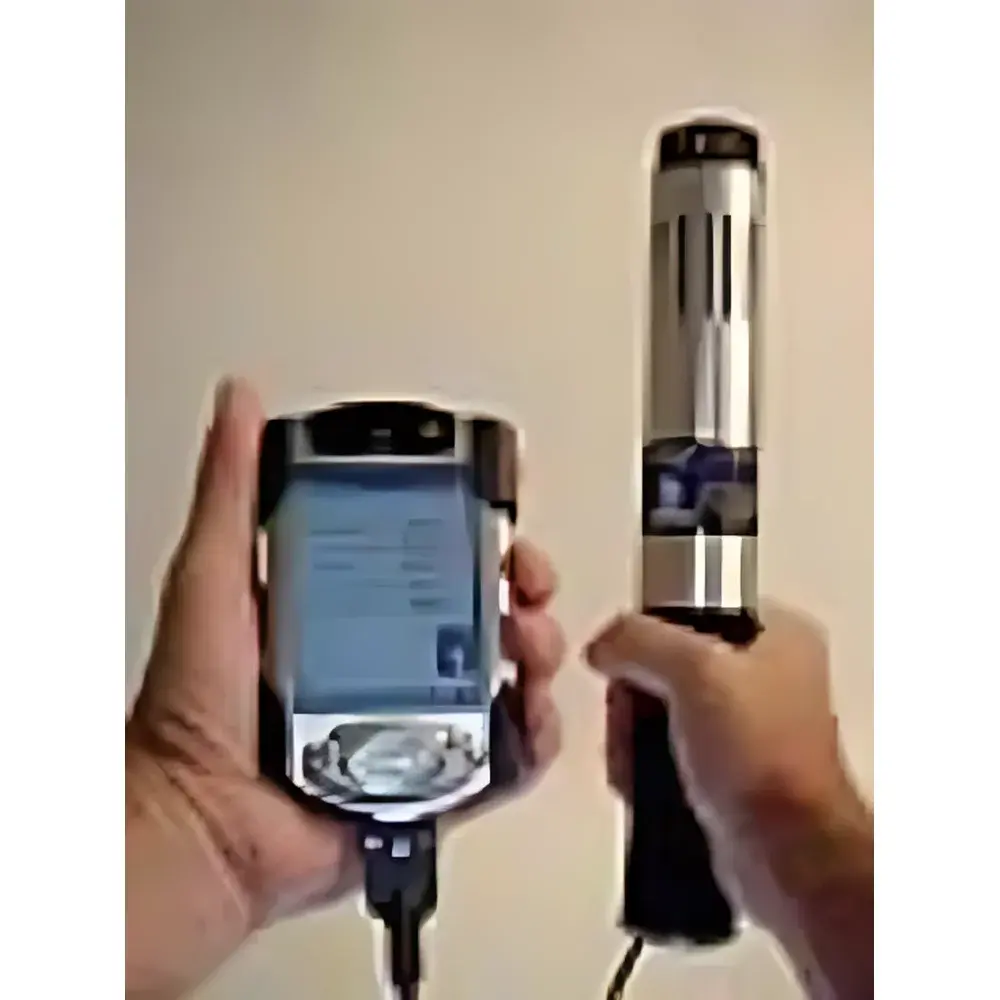
Graywolf TG502 Portable TVOC and Toxic Gas Detector
| Brand | Graywolf |
|---|---|
| Origin | USA |
| Model | TG502 |
| Detection Principle | Photoionization Detection (PID) with 10.6 eV UV lamp |
| TVOC Range (ppb mode) | 0.01–20.00 ppm (selectable units: ppb or ppm) |
| TVOC Range (ppm mode) | 0.1–2000 ppm |
| Relative Humidity Range | 0.0–100.0 %RH |
| RH Accuracy | ±2% RH (<80% RH), ±3% RH (>80% RH) |
| Temperature Range | −10°C to +70°C |
| Temp Accuracy | ±0.3°C |
| Response Time (90%) | <60 s for PID, RH, and temperature |
| Probe Dimensions | Ø5 cm × 30 cm |
| Probe Weight | 0.7 kg (including batteries) |
| Power Supply | Two D-cell batteries (150 h typical runtime) or optional 3 V DC adapter |
| Integrated Sensors | PID (10.6 eV), temperature, relative humidity |
| Optional Add-on Gases (up to 3 simultaneously) | SO₂, NO₂, CO, NH₃, H₂S, HCN, HCl, H₂, Cl₂, O₂, O₃, EtO, NO (NO and EtO mutually exclusive), CO/H₂S dual-gas sensor |
Overview
The Graywolf TG502 is a field-deployable, palm-sized environmental monitoring platform engineered for real-time, multi-parameter assessment of volatile organic compounds (VOCs) and hazardous gases in indoor air quality (IAQ), industrial hygiene, remediation, and emergency response applications. At its core lies a photoionization detector (PID) equipped with a stable 10.6 eV ultraviolet lamp—optimized for broad-spectrum detection of aromatic hydrocarbons, ketones, aldehydes, amines, and other photoionizable VOCs without fragmentation. Unlike single-gas fixed-range instruments, the TG502 supports dual-range PID operation: high-sensitivity ppb-level detection (0.01–20.00 ppm) for trace contamination screening and robust ppm-level measurement (0.1–2000 ppm) for occupational exposure evaluation. The integrated probe houses precision temperature and relative humidity sensors, enabling on-the-fly compensation of PID response and derivation of secondary psychrometric parameters—including dew point, wet-bulb temperature, absolute humidity, specific humidity, and moisture content—without external instrumentation.
Key Features
- Modular, expandable architecture: Base probe includes PID (10.6 eV), temperature, and RH sensors; up to three additional electrochemical or metal-oxide gas sensors may be concurrently installed.
- True handheld form factor: Compact cylindrical probe (Ø5 cm × 30 cm; 0.7 kg with batteries) designed for one-handed operation in confined spaces, ceiling plenums, ductwork, and personal breathing zone sampling.
- Dual-range PID flexibility: User-selectable measurement units (ppb/ppm) and auto-ranging logic ensure optimal signal-to-noise performance across orders-of-magnitude concentration gradients.
- Extended battery life: Two standard D-cell alkaline batteries provide ≥150 hours of continuous operation; optional 3 V DC power input enables indefinite benchtop or vehicle-mounted use.
- Real-time environmental compensation: Onboard thermistor and capacitive RH sensor deliver simultaneous, compensated readings—critical for regulatory compliance under ASTM D6192 and ISO 16000-22 protocols.
- Ruggedized probe housing: IP54-rated enclosure resists dust ingress and incidental moisture exposure during field deployment.
Sample Compatibility & Compliance
The TG502 is validated for direct aspiration sampling of ambient air, ducted airstreams, headspace vapors, and sealed enclosures. Its PID response is calibrated against isobutylene per IEC 60079-29-1 and meets functional equivalency requirements for OSHA 29 CFR 1910.120 (HAZWOPER) preliminary screening and EPA Method TO-15 supplemental verification. All integrated sensors comply with ACGIH TLV® and NIOSH REL reference conditions. Data logging and reporting support audit-ready documentation aligned with ISO/IEC 17025 quality management systems and GLP-compliant field studies. Optional sensors for O₂, CO, H₂S, and Cl₂ are certified to UL 2075 and EN 45544-1 for workplace safety applications.
Software & Data Management
The TG502 interfaces via USB or Bluetooth with Graywolf’s proprietary WinLog software (Windows-based), enabling real-time graphing, customizable alarm thresholds, automatic calibration logging, and timestamped CSV export. Software features include PID response curve fitting, humidity-corrected VOC concentration overlays, and psychrometric chart generation. All data files embed full metadata (probe ID, sensor configuration, calibration date, operator ID), satisfying FDA 21 CFR Part 11 requirements for electronic records when used with enabled audit-trail and user-access controls. Firmware updates and sensor configuration are performed through the same interface—eliminating dependency on proprietary hardware programmers.
Applications
- Indoor Air Quality (IAQ) assessments per ASHRAE Standard 62.1 and LEED IEQ Credit 3.2.
- Post-remediation verification following mold, fire-damage, or chemical spill events.
- Occupational exposure monitoring in laboratories, paint booths, printing facilities, and semiconductor cleanrooms.
- Leak detection and source identification during HVAC commissioning and building diagnostics.
- Emergency response triage for unknown vapor releases—supporting incident command system (ICS) decision-making with rapid, multi-gas reconnaissance.
- Research-grade environmental monitoring where portability, parameter density, and trace-level sensitivity are prioritized over laboratory-grade reproducibility.
FAQ
Can the TG502 simultaneously detect TVOC and three toxic gases?
Yes—the base probe measures TVOC (via PID), temperature, and RH by default; up to three additional gas sensors (e.g., CO, H₂S, O₂) can be physically installed and operated concurrently.
Is the 10.6 eV lamp replaceable in the field?
Yes—the UV lamp is a user-serviceable component with documented replacement procedure and no recalibration required post-installation.
Does the instrument meet NIST-traceable calibration requirements?
Each TG502 ship with a NIST-traceable calibration certificate for PID and environmental sensors; field recalibration is supported using certified span gases and humidity generators.
What is the minimum detectable concentration for benzene using the ppb-mode PID?
Based on ionization efficiency and lamp output stability, the practical limit of detection for benzene is approximately 0.3 ppb (signal-to-noise ≥3) under controlled lab conditions.
Can data be exported for integration into enterprise EHS platforms?
Yes—WinLog supports automated export to SQL databases, API-driven ingestion via RESTful endpoints, and native compatibility with common EHS software including Intelex, ETQ Reliance, and Sphera Gensuite.







