
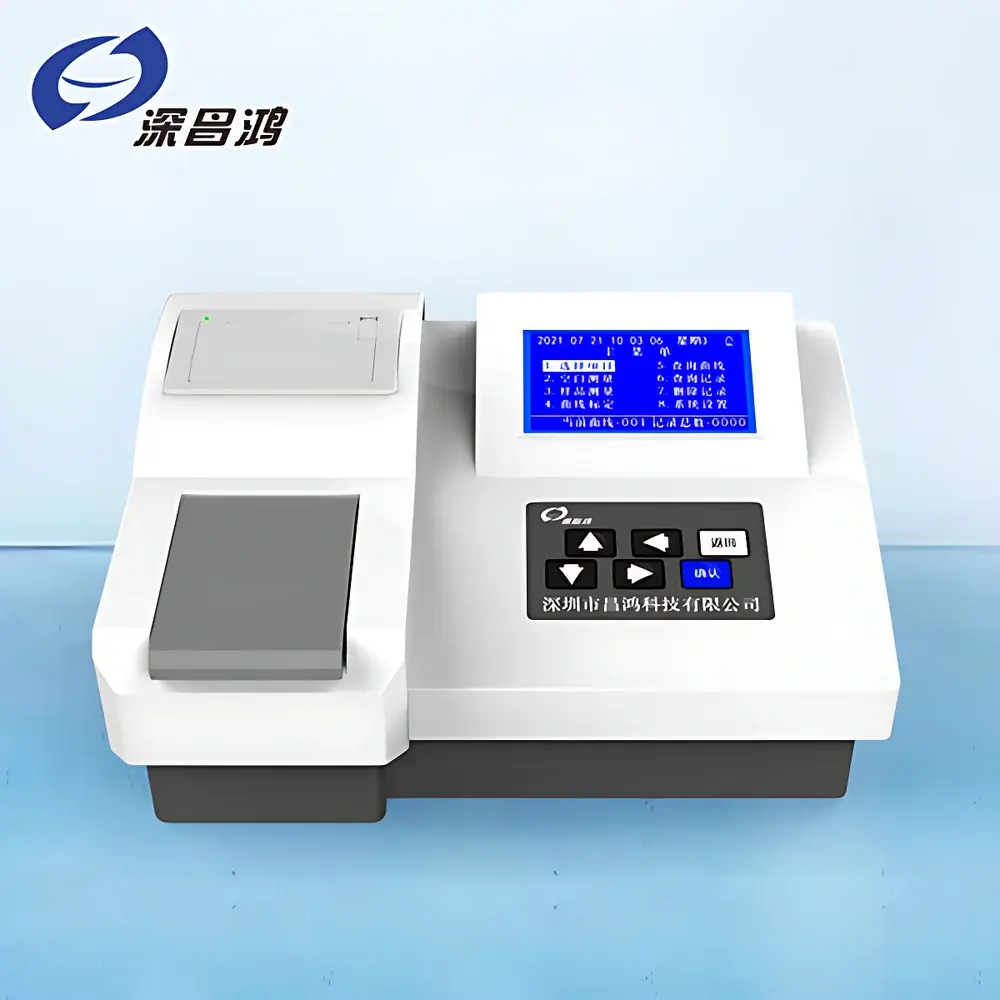
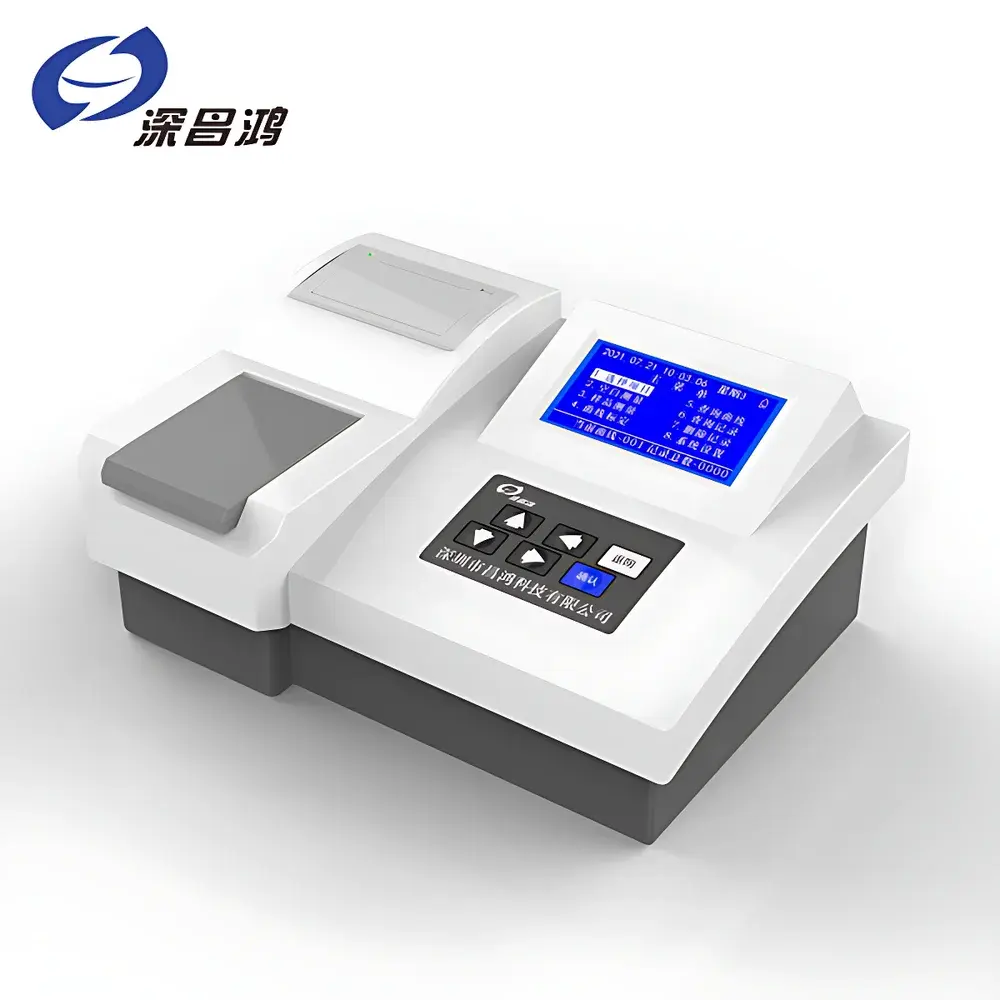
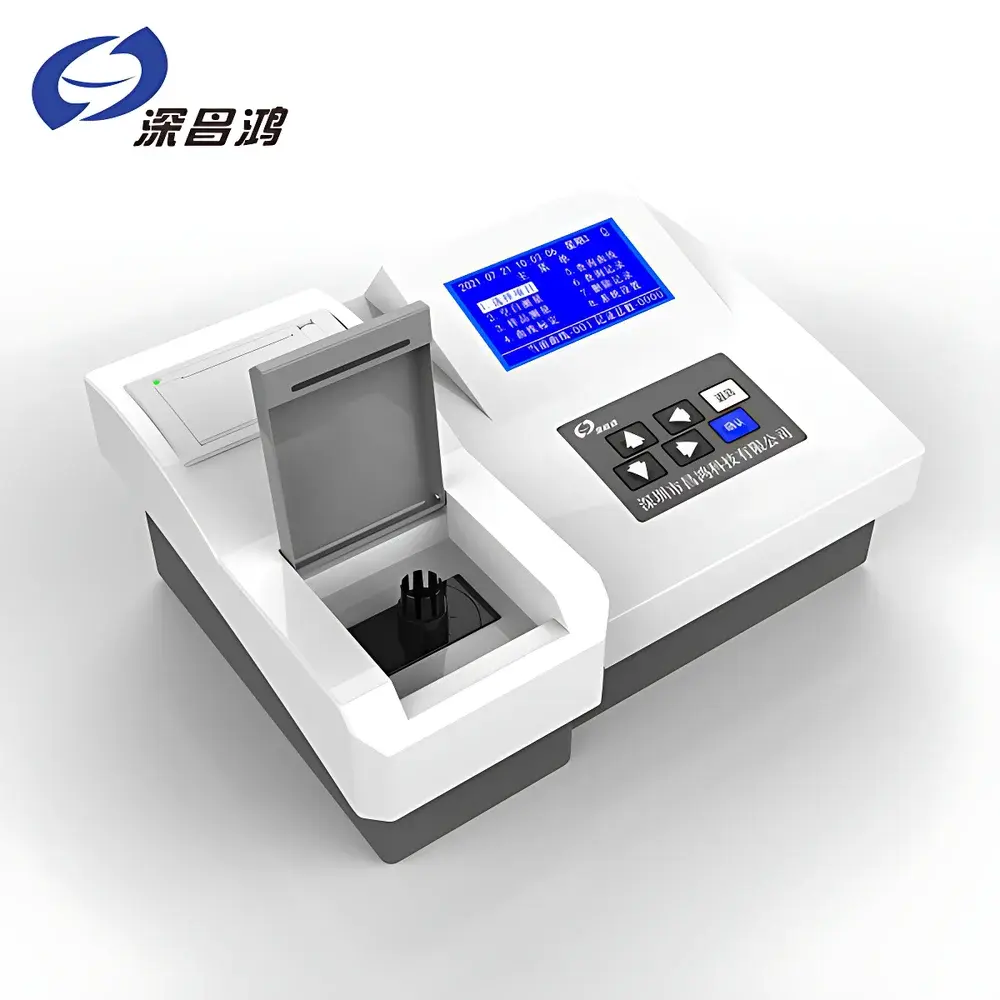
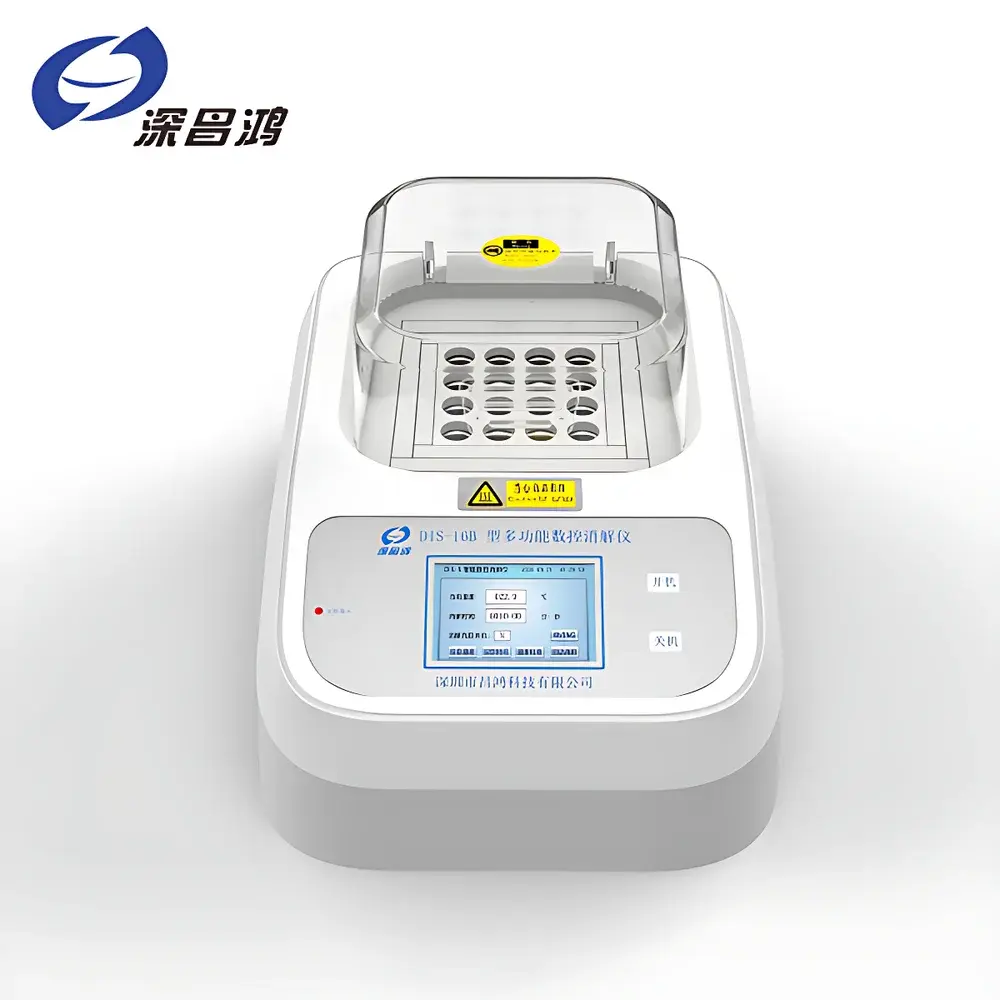
Shenchanghong CN-201A COD & Ammonia-N Analyzer
| Brand | Shenchanghong |
|---|---|
| Origin | Guangdong, China |
| Manufacturer Type | Direct Manufacturer |
| Instrument Type | Benchtop Laboratory Analyzer |
| Model | CN-201A |
| Measurement Principle | Rapid Catalytic Digestion (COD) / Nesslerization (Ammonia-N) |
| Wavelength | 610 nm |
| COD Range | 5–2000 mg/L (extendable to 20,000 mg/L) |
| Ammonia-N Range | 0.02–25 mg/L |
| COD Accuracy | ≤ ±5% |
| Ammonia-N Accuracy | ≤ ±3% |
| Detection Limit (COD) | 0.1 mg/L |
| Detection Limit (NH₃-N) | 0.02 mg/L |
| Digestion Temperature | 165 °C (adjustable 0–200 °C) |
| Digestion Time | 15 min (programmable) |
| Batch Capacity | 16 samples (optional 20/25/36) |
| Repeatability | ≤ ±3% |
| Optical Stability | ≤ 0.002 A/20 min |
| Chloride Interference Tolerance (COD) | ≤ 2000 mg/L |
| Data Storage | 500 results with curve ID, date/time stamp |
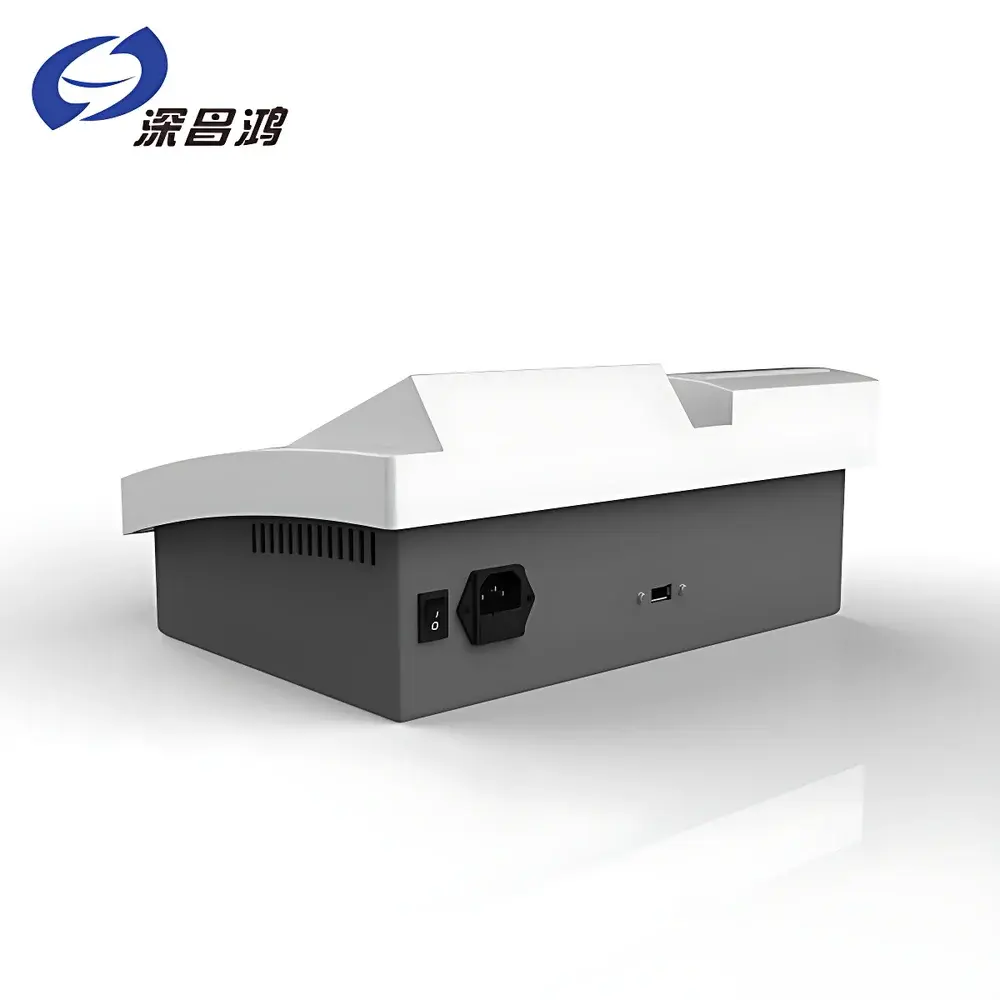
| Interface | USB 2.0 |
| Display | LCD with Chinese/English menu |
| Dimensions (Analyzer) | 340 × 250 × 130 mm |
| Dimensions (Digestion Unit) | 260 × 355 × 135 mm (excl. shield) |
| Weight (Analyzer) | 4.0 kg |
| Weight (Digestor) | 5.5 kg |
Overview
The Shenchanghong CN-201A COD & Ammonia-N Analyzer is a dual-parameter benchtop spectrophotometric instrument engineered for precise, simultaneous quantification of Chemical Oxygen Demand (COD) and ammonia nitrogen (NH₃-N) in aqueous environmental samples. It integrates two standardized analytical methodologies—rapid catalytic digestion followed by spectrophotometric detection at 610 nm for COD, and Nesslerization with absorbance measurement in the visible range for NH₃-N—within a single, modular platform. The system employs a high-stability cold light source and narrow-band interference optical architecture to ensure minimal photometric drift and high signal-to-noise ratio. Designed for routine compliance testing in municipal wastewater treatment plants, environmental monitoring stations, and academic research laboratories, the CN-201A meets core functional requirements outlined in ISO 6060 (COD determination) and ISO 7150-1 (ammonia-nitrogen by Nessler method), while supporting trace-level analysis under GLP-aligned operational protocols.
Key Features
- Dual independent optical paths: Dedicated optical channels for COD and NH₃-N eliminate cross-wavelength interference and maintain long-term photometric integrity.
- Modular digestion unit with PID-controlled heating: Programmable temperature range (room temperature to 200 °C) and time (1–120 min) enable method flexibility beyond standard COD/NH₃-N protocols—including total phosphorus or heavy metal digestion per EPA 365.4 or ISO 11908.
- Reinforced quartz-glass digestion/cuvette tubes: Chemically inert, heat-resistant, and mechanically robust; validated for ≥500 reuse cycles without spectral degradation or leakage risk.
- Embedded calibration management: Supports up to 20 user-defined or factory-loaded calibration curves; includes curve recovery function to restore deleted or corrupted working curves without recalibration.
- Robust data governance: All measurements are timestamped and tagged with operator ID (if enabled), curve ID, and digestion parameters; stored values persist through power loss.
- Human-centered interface: Backlit LCD display with bilingual (English/Chinese) menu navigation; intuitive icon-driven workflow reduces operator training time and minimizes input error.
Sample Compatibility & Compliance
The CN-201A accepts liquid water samples from surface water, effluent, influent, groundwater, and industrial process streams. Sample matrix compatibility has been verified for chloride concentrations up to 2000 mg/L in COD analysis—sufficient for most municipal and secondary-treated wastewaters. For ammonia-N, the Nessler method demonstrates linearity across 0.02–25 mg/L with negligible interference from common cations (Ca²⁺, Mg²⁺, Na⁺) below 500 mg/L and anions (SO₄²⁻, Cl⁻) below 1000 mg/L. Instrument performance complies with key regulatory reference frameworks: ASTM D1253 (COD), ISO 6060 (COD), ISO 7150-1 (NH₃-N), and US EPA Method 350.1 (ammonia). While not 21 CFR Part 11–certified out-of-the-box, audit-trail-ready data export via USB enables integration into validated LIMS environments requiring electronic record retention.
Software & Data Management
Data handling is managed entirely onboard via embedded firmware. Each result includes sample ID (user-input), measurement type (COD/NH₃-N), concentration value, detection wavelength, curve number, digestion temperature/duration, and UTC timestamp. Up to 500 records are retained in non-volatile memory. USB 2.0 interface supports direct transfer of CSV-formatted datasets to Windows/Linux workstations for further statistical analysis (e.g., trend charts, control charts per ISO 8402). No proprietary software installation is required—files open natively in Excel or LibreOffice Calc. Optional PC-based reporting tools (provided separately) support PDF generation with lab header, QA/QC flags, and signature fields compliant with internal QA documentation standards.
Applications
- Routine effluent monitoring per national discharge permits (e.g., China’s GB 8978–1996, EU Urban Wastewater Treatment Directive 91/271/EEC)
- Process control in activated sludge, MBR, and denitrification systems where real-time COD:NH₃-N ratios inform carbon dosing and aeration optimization
- Academic teaching labs conducting APHA Standard Methods 5220B (COD) and 4500-NH₃ B (Nessler)
- Field-deployable lab verification: Paired with portable power supplies and digestion cooling racks, the CN-201A supports near-lab-quality analysis in mobile environmental assessment units
- Method validation studies comparing rapid digestion against open-reflux (ISO 6060) or distillation-based NH₃-N reference methods
FAQ
Does the CN-201A require external calibration standards for daily use?
No—factory preloaded curves are traceable to NIST SRM 2169a (COD) and NIST SRM 2168 (NH₃-N); however, users must verify accuracy with certified reference materials (CRMs) at least once per shift when operating under QA/QC protocols.
Can the digestion unit be used for other analytes like total phosphorus or heavy metals?
Yes—the programmable temperature and timer support EPA 365.4 (total phosphorus) and ISO 11908 (chromium VI) digestion protocols; tube compatibility has been confirmed for HNO₃/H₂SO₄/H₃PO₄ acid mixtures up to 180 °C.
Is the optical system susceptible to humidity or ambient light during operation?
No—the sealed optical chamber incorporates light-tight baffling and temperature-compensated photodiode detection; validated performance across 30–85% RH and ambient illuminance up to 10,000 lux.
What maintenance intervals are recommended for long-term reliability?
Optical path cleaning every 200 measurements; digestion block calibration verification quarterly using PT100 reference probe; cuvette tube inspection for microcracks or etching prior to each batch.
How does the instrument handle samples with turbidity or suspended solids?
Users must centrifuge or filter (0.45 µm membrane) samples prior to analysis; the CN-201A does not include built-in turbidity compensation, as per ISO 6060 and ISO 7150-1 requirements for uncorrected absorbance measurement.







