
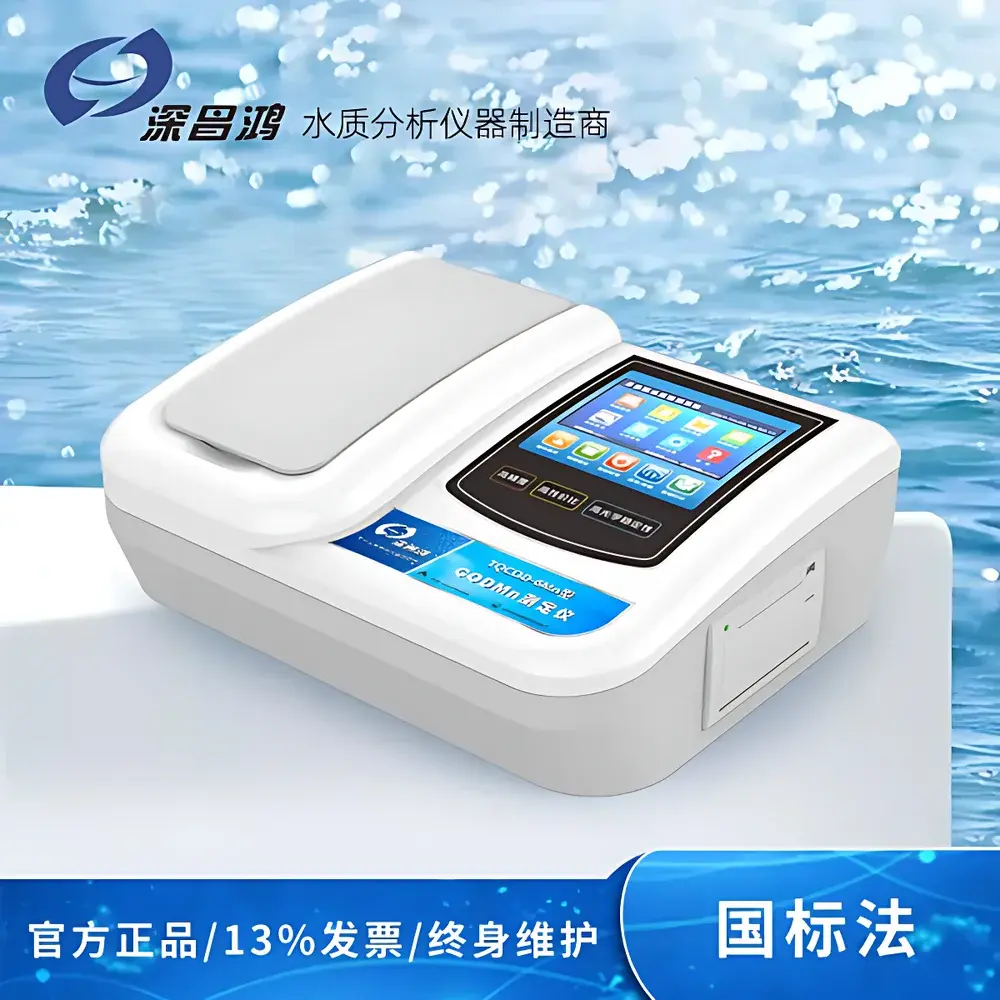
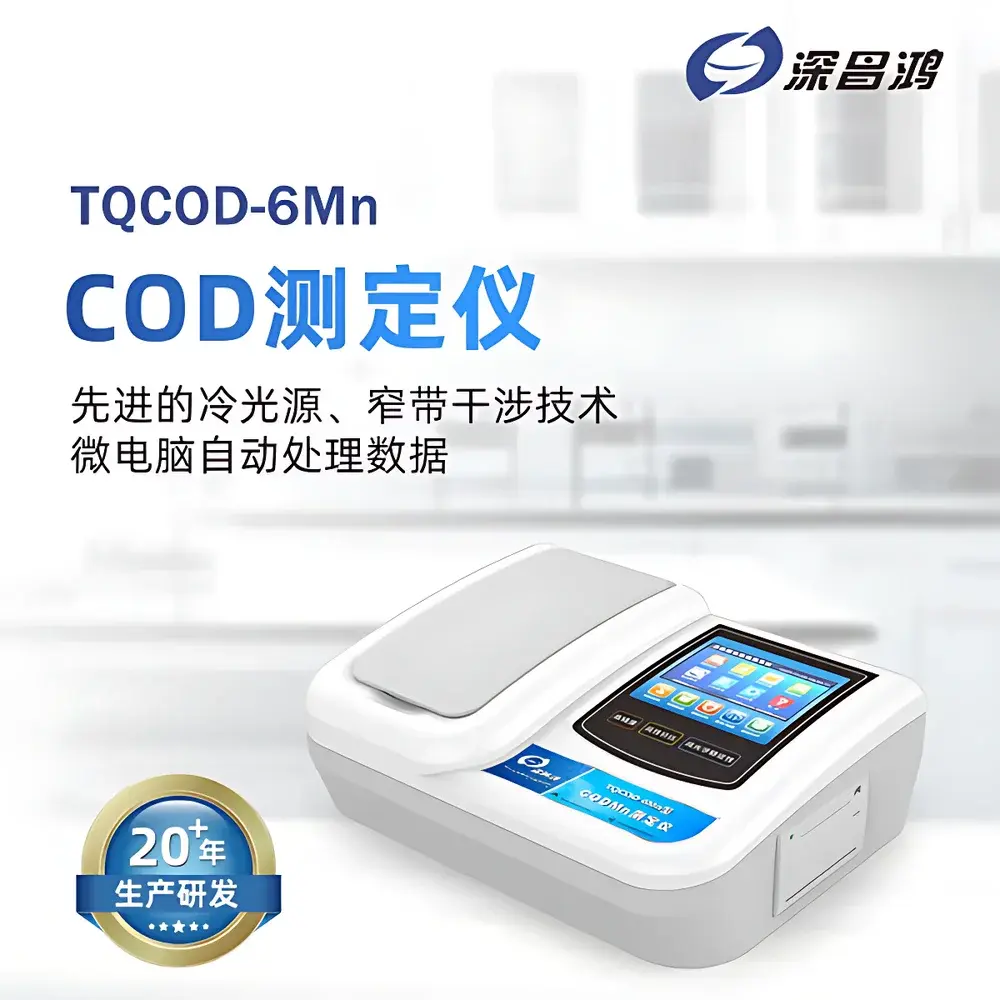

Shenchanghong TQCOD-6Mn Permanganate Index (CODMn) Analyzer
| Brand | Shenchanghong |
|---|---|
| Origin | Guangdong, China |
| Manufacturer Type | Manufacturer |
| Product Category | Domestic |
| Model | TQCOD-6Mn |
| Measurement Principle | Acidic Potassium Permanganate Oxidation (ISO 8467) |
| Instrument Type | Benchtop Laboratory Analyzer |
| Range | 0.00–10.00 mg/L (dilutable beyond range) |
| Repeatability | ±3% RSD |
| Accuracy | ±5% of full scale |
| LOD | 0.2 mg/L |
| Resolution | 0.01 mg/L |
| Single-Test Duration | 30 min |
| Digestion Temperature | 100 °C ±1.5 °C |
| Optical Stability | ≤0.002 A / 20 min |
| Dimensions (Analyzer) | 400 × 300 × 140 mm |
| Weight | 2.6 kg |
| Power Supply | AC 220 V ±10%, 50 Hz |
| Operating Environment | 5–40 °C, RH ≤85%, non-condensing, low vibration & EMI |
Overview
The Shenchanghong TQCOD-6Mn Permanganate Index (CODMn) Analyzer is a dedicated benchtop instrument engineered for precise quantification of the permanganate index—also known as CODMn—in low-organic-load water matrices. It implements the standardized acidic potassium permanganate oxidation method (aligned with ISO 8467:1993 and GB/T 5750.7–2006), wherein dissolved organic matter in water samples is oxidized by KMnO4 under controlled heating (100 °C, 30 min), followed by photometric determination of residual permanganate at 525 nm. This method is specifically recommended for source waters, drinking water supplies, and lightly polluted surface waters where dichromate-based CODCr methods yield excessive interference or over-oxidation. The analyzer decouples optical measurement from thermal digestion to preserve long-term photometric integrity and minimize thermal drift in absorbance readings.
Key Features
- Optically isolated design: Independent spectrophotometer and digestion block eliminate thermal coupling, ensuring stable baseline performance over extended operation cycles.
- Cold LED light source with narrow-band interference filter (center wavelength: 525 nm, bandwidth: <10 nm) delivers high photometric repeatability and eliminates lamp aging effects common in tungsten-halogen systems.
- 16-step adjustable reference intensity calibration enables dynamic linearization across wide absorbance ranges (0.000–2.000 A), supporting accurate quantitation without manual gain switching.
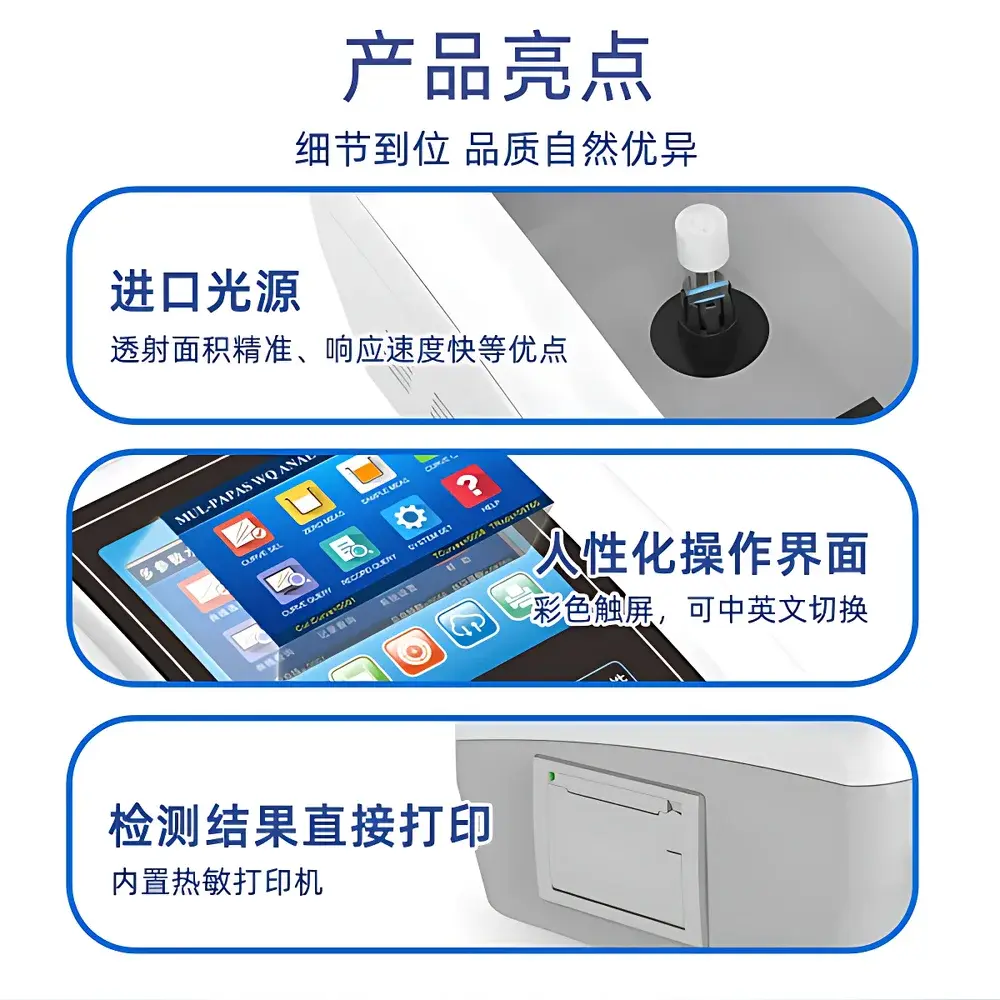
- Full-color capacitive touchscreen interface with dual-language (English/Chinese) firmware, contextual help prompts, and guided workflow navigation—designed for routine use by laboratory technicians with minimal training.
- Dual-stage temperature control in the digestion module: Multi-point NTC sensor calibration compensates for inherent thermistor nonlinearity, achieving ±1.5 °C accuracy at 100 °C setpoint.
- Integrated safety architecture: Dual thermal protection—programmable auto-shutdown post-digestion and hardwired cutoff at 200 °C—prevents overheating and ensures compliance with IEC 61010-1 safety requirements.
- Comprehensive data traceability: Each calibration stores standard concentration values, corresponding absorbance readings, timestamp, operator ID, and curve equation parameters—fully reconstructible for audit purposes.
Sample Compatibility & Compliance
The TQCOD-6Mn is validated for use with clear, low-turbidity aqueous samples including potable water, spring water, reservoir inflows, and treated effluents meeting ISO 8467 applicability criteria (CODMn ≤ 10 mg/L). Samples exceeding the upper limit are accommodated via certified dilution protocols documented in the onboard SOP library. The system supports GLP-compliant operation through mandatory operator authentication, immutable audit trails (including all calibrations, measurements, and parameter changes), and time-stamped electronic records compliant with FDA 21 CFR Part 11 principles when interfaced with validated LIMS software. All optical and thermal subsystems undergo factory verification against traceable NIST-maintained standards.
Software & Data Management
- On-device storage capacity: ≥100,000 measurement records, each containing analyte name, concentration, unit, timestamp, operator ID, digestion batch ID, and curve reference.
- Curve management: Preloaded with 250 factory-validated calibration curves; users may define, validate, and store up to 3,500 custom curves—including multi-point nonlinear fits—with full metadata retention.
- Data export: USB 2.0 host interface enables direct transfer of CSV-formatted datasets to external PCs; no proprietary drivers required.
- Reporting: Integrated thermal printer supports on-demand hardcopy output of individual results or batch summaries—including calibration reports, QC checks, and trend logs.
- System recovery: “One-touch restore” reinitializes firmware, default curves, and factory configuration without requiring PC connectivity or service intervention.
Applications
This analyzer serves environmental monitoring laboratories conducting routine compliance testing under national drinking water standards (e.g., China’s GB 5749–2022), watershed assessment programs tracking organic loading in headwater streams, and municipal utilities verifying treatment efficacy in ozone-biofiltration or granular activated carbon (GAC) processes. Its optimized sensitivity (LOD: 0.2 mg/L) and precision (±3% RSD) make it suitable for detecting subtle seasonal shifts in natural organic matter (NOM) concentrations—critical for disinfection byproduct (DBP) precursor control. Research applications include comparative studies of biodegradable vs. refractory organic fractions in humic-rich groundwater systems.
FAQ
What regulatory standards does the TQCOD-6Mn comply with?
It adheres to ISO 8467:1993 for methodology, GB/T 5750.7–2006 for domestic validation, and incorporates design controls aligned with IEC 61010-1 for electrical safety.
Can the instrument be used for wastewater or seawater analysis?
No—it is not intended for high-salinity or high-COD matrices (>10 mg/L); such samples require CODCr methods per ISO 6060 or EPA 410.4.
Is method validation documentation available?
Yes—factory-provided validation reports include linearity (R² ≥0.999), intermediate precision (n=6 replicates across 3 days), spike recovery (92–105%), and robustness testing per ICH Q2(R2) principles.
How is calibration traceability maintained?
All primary standards are traceable to NIM (National Institute of Metrology, China) certified potassium hydrogen phthalate and potassium permanganate reference materials; calibration certificates are stored electronically with each curve.
Does the system support remote monitoring or network integration?
The current hardware includes only USB host functionality; Ethernet or Wi-Fi modules are not integrated but may be added via third-party serial-to-Ethernet bridges compatible with Modbus RTU protocol.
Related Products







