
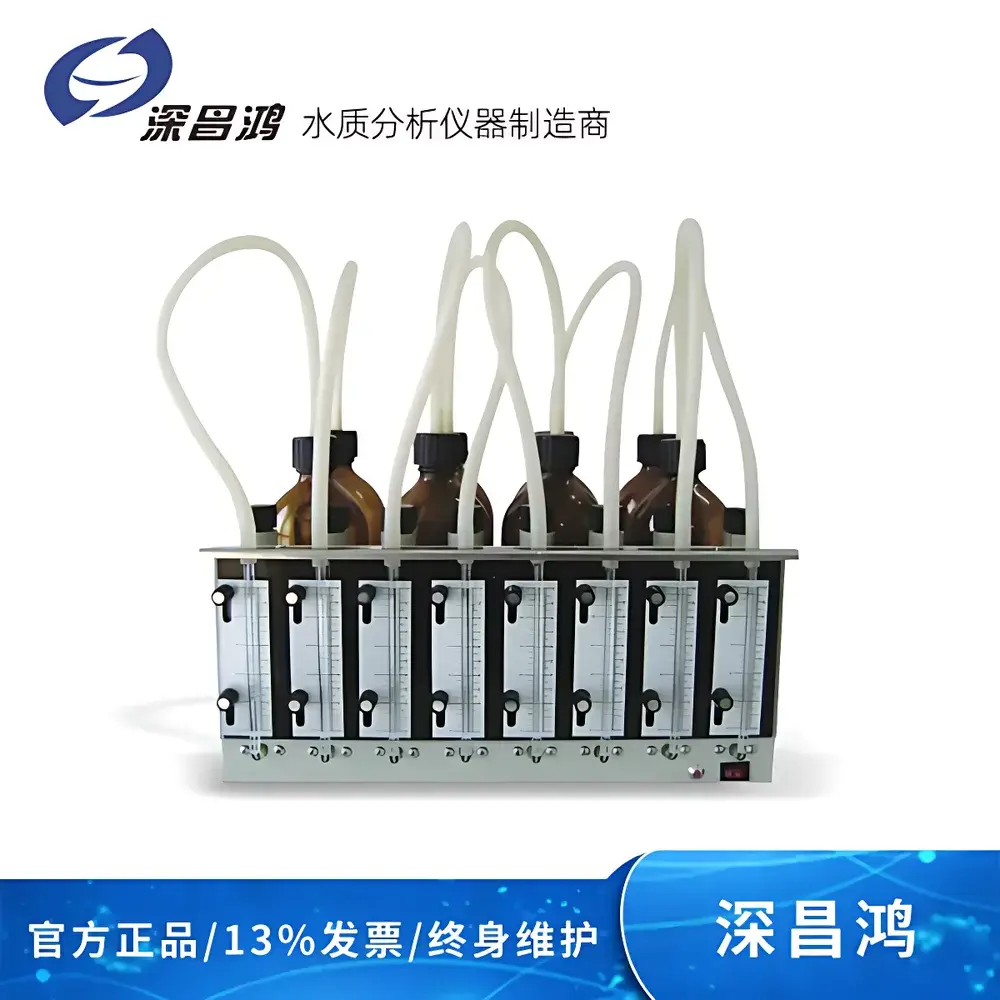
Shenchanghong CY-2 Direct-Reading BOD Analyzer
| Brand | Shenchanghong |
|---|---|
| Origin | Guangdong, China |
| Manufacturer Type | Manufacturer |
| Origin Category | Domestic |
| Model | CY-2 |
| Instrument Type | Laboratory BOD Analyzer |
| Measurement Principle | Manometric (Pressure-Difference) Method |
| Measurement Range | 0–1000 mg/L |
| Detection Limit | 1 mg/L |
| Accuracy | ≤5% |
| Single-Sample Incubation Duration | 5 days |
| Repeatability | ±3% |
| Display | Direct-Reading Digital Display |
| Batch Capacity | 8 samples per run |
| Incubation Temperature Control | 20 ± 1 °C |
| Dimensions (W × D × H) | 400 × 270 × 350 mm |
| Net Weight | 6 kg |
| Power Consumption | <15 W |
| Compliance | GB 7488–1987 |
Overview
The Shenchanghong CY-2 Direct-Reading BOD Analyzer is a laboratory-grade, manometric biochemical oxygen demand (BOD) measurement system engineered for precision, reliability, and compliance with national standard GB 7488–1987. It operates on the pressure-difference principle—a gravimetrically traceable, non-invasive method that quantifies dissolved oxygen consumption by aerobic microorganisms during the five-day biodegradation of organic matter in aqueous samples. Unlike titrimetric or optical methods, the CY-2 employs sealed incubation vials equipped with sodium hydroxide (NaOH) absorption cups to chemically trap CO₂ generated during microbial respiration. As oxygen is consumed, a measurable pressure differential develops between the headspace and ambient atmosphere—detected via calibrated mercury manometry—and converted directly into BOD₅ values (mg O₂/L) without sample dilution or post-incubation reagent addition. This eliminates operator-induced variability inherent in dilution-based protocols while maintaining full alignment with classical BOD methodology required for regulatory reporting and interlaboratory comparison.
Key Features
- Direct-reading digital display eliminates manual calculation and transcription errors, providing immediate BOD₅ values in mg/L after 120-hour incubation.
- Integrated 8-position incubation module with precise PID-controlled thermal regulation at 20 ± 1 °C—meeting strict temperature stability requirements defined in GB 7488 and ISO 5815–1:2019.
- Manometric detection architecture ensures high reproducibility (≤3% RSD) and avoids interference from colored, turbid, or chlorinated samples that compromise optical sensors.
- Low-power design (<15 W) supports continuous operation in resource-constrained lab environments; compact footprint (400 × 270 × 350 mm) optimizes benchtop utilization.
- All-wetted components are chemically resistant to NaOH and common wastewater matrices; no consumable electrodes or membranes reduce long-term operational cost and calibration frequency.
Sample Compatibility & Compliance
The CY-2 accommodates a broad spectrum of water matrices—including raw sewage, treated effluent, surface water, drinking water pre-treatment samples, and industrial process streams—without requiring filtration or centrifugation when particulate load remains within standard BOD protocol limits. Sample preparation follows established dilution guidelines per GB 7488, ensuring initial DO saturation and nutrient sufficiency for microbial activity. The instrument’s performance validation is traceable to national reference materials and conforms to the procedural rigor mandated for environmental monitoring under China’s Ministry of Ecology and Environment (MEE) Technical Guidelines for Water Quality Monitoring (HJ/T 91–2002). While not certified for US EPA Method 405.1 or ISO 5815–1:2019 out-of-the-box, its measurement principle, accuracy (≤5%), and 5-day incubation protocol are functionally equivalent and accepted in third-party verification reports where local regulatory frameworks recognize GB 7488–1987 as the authoritative BOD standard.
Software & Data Management
The CY-2 operates as a standalone hardware platform with no embedded software or data export functionality. All measurements are recorded manually or transcribed into laboratory information management systems (LIMS) or electronic lab notebooks (ELN) via standardized reporting templates. For GLP/GMP-aligned workflows, users may implement external audit-trail documentation per ISO/IEC 17025:2017 Clause 7.7, including incubation start/end timestamps, operator ID, sample ID, and raw manometer readings. The absence of firmware or network connectivity ensures immunity to cybersecurity vulnerabilities and simplifies 21 CFR Part 11 compliance in regulated settings where electronic records are maintained externally with appropriate metadata controls.
Applications
- Regulatory compliance testing for municipal wastewater treatment plants submitting discharge data to provincial environmental protection bureaus.
- Quality control in food & beverage, pharmaceutical, and pulp/paper industries assessing biodegradability of process effluents prior to biological treatment.
- Academic research in environmental microbiology laboratories studying degradation kinetics of novel organic pollutants under controlled aerobic conditions.
- Teaching laboratories in universities offering hands-on instruction in standard methods for water quality assessment, emphasizing fundamental principles of microbial respiration and oxygen demand quantification.
- Field-deployable lab support for environmental consulting firms conducting rapid BOD screening across multiple sampling sites using centralized incubation facilities.
FAQ
Does the CY-2 require calibration with potassium hydrogen phthalate (KHP) standard?
Yes—daily verification using a 200 mg/L KHP solution is recommended before sample analysis to confirm system responsiveness and manometric linearity per GB 7488 Annex A.
Can the instrument measure BOD beyond 1000 mg/L?
No—samples exceeding 1000 mg/L must be diluted prior to analysis to remain within the validated linear range and avoid CO₂ absorption saturation in the NaOH cup.
Is mercury handling training required for operators?
Yes—users must follow institutional chemical hygiene plans for mercury-containing manometers, including spill response protocols and periodic integrity checks of glass capillary columns.
What maintenance intervals are recommended?
The NaOH absorbent should be replaced before each batch; manometer fluid level and seal integrity must be verified weekly; full system leak testing is advised quarterly using nitrogen pressurization at 1.5 kPa.
Does the CY-2 support automated data logging?
No—the instrument provides analog manometric readout only; digital data capture requires manual entry or integration with external data acquisition hardware.
Related Products







