
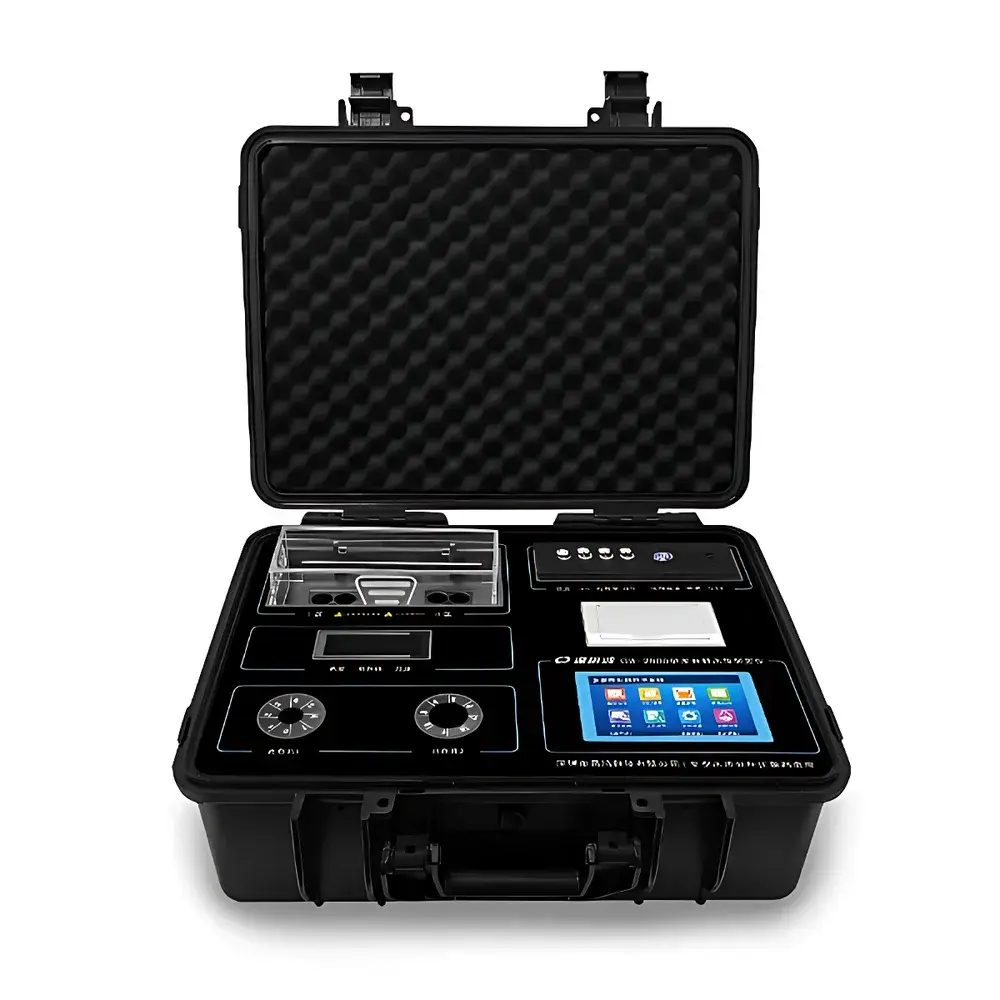
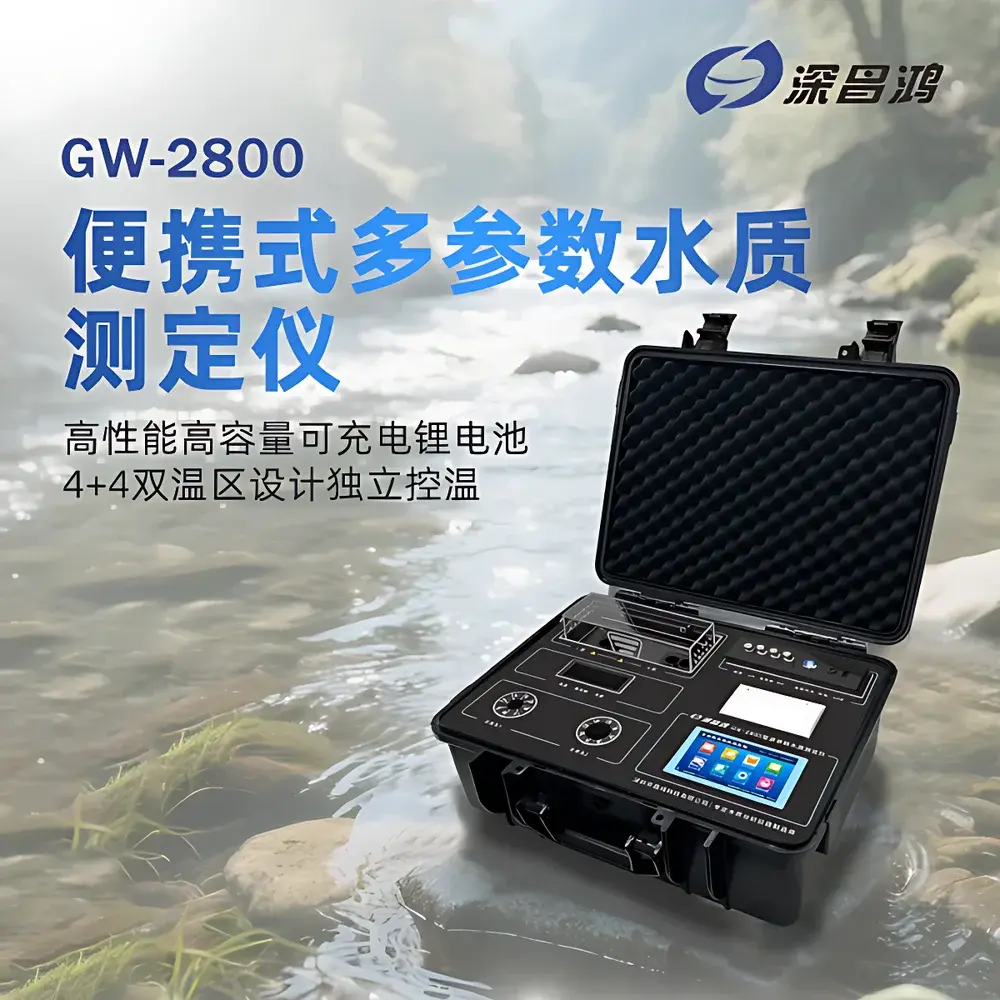
Shenchanghong GW-2800 Portable Multi-Parameter Water Quality Analyzer with Dual-Temperature 8-Position Digestion Block
| Brand | Shenchanghong |
|---|---|
| Origin | Guangdong, China |
| Manufacturer Type | Direct Manufacturer |
| Country of Origin | China |
| Model | GW-2800 |
| Instrument Type | Portable/HANDHELD Water Quality Analyzer |
| Measurable Parameters | COD, Ammonia Nitrogen, Total Phosphorus, Total Nitrogen, Copper, Iron, Nickel, Hexavalent Chromium, Phosphate, Nitrite, pH, Residual Chlorine, and >60 customizable parameters |
| Wavelength Range | 340, 420, 440, 470, 520, 540, 560, 610, 630, 660, 680, 700 nm (user-selectable |
| pH/Conductivity/Dissolved Oxygen | Electrochemical sensor option available |
| Accuracy | ≤ ±5% FS |
| Repeatability | ≤ 2% |
| Optical Stability | Absorbance drift < 0.002 A within 20 min |
| Temperature Control Range | Ambient to 200 °C |
| Temp. Control Accuracy | ±0.5 °C |
| Digestion Time Setting | 1–9999 min |
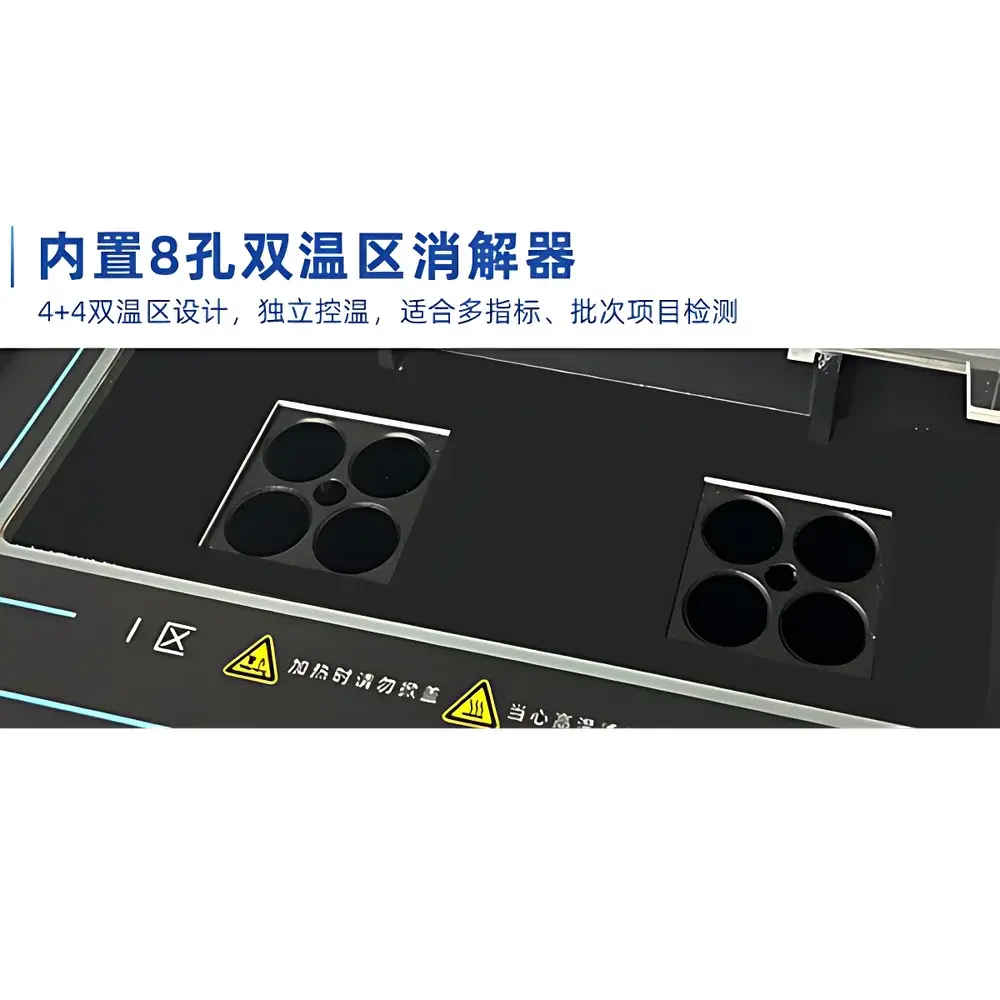
| Digestion Capacity | 8 samples (4+4 dual-zone independent temperature control) |
| Display | Color capacitive touchscreen with bilingual UI (English/Chinese) |
| Dimensions | 453 × 333 × 139 mm |
| Weight | 9 kg |
| Power Supply | Integrated high-capacity lithium battery (63 W charging power) |
| AC input | 220 ± 22 V, 50 ± 0.5 Hz |
| Operating Environment | 5–40 °C, RH ≤ 85%, no strong vibration or EMI |
| Data Storage | 99,999 measurement records + 200 factory curves + 3,000 user-defined calibration curves |
| Light Intensity Adjustment | 16-level programmable LED intensity |
| Optical Calibration Support | Yes |
| Security | Password-protected system settings & startup |
| Connectivity | USB port for data export |
Overview
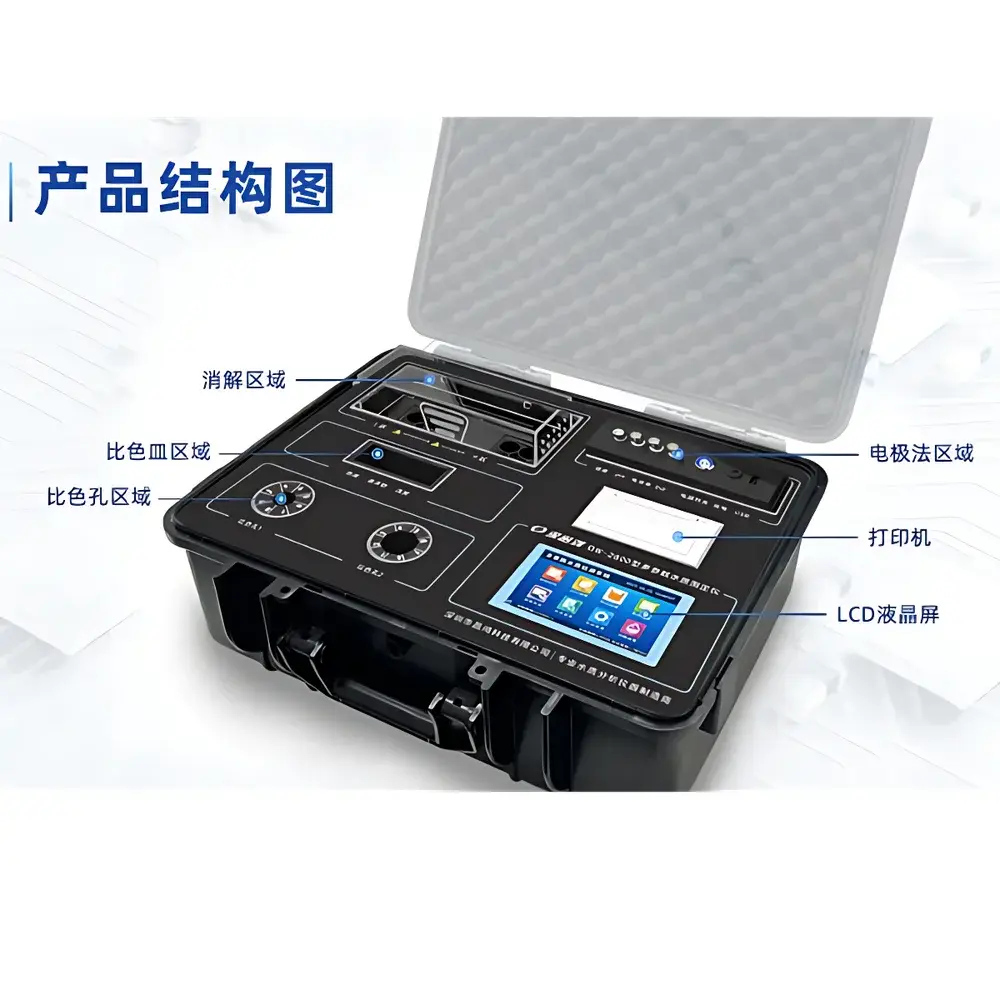
The Shenchanghong GW-2800 is an integrated portable multi-parameter water quality analyzer engineered for field-deployable environmental monitoring, regulatory compliance verification, and on-site wastewater process control. It combines electrochemical sensing (for pH, conductivity, and dissolved oxygen), turbidimetry (via dual-mode scattered/transmitted light detection), and spectrophotometric analysis (using fixed-wavelength LED sources across 12 discrete bands from 340 nm to 700 nm) into a single ruggedized platform. Unlike modular benchtop systems requiring external digestion units, the GW-2800 incorporates an embedded dual-temperature 8-position digestion block — enabling simultaneous thermal pretreatment of two independent parameter groups (e.g., COD + total phosphorus at 165 °C, and ammonia nitrogen + nitrite at 100 °C) without cross-contamination or manual repositioning. Its optical architecture employs long-life LEDs (rated >100,000 hours), programmable 16-level light intensity control, and on-board photometric calibration routines to maintain traceable accuracy across wide dynamic ranges — critical for meeting ISO 7027 (turbidity), ISO 6060 (COD), ISO 11908 (ammonia), and EPA Method 365.3 (phosphate) field validation requirements.
Key Features
- Dual-zone 8-position digestion module with independent temperature control (±0.5 °C accuracy) — supports concurrent high- and low-temperature digestion protocols per ASTM D1252, HJ 828–2017, and HJ 636–2012.
- Integrated electrochemical sensor interface compatible with standardized pH, conductivity, and DO probes — eliminating need for separate meters during multi-parameter surveys.
- Fixed-wavelength LED photometer with auto-wavelength selection logic based on selected test method — ensures spectral fidelity without mechanical grating movement or lamp aging drift.
- Ruggedized IP65-rated enclosure with shock-absorbing rubberized corners, dust-sealed keypad, and anti-glare touchscreen — certified for continuous operation in humid, dusty, or rain-exposed field conditions.
- Extended field endurance: 48-hour main unit runtime on full charge; up to 3 hours of continuous dual-temperature digestion (8 samples × 2 zones) without AC power.
- Comprehensive data governance: Full audit trail including operator ID, timestamp, calibration history, raw absorbance values, standard reference points, and curve equation metadata — compliant with GLP documentation standards.
- Built-in thermal printer with date/time stamp and parameter-specific report templates — enables immediate hardcopy generation for chain-of-custody documentation.
Sample Compatibility & Compliance
The GW-2800 accommodates standard 10–25 mm round cuvettes, 16 mm glass tubes, and flat-bottomed vials — compatible with all major commercial reagent kits (e.g., Hach, Merck, and domestic certified kits per CNAS-CL01). Its digestion block accepts both 16 mm × 100 mm and 12 mm × 75 mm digestion tubes, supporting common methods for COD (closed reflux, 150 °C, 2 h), total phosphorus (persulfate oxidation, 120 °C), and heavy metals (acid digestion per EPA 3015A). All optical measurements conform to Beer–Lambert law linearity validation protocols. The system meets CE marking requirements for electromagnetic compatibility (EN 61326-1) and environmental robustness (EN 60529 IP65). While not FDA 21 CFR Part 11–certified out-of-box, its password-protected configuration, immutable audit logs, and USB-exportable CSV/Excel-formatted datasets support integration into validated laboratory information management systems (LIMS) under ISO/IEC 17025 frameworks.
Software & Data Management
The embedded firmware provides a menu-driven interface with contextual help overlays, multilingual prompts (English/Chinese toggle), and guided workflow navigation for digestion setup, calibration, and measurement. Calibration curves are stored with full provenance: each user-defined curve retains the original standard concentrations, measured absorbances, operator ID, ambient temperature, and calibration timestamp. Up to 3,000 custom curves may be saved alongside 200 preloaded factory curves covering >60 parameters. Data records include parameter name, concentration value, unit, detection wavelength, digestion temperature/duration, and QC flags (e.g., “outlier,” “retest required”). Export occurs via USB mass-storage mode — generating timestamped .CSV files containing all metadata required for regulatory submission (e.g., China’s MEP Order No. 39 reporting, EU WFD Annex V QA/QC logs). Optional PC software (Windows/macOS) enables batch curve optimization, statistical trend analysis, and PDF report generation with digital signature fields.
Applications
- Field-based compliance monitoring for municipal wastewater discharge (GB 18918–2002, EU Urban Wastewater Treatment Directive).
- Rapid screening of surface water bodies (rivers, lakes, reservoirs) for eutrophication indicators (TN, TP, NH₃-N, NO₂⁻) and toxic metals (Cr⁶⁺, Ni, Cu, Fe).
- Drinking water safety verification at distribution points — residual chlorine, pH, turbidity, and phosphate corrosion inhibitor dosing control.
- Industrial effluent characterization in electroplating, textile dyeing, and chemical manufacturing facilities.
- Educational and research use in environmental science programs requiring portable, method-agnostic instrumentation for method development and inter-laboratory comparison studies.
FAQ
Does the GW-2800 support EPA-approved digestion methods?
Yes — its temperature range (ambient to 200 °C) and precise ±0.5 °C control enable execution of EPA Methods 410.4 (COD), 353.2 (nitrate/nitrite), and 365.3 (phosphate), provided compatible reagents and digestion tubes are used.
Can calibration curves be transferred between instruments?
Yes — curves are stored as encrypted .CAL files exportable via USB and importable onto other GW-2800 units, ensuring method consistency across fleet deployments.
Is optical recalibration required after battery replacement?
No — the system retains dark-current and baseline references in non-volatile memory; however, routine photometric verification using neutral density filters is recommended every 3 months per ISO 17025 Clause 6.4.6.
What is the maximum sample volume supported per digestion tube?
Standard capacity is 10 mL for 16 mm tubes and 5 mL for 12 mm tubes — consistent with HJ/T 399–2007 and ISO 6060 volumetric requirements.
Does the instrument meet GLP data integrity requirements?
It supports core GLP principles: unique operator login, immutable timestamps, full calibration traceability, and exportable audit logs — though formal site-specific validation per OECD GLP Principles remains the user’s responsibility.







