
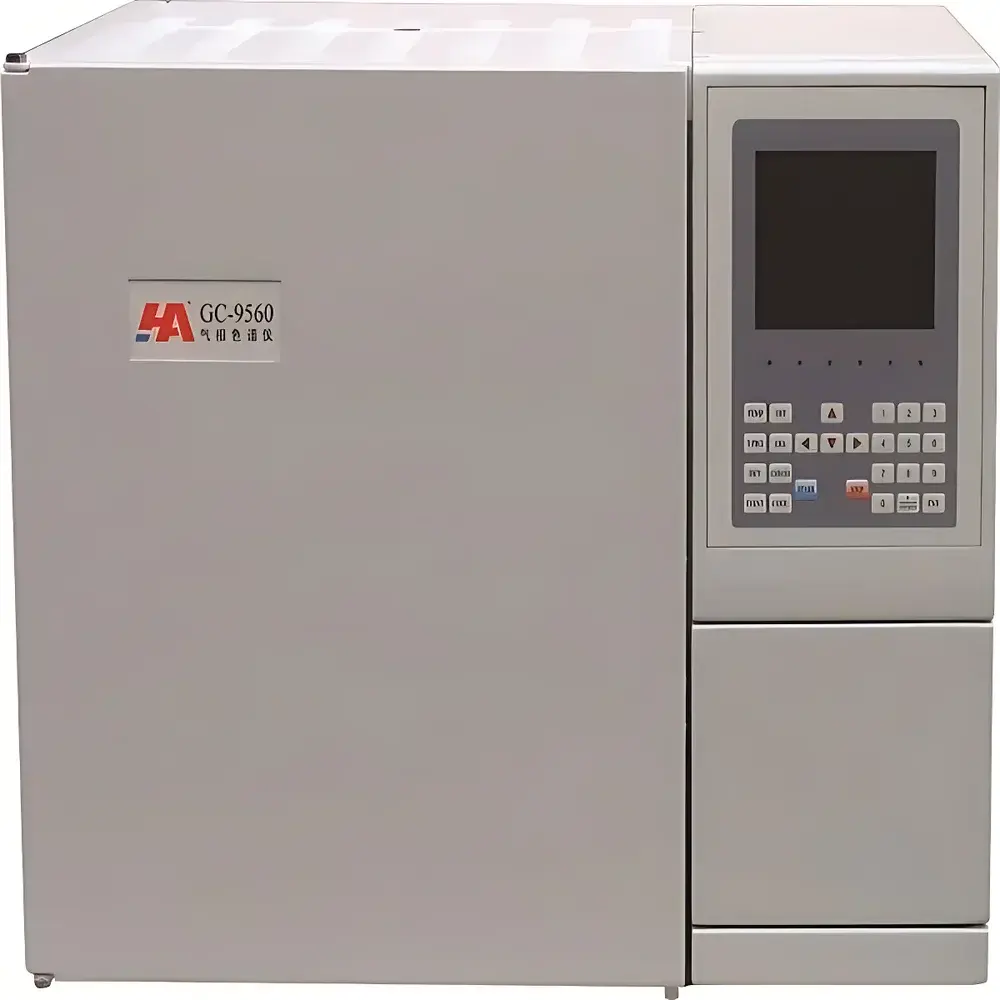
HuaiAi GC-9560 Helium Ionization Gas Chromatograph for Carbon Tetrafluoride (CF₄) Analysis
| Brand | HuaiAi |
|---|---|
| Origin | Shanghai, China |
| Manufacturer Type | Direct Manufacturer |
| Regional Classification | Domestic (China) |
| Model | GC-9560 |
| Price Range | USD 7,000–14,000 |
| Instrument Type | Laboratory Gas Chromatograph |
| Application Domain | Petrochemical & Electronic Specialty Gases |
| Temperature Control Range | Ambient +8 °C to 399 °C |
| Maximum Ramp Rate | 40 °C/min |
| Oven Cooling Time | <5 min (from 350 °C to 50 °C) |
| Carrier Gas Flow Range & Control | 0–500 mL/min |
| Carrier Gas Pressure Range & Control | 0–0.4 MPa |
| Injector Maximum Operating Temperature | 399 °C |
| Injector Pressure Setting Range | 0–0.4 MPa |
| Injector Total Flow Setting Range | 0–500 mL/min |
Overview
The HuaiAi GC-9560 Helium Ionization Gas Chromatograph is a purpose-engineered analytical system designed for ultra-trace impurity profiling in high-purity carbon tetrafluoride (CF₄) and other electronic-grade specialty gases. It operates on the principle of helium ionization detection (HID), a non-destructive, universal detection method with exceptional sensitivity toward permanent gases and low-molecular-weight halocarbons. Unlike flame ionization or thermal conductivity detectors, HID achieves sub-ppb detection limits (≤5 ppb for N₂, O₂, CO, CO₂, SF₆, and moisture) by generating metastable helium ions that induce electron ejection upon collision with analyte molecules. This mechanism delivers stable baseline performance, minimal drift, and immunity to matrix-induced quenching—critical for routine QC of CF₄ used in semiconductor etching, plasma CVD, and flat-panel display manufacturing.
Key Features
- High-sensitivity helium ionization detector (HID) with optimized discharge cell geometry and low-noise electrometer circuitry for consistent signal-to-noise ratios across multi-year operation.
- Proprietary center-cutting multidimensional GC configuration: enables selective isolation and refocusing of target impurities (e.g., N₂, O₂+Ar, CO, CO₂, SF₆, H₂O, HF, C₂F₆, C₃F₈) while rejecting dominant CF₄ matrix peaks—eliminating column overloading and improving resolution.
- Dual independent oven zones with multi-column compartment architecture: allows simultaneous temperature programming of separation columns (e.g., molecular sieve 5A + PLOT Al₂O₃/KCl) and backflush/valve switching modules under precisely synchronized conditions.
- Integrated inlet pressure auto-correction system: dynamically compensates for pressure fluctuations during sample introduction, ensuring reproducible injection volumes across varying cylinder pressures and gas compositions (He, Ar, N₂, or CF₄-based matrices).
- Valve systems equipped with continuous purge gas routing: prevents cross-contamination and adsorption of reactive species (e.g., HF, moisture) on valve surfaces; all fluidic pathways constructed from electropolished stainless steel and VCR-compliant fittings.
- Robust temperature control: programmable oven supports ramp rates up to 40 °C/min and cools from 350 °C to 50 °C in under five minutes—enabling rapid cycle times without thermal stress on capillary or packed columns.
Sample Compatibility & Compliance
The GC-9560 is validated for analysis of CF₄ gas streams conforming to SEMI F57, GB/T 16942–2022, and ISO 8573-8 purity specifications. It quantitatively resolves ≥12 impurities—including nitrogen, oxygen/argon, carbon monoxide, carbon dioxide, sulfur hexafluoride, water vapor, hydrogen fluoride, and higher perfluorocarbons (C₂F₆, C₃F₈)—in matrices ranging from 99.995% to 99.9999% CF₄ purity. All hardware components meet ASME B31.3 process piping standards for high-pressure gas service. The system supports audit-ready operation under GLP and ISO/IEC 17025 frameworks, with optional firmware enabling electronic signatures, user access levels, and 21 CFR Part 11–compliant data integrity controls (including immutable audit trails and instrument event logs).
Software & Data Management
Control and data acquisition are managed via HuaiAi ChromoSoft v4.x, a Windows-based platform supporting method development, sequence scheduling, peak integration using iterative tangent-skimming algorithms, and automated purity calculation per IUPAC-recommended mass-balance protocols. Raw chromatograms and processed reports are stored in vendor-neutral .CDF format (compatible with OpenChrom and AIA-standard viewers). Calibration curves support multi-point linear and quadratic regression with residual diagnostics; system suitability tests (SST) include retention time stability (RSD <0.15%), peak area repeatability (RSD <1.2%), and LOD/LOQ verification per ICH Q2(R2). Data export options include CSV, PDF, and XML for LIMS integration.
Applications
- Quality assurance of CF₄ cylinders supplied to semiconductor fabrication facilities (fabs), including incoming inspection and lot release testing.
- Monitoring impurity build-up in recirculated process gas loops during plasma etch tool maintenance cycles.
- Validation of purification system performance (e.g., getter beds, cryogenic traps) in bulk gas production plants.
- Supporting R&D for next-generation etchants requiring sub-ppb-level O₂ or H₂O control.
- Compliance testing for ISO 8573-8 Class 1 compressed air/gas purity certification in cleanroom environments.
FAQ
What detection limit does the GC-9560 achieve for moisture (H₂O) in CF₄?
Under optimized conditions using a chilled mirror interface and PLOT Q-column, the system achieves a practical detection limit of 3 ppb (v/v) for water vapor.
Can the instrument analyze mixed halogenated gases beyond CF₄?
Yes—method templates are available for C₂F₆, C₃F₈, CHF₃, and SF₆ matrices; column selection and valve timing must be adjusted per compound volatility and polarity.
Is remote monitoring supported?
Standard Ethernet connectivity enables secure remote access via VPN; optional OPC UA server module allows real-time integration with MES/SCADA platforms.
What maintenance intervals are recommended for the HID source?
Discharge electrode cleaning is advised every 6 months under continuous operation; full source replacement is rated for ≥20,000 hours of service life.
Does the system comply with Chinese national metrological verification regulations?
Yes—certified per JJG 700–2016 (Gas Chromatograph Verification Regulation) and included in the Shanghai Municipal Science & Technology Commission’s A-Class Industrial Transformation Project portfolio.





