
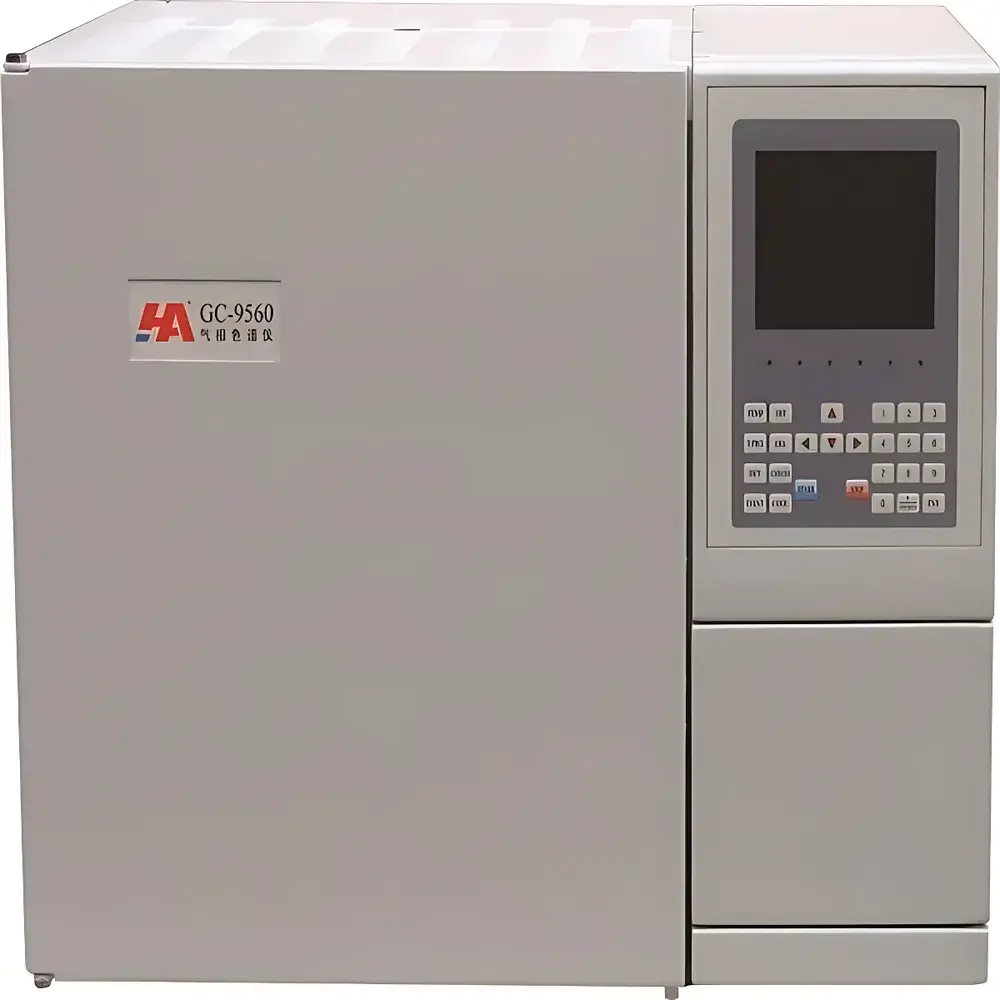
HuaiAi GC-9560-HD Transformer Oil Dedicated Gas Chromatograph
| Brand | HuaiAi |
|---|---|
| Origin | Shanghai, China |
| Manufacturer Type | Direct Manufacturer |
| Instrument Type | Laboratory Gas Chromatograph |
| Application Field | Power Industry Specific |
| Temperature Control Range | Ambient +8 °C to 399 °C |
| Oven Ramp Rate | 1–40 °C/min |
| Oven Cool-down Rate | ~50 °C in ≈7 min |
| Carrier Gas Flow Range & Control | 0–500 mL/min |
| Carrier Gas Pressure Range & Control | 0–0.4 MPa |
| Injector Maximum Operating Temperature | 399 °C |
| Injector Pressure Setting Range | 0–0.4 MPa |
| Injector Total Flow Setting Range | 0–500 mL/min |
Overview
The HuaiAi GC-9560-HD Transformer Oil Dedicated Gas Chromatograph is a purpose-built analytical system engineered for the precise quantification of dissolved gases in electrical insulating oils—primarily mineral-based transformer oils used in high-voltage power equipment. It operates on the principle of capillary gas chromatography with multi-detector configuration, enabling simultaneous separation and detection of key fault-gas species—including hydrogen (H2), oxygen (O2), methane (CH4), ethane (C2H6), ethylene (C2H4), acetylene (C2H2), carbon monoxide (CO), and carbon dioxide (CO2). The instrument implements a three-detector flow path: one thermal conductivity detector (TCD) for permanent gases (H2, O2) and two flame ionization detectors (FID1 and FID2) configured to isolate hydrocarbon analysis from CO/CO2 interference—particularly critical for accurate C2H2 measurement at trace levels. This architecture supports full quantitative analysis of all eight gases within ≤7 minutes per injection, meeting the time-efficiency and sensitivity requirements of routine DGA (Dissolved Gas Analysis) in utility laboratories and OEM quality control environments.
Key Features
- Triple-detector configuration (TCD + dual FID) with signal routing logic to eliminate cross-sensitivity between CO/CO2 and hydrocarbons—enhancing specificity for C2H2 and improving method robustness.
- Programmable oven temperature control from ambient +8 °C to 399 °C, with ramp rates adjustable from 1 to 40 °C/min and rapid cool-down (~50 °C in ~7 min) for high-throughput operation.
- Independent, digitally controlled carrier gas pressure and flow modules (0–0.4 MPa; 0–500 mL/min) for reproducible retention time stability and method transferability.
- High-temperature injector (up to 399 °C) with pressure- and flow-programmable operation, optimized for headspace sampling of degassed oil extracts.
- Integrated hardware-level baseline compensation for seamless TCD/FID2 signal switching—eliminating manual baseline realignment during sequential detection.
Sample Compatibility & Compliance
The GC-9560-HD is validated for use with ASTM D3612-compliant headspace extraction procedures and fully aligned with Chinese national standards governing DGA: GB/T 17623–1998 (determination method), GB/T 7252–2001, and DL/T 722–2000 (interpretation guidelines). Its detection limits meet or exceed industry benchmarks for diagnostic sensitivity: ≤2 μL/L for H2, CO, and CO2; ≤0.1 μL/L for CH4, C2H4, C2H6, and C2H2. The system supports GLP-compliant workflows through audit-trail-enabled software logging, electronic signature support, and data integrity safeguards consistent with FDA 21 CFR Part 11 principles. All calibration, integration, and reporting functions are traceable to documented SOPs required for ISO/IEC 17025-accredited power laboratory operations.
Software & Data Management
The GC-9560V4.0 Power Industry Chromatography Workstation provides full bidirectional instrument control and compliant data handling under Windows XP. It features 24-bit USB A/D acquisition with ±1 μV resolution, dual analog input channels (–1 V to +1 V), and dynamic range exceeding 106. The software delivers automated peak identification, customizable integration parameters, and built-in DGA interpretation tools—including IEC 60599-style three-ratio coding, Duval triangle analysis, and Rogers ratio diagnostics. Data storage follows an open relational structure: all raw chromatograms, method files, calibration records, and result metadata are stored in accessible folders with timestamped versioning. Reports export to editable Word templates or CSV/Excel formats, supporting centralized database ingestion and cross-departmental review. Audit logs record user actions, parameter changes, and result modifications—enabling full traceability during regulatory inspection or internal QA review.
Applications
- Routine dissolved gas analysis (DGA) for predictive maintenance of power transformers, reactors, and bushings.
- Factory acceptance testing (FAT) and type testing of new oil-filled equipment per IEEE C57.104 and IEC 60599.
- Oil reclamation and regeneration process monitoring in service depots.
- Root-cause failure investigation following electrical faults or thermal anomalies.
- Long-term trend analysis of gas accumulation rates across fleet-wide asset databases.
FAQ
What gases does the GC-9560-HD quantify, and how are they distributed across detectors?
H2 and O2 are measured by the TCD; CH4, C2H4, C2H6, and C2H2 by FID1; CO and CO2 by FID2—ensuring minimal interferences and optimal signal-to-noise ratios.
Is the system compliant with international DGA standards beyond Chinese regulations?
Yes—the method design and performance specifications align with ASTM D3612, IEC 60599, and IEEE C57.104 requirements for detection limits, repeatability, and diagnostic reporting.
Can the workstation interface with LIMS or enterprise asset management systems?
Data exports in CSV, XML, and structured folder hierarchies support integration with third-party LIMS, CMMS, and SCADA platforms via standard file ingestion protocols.
What is the typical detection limit for acetylene (C2H2) under standard operating conditions?
With 1 mL oil sample volume and headspace equilibration, the minimum detectable concentration is 0.1 μL/L—meeting the threshold for early-stage arcing detection per DL/T 722.
Does the system support unattended overnight operation with auto-sampling?
The GC-9560-HD is compatible with standard 10-position or 16-position autosamplers (sold separately); full sequence control—including vial selection, syringe wash, and injection timing—is managed via GC-9560V4.0 software.





