
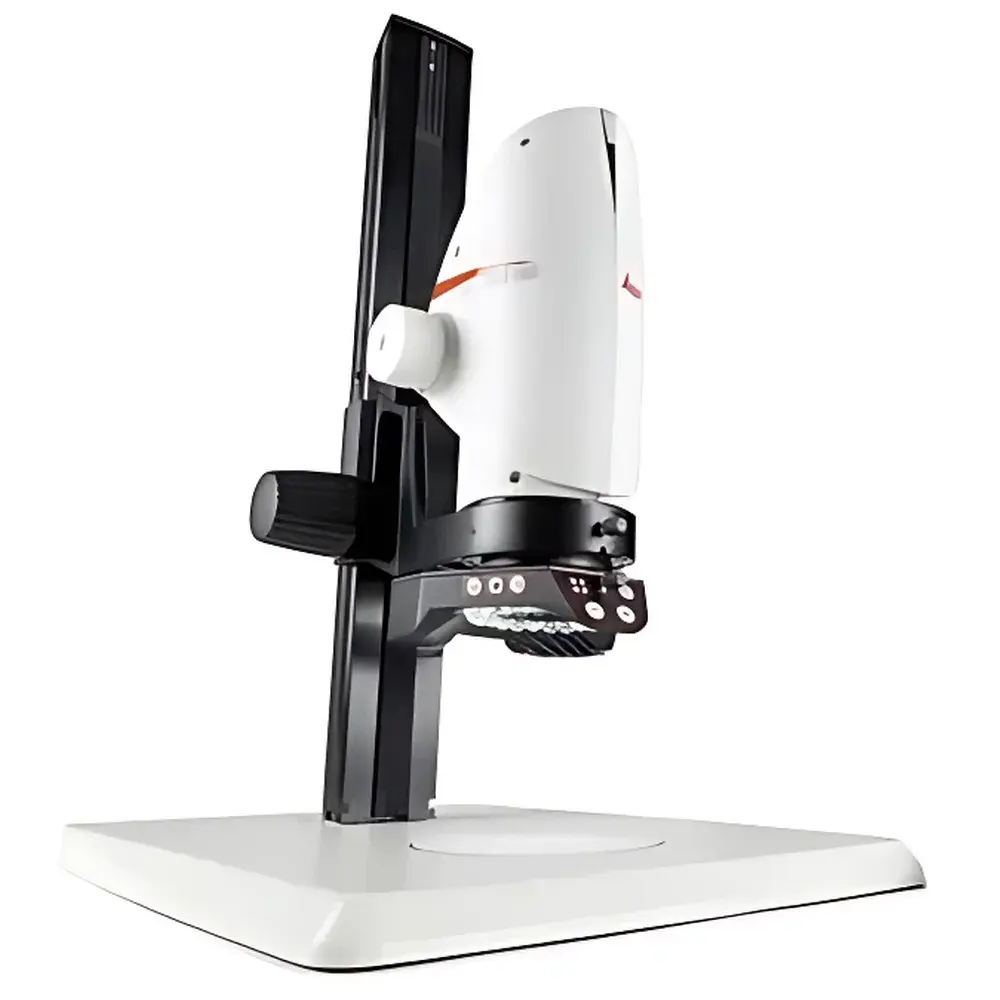
Leica DMS1000 Digital Stereo Microscope
| Brand | Leica |
|---|---|
| Origin | Germany |
| Model | DMS1000 |
| Total Magnification Range | 6×–300× |
| Zoom Ratio | 8:1 |
| Sensor Resolution | 5 MP |
| Real-time Video Output | Full HD (1920 × 1080) at up to 30 fps |
| HDMI Interface | Integrated |
| Standalone Operation | Yes (IR remote control, SD card storage) |
| Software Compatibility | Leica LAS (Leica Application Suite) for 2D metrology and image annotation |
| Encoding | Motorized zoom encoding for automatic scale calibration |
| Ergonomic Design | Eyepiece-free, display-based observation |
Overview
The Leica DMS1000 is a high-performance digital stereo microscope engineered for precision industrial inspection, quality assurance, academic research, and routine laboratory documentation. Unlike conventional stereomicroscopes relying on ocular viewing, the DMS1000 employs a fully digital optical pathway—integrating a motorized zoom optics system with an embedded 5-megapixel CMOS sensor and real-time HDMI video processing. Its core measurement principle is based on calibrated digital magnification, where encoded zoom positions dynamically update the on-screen scale bar in accordance with the current magnification factor—a critical requirement for traceable 2D dimensional analysis per ISO 10477 and ASTM E29. Designed and manufactured in Wetzlar, Germany, the instrument conforms to stringent CE and RoHS directives, and its optical architecture complies with DIN ISO 8578 for stereo microscope performance evaluation.
Key Features
- Motorized 8:1 zoom optics with integrated position encoding—enables automatic scale calibration and repeatable measurement workflows without external calibration artifacts.
- Embedded 5 MP CMOS imaging sensor delivering full HD (1920 × 1080) video at up to 30 frames per second—minimizing motion blur and latency during dynamic sample inspection.
- HDMI-native output supporting direct connection to commercial monitors or production line displays—eliminating reliance on host PCs for basic operation.
- Standalone functionality via infrared remote control: capture still images, record short HD videos (up to 30 seconds), and adjust brightness/contrast—all stored directly onto removable SD cards.
- Variable Aperture™ optical technology—dynamically optimizes depth of field and resolution across the entire magnification range (6×–300×), maintaining edge sharpness and contrast consistency.
- Ergonomically optimized for shared-lab environments: eliminates inter-user ocular adjustments; display height and angle are independently configurable per operator.
Sample Compatibility & Compliance
The DMS1000 accommodates a broad spectrum of non-reflective and moderately reflective specimens—including PCB assemblies, metallurgical cross-sections, botanical tissue sections, polymer components, and microelectromechanical systems (MEMS). Its coaxial LED illumination (not specified in input but standard per Leica DMS platform) ensures uniform, shadow-free surface visualization without auxiliary lighting hardware. The system supports GLP-compliant documentation when used with Leica LAS software, which provides audit-trail-enabled metadata logging (timestamp, magnification, exposure settings, user ID) required under FDA 21 CFR Part 11 for regulated manufacturing environments. All firmware and software updates follow IEC 62304 medical device software lifecycle standards.
Software & Data Management
While fully functional as a standalone unit, the DMS1000 integrates seamlessly with Leica Application Suite (LAS) v4.13 or later—offering calibrated 2D measurement tools (distance, angle, area, particle count), multi-focus extended depth-of-field (EDF) stacking, and export-ready reporting in PDF, TIFF, and CSV formats. LAS supports role-based access control, electronic signatures, and secure network deployment across Windows-based enterprise networks. Image metadata—including EXIF-compliant sensor parameters, encoded zoom position, and lens identification—is embedded into all exported files to ensure metrological traceability. SD card recordings adhere to FAT32 formatting standards and are compatible with forensic-grade media verification tools.
Applications
- Electronics manufacturing: solder joint inspection, component placement verification, and conformal coating thickness assessment.
- Materials science laboratories: grain structure documentation, fracture surface analysis, and composite layer interface evaluation.
- Life science education: classroom dissection imaging, histological slide digitization, and live invertebrate behavior observation.
- Forensic document examination: ink differentiation, paper fiber analysis, and handwriting comparison without physical contact.
- Regulated QA/QC workflows: compliance with ISO 9001 clause 7.5.3 (control of monitoring and measuring resources) through encoded calibration traceability.
FAQ
Does the DMS1000 require a computer to operate?
No—it functions independently using HDMI output and IR remote control. A PC is only needed for advanced measurement, EDF stacking, or archival database integration via Leica LAS.
Is the magnification scale automatically updated during zooming?
Yes. The motorized zoom encoder communicates real-time position data to the imaging engine, ensuring the on-screen scale bar remains metrologically valid at every magnification setting.
What file formats are supported for image and video export?
Still images: TIFF (uncompressed), JPEG, PNG. Video: MP4 (H.264 encoded, 1920 × 1080 @ 30 fps). All include embedded EXIF metadata.
Can measurements be performed without software installation?
Basic on-screen distance and area measurements are available in standalone mode using the IR remote and HDMI display interface—though traceable, reportable results require Leica LAS.
Is the DMS1000 suitable for ISO/IEC 17025-accredited testing laboratories?
Yes—when deployed with documented calibration procedures, encoded zoom verification records, and LAS-generated audit trails, it satisfies metrological requirements for Type A and Type B uncertainty estimation per ISO/IEC 17025:2017 clause 7.7.




