
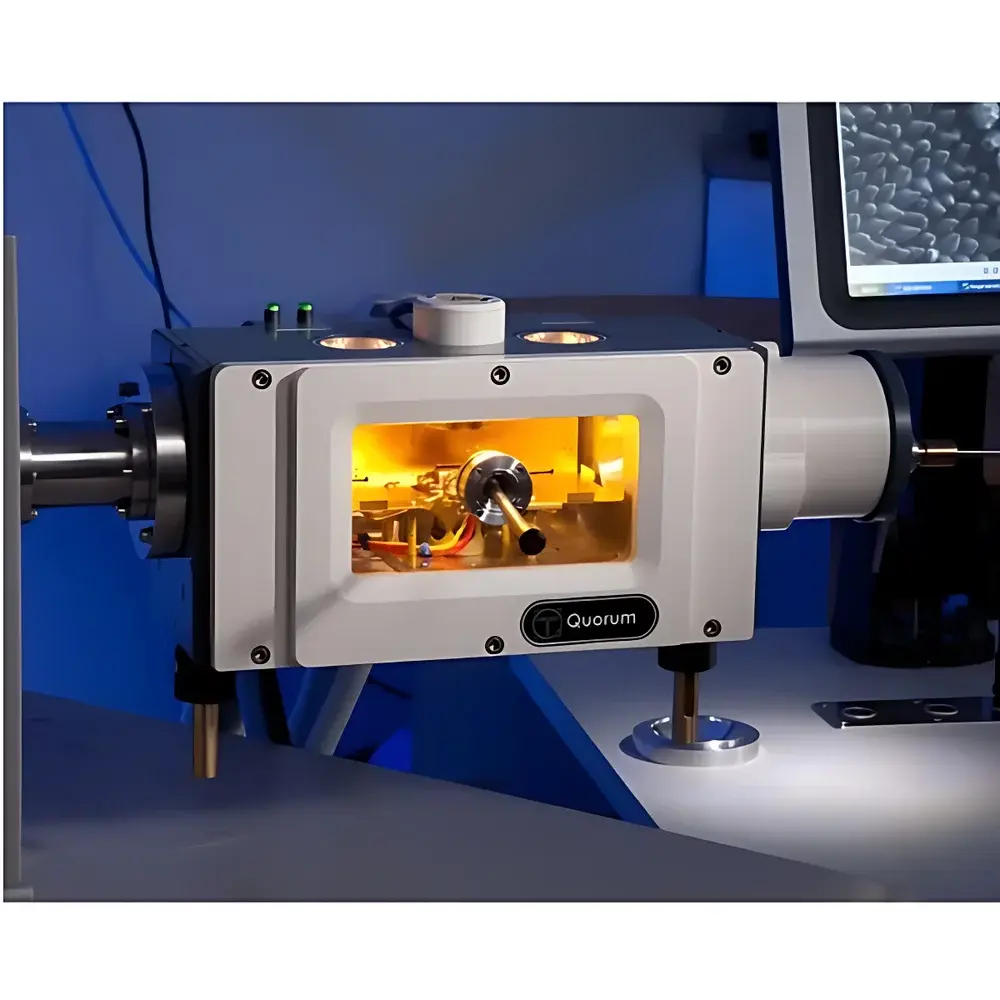
Quorum PP3010T Cryo-Transfer System
| Brand | Quorum |
|---|---|
| Origin | United Kingdom |
| Model | PP3010T |
| Type | Cryogenic Transfer System for SEM |
| Application | Cryo-SEM Sample Preparation and In-Situ Cold Stage Integration |
| Temperature Range | Down to –185 °C (Liquid Nitrogen Cooled) |
| Compatibility | Cold Field Emission SEMs (CFEG-SEM), Conventional SEMs with Cryo-Compatible Stages |
Overview
The Quorum PP3010T Cryo-Transfer System is a high-integrity, vacuum-compatible cryogenic sample handling platform engineered for seamless integration with cold field emission scanning electron microscopes (CFEG-SEM) and conventional SEMs equipped with cryo-capable stages. It implements the core principles of cryo-scanning electron microscopy (Cryo-SEM), a technique grounded in rapid vitrification—where aqueous or hydrated specimens are cooled at rates exceeding 10⁶ K/s to achieve amorphous ice formation without crystalline lattice disruption. This preserves native ultrastructure in biological tissues, soft polymers, hydrogels, emulsions, pharmaceutical formulations, and frozen-hydrated food matrices. Unlike room-temperature SEM workflows requiring dehydration and conductive coating—processes inducing shrinkage, collapse, and artefactual topography—the PP3010T enables direct imaging of fully hydrated, beam-sensitive samples under stable cryogenic conditions. Its design conforms to fundamental requirements of cryo-EM workflow integrity: thermal stability, contamination control, and vacuum compatibility across transfer interfaces (preparation chamber → load lock → microscope stage).
Key Features
- Vacuum-tight, double-shielded transfer rod with integrated liquid nitrogen (LN₂) cooling circuit ensuring continuous thermal isolation from ambient to cryo-stage (≤ –185 °C)
- Modular architecture compatible with Quorum’s Q150T ES sputter coater and EM CPD300 critical point dryer for end-to-end cryo-prep integration
- Electronically interlocked safety protocol preventing accidental warm-up during transfer; real-time temperature monitoring via calibrated Pt100 sensors
- Optimized cold finger geometry minimising thermal gradient across specimen mount, reducing frost deposition and enhancing long-term imaging stability
- ISO Class 5 (Class 100) cleanroom-compatible loading mechanism with anti-contamination baffle and cryo-shutter for controlled exposure during stage insertion
- Compatible with standard Gatan, Oxford Instruments, and FEI-style cryo-stages via mechanical interface adaptors (specify mounting flange type upon order)
Sample Compatibility & Compliance
The PP3010T supports specimens mounted on standard 3.05 mm TEM grids, cryo-SEM stubs (e.g., Al stubs with carbon tape), and custom-fabricated copper planchets. It accommodates bulk samples up to 10 mm diameter × 3 mm thickness post-fracture. Applications span structural biology (virus particles, membrane proteins), plant tissue cryo-fracture, lipid bilayer morphology, freeze-dried biopharmaceuticals, and nanocomposite phase distribution analysis. The system complies with ISO 14644-1 for particulate cleanliness during loading, adheres to ASTM E2932–22 guidelines for cryo-SEM specimen preparation, and meets essential safety requirements per IEC 61010-1 for laboratory electrical equipment. Full traceability logs—including LN₂ consumption, stage temperature history, and vacuum ramp profiles—are exportable for GLP/GMP audit compliance.
Software & Data Management
While the PP3010T operates as a hardware-integrated subsystem without embedded firmware, it interfaces with Quorum’s Quorum Suite v5.2 software suite via RS-232/USB. This enables synchronized logging of thermal and vacuum parameters alongside microscope acquisition metadata. Temperature and pressure telemetry are time-stamped and cross-referenced with SEM image headers (via TIFF/EDS metadata embedding), supporting FDA 21 CFR Part 11–compliant data archiving when deployed within validated laboratory information management systems (LIMS). Audit trails record operator ID, session start/end timestamps, and any manual override events—ensuring full ALCOA+ (Attributable, Legible, Contemporaneous, Original, Accurate, Complete, Consistent, Enduring, Available) data integrity.
Applications
- High-resolution imaging of unstained, unfixed biological cells and extracellular matrices in near-native state
- In situ observation of ice nucleation dynamics and recrystallisation behaviour in frozen foods and cryoprotectant solutions
- Morphological characterisation of lyophilised monoclonal antibody aggregates and vaccine nanoparticle dispersions
- Fracture surface analysis of thermoplastic elastomers and block copolymer thin films
- Correlative cryo-SEM/FIB-SEM volume reconstruction of hydrated biofilms and microbial consortia
- Quality control of cryo-milled active pharmaceutical ingredients (APIs) and amorphous solid dispersions
FAQ
What vacuum level is required for safe transfer into the SEM column?
The PP3010T requires ≤5×10⁻⁵ mbar in the load-lock chamber prior to insertion; final column pressure must be ≤1×10⁻⁶ mbar for optimal cryo-imaging.
Can the system be retrofitted to older SEM models?
Yes—provided the microscope features a cryo-stage port with ≥60 mm clear aperture and compatible flange standard (CF35, CF63, or KF40); Quorum provides custom adapter kits.
Is liquid nitrogen refilling automated?
No—LN₂ refill is manual via calibrated Dewar interface; typical hold time is 8–12 hours at –185 °C with full reservoir.
Does the PP3010T support in-column cryo-fracturing?
It is designed for ex-situ fracturing in dedicated cryo-prep chambers (e.g., Quorum Q150T ES with cryo-fracture module); in-column fracture is not supported.
How is contamination minimised during transfer?
Through sequential differential pumping, cold traps at –196 °C, and a shuttered transfer path that isolates the specimen until final stage docking.





