
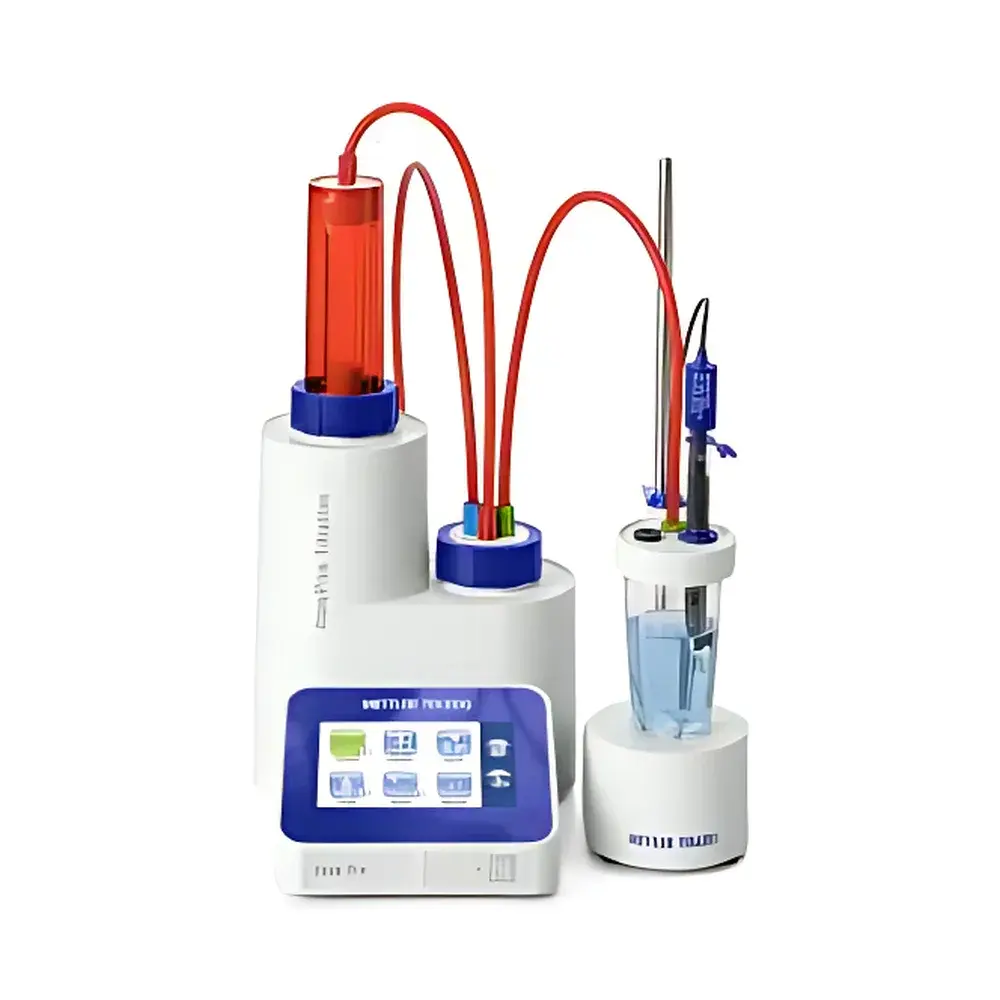
METTLER TOLEDO EasyPlus ET38 Automatic Potentiometric Titrator
| Brand | METTLER TOLEDO |
|---|---|
| Origin | Switzerland |
| Model | ET38 |
| pH Measurement Range | 1–14 |
| pH Resolution | 0.01 |
| pH Accuracy | ±0.2% of full scale |
| Titration Precision | ±0.3 µL per dispensing step |
| Instrument Type | General-purpose Automatic Potentiometric Titrator |
| Compliance | Designed for GLP/GMP-aligned laboratory workflows |
| Software Interface | iTitrate method-guided setup engine |
| Data Output | USB and RS232 connectivity for printer (e.g., USB-P25) and PC-based EasyDirect™ software integration |
Overview
The METTLER TOLEDO EasyPlus ET38 Automatic Potentiometric Titrator is a benchtop electrochemical analyzer engineered for precision, repeatability, and operational simplicity in redox titrations. Based on potentiometric endpoint detection—measuring potential change across a redox-sensitive electrode pair as titrant is incrementally delivered—the ET38 identifies stoichiometric equivalence points with high reproducibility in non-aqueous and aqueous matrices. Its core architecture integrates a microprocessor-controlled burette drive, high-stability reference and indicator electrode circuitry, and real-time potential monitoring at 100 mV/s sampling rate. Designed and manufactured in Switzerland, the system complies with fundamental requirements for traceable, auditable analytical processes in regulated environments—including alignment with ISO/IEC 17025 documentation practices and support for FDA 21 CFR Part 11–compliant data handling when used with validated EasyDirect™ configurations.
Key Features
- Integrated composite platinum-sheet redox electrode—optimized for rapid electron transfer kinetics and minimal polarization drift during prolonged titration sequences.
- iTitrate intelligent method setup wizard guides users through parameter selection (e.g., titrant concentration, expected sample volume, endpoint slope threshold) without requiring prior electrochemistry expertise.
- Real-time titration curve visualization with automatic first-derivative peak detection for robust equivalence point identification—even in low-slope or multi-step redox systems.
- USB and RS232 interfaces enable direct connection to METTLER TOLEDO USB-P25 thermal printers for GLP-compliant hardcopy output or to PCs running EasyDirect™ software for automated result calculation, audit trail generation, and electronic signature support.
- Modular design supports future expansion with optional dosing units, sample changers, or thermometric sensor modules—maintaining compatibility with METTLER TOLEDO’s broader EasyPlus platform ecosystem.
Sample Compatibility & Compliance
The ET38 accommodates liquid and semi-liquid samples across food, beverage, environmental, electroplating, and cleaning formulation laboratories. Validated applications include ascorbic acid quantification in fruit juices (AOAC 967.22), peroxide value determination in edible oils (ISO 3960), reducing sugar analysis in wine must (OIV-MA-AS313-01), and hydrogen peroxide concentration in industrial process baths. All measurements adhere to standard pH range specifications (1–14) with resolution of 0.01 pH units and accuracy within ±0.2% of full scale. The instrument’s firmware and hardware architecture are designed to meet foundational elements of GxP compliance—including user access levels, method version control, and electronic record integrity—when deployed with appropriate procedural controls and periodic verification per ISO/IEC 17025 clause 6.4.
Software & Data Management
The embedded iTitrate interface operates via intuitive icon-driven navigation, eliminating reliance on memorized command syntax. Each method stores complete metadata: electrode type, titrant batch ID, calibration history, and operator ID. When connected to EasyDirect™ v3.5 or later, the ET38 generates time-stamped, immutable audit trails containing raw potential vs. volume data, derivative curves, calculated results, and user actions—fully compliant with ALCOA+ principles (Attributable, Legible, Contemporaneous, Original, Accurate). Data export supports CSV, PDF, and XML formats for LIMS integration or regulatory submission packages.
Applications
- Determination of ascorbic acid (vitamin C) in fortified beverages using iodometric titration.
- Quantification of hydroperoxides in vegetable oils and fats via ferric thiocyanate or iodometric methods.
- Analysis of reducing sugars in grape must and fruit concentrates using Fehling’s solution or copper-based redox titrants.
- Monitoring hydrogen peroxide concentration in printed circuit board (PCB) etching baths and medical device sterilization solutions.
- Quality control of chlorine dioxide and hypochlorite disinfectants in municipal water treatment facilities.
FAQ
What electrode is included with the ET38 as standard?
The instrument ships with a METTLER TOLEDO composite platinum-sheet redox electrode (InLab® Redox Pro or equivalent), pre-calibrated and optimized for rapid response in iodometric, cerimetric, and permanganometric titrations.
Can the ET38 perform Karl Fischer moisture titration?
No—the ET38 is configured exclusively for potentiometric redox and acid-base endpoints; it does not support coulometric or volumetric Karl Fischer reagents or dedicated KF electrodes.
Is method validation support available for pharmaceutical use?
Yes—METTLER TOLEDO provides IQ/OQ documentation templates and application notes aligned with USP , EP 2.2.20, and ICH Q2(R2) guidelines for redox titration method verification.
How is calibration traceability maintained?
Electrode calibration uses NIST-traceable pH buffer standards (e.g., DIN 19266); titrant concentration verification follows ISO 8655-6 gravimetric protocols using certified reference materials.
What maintenance intervals are recommended for routine operation?
Daily electrode rinsing and storage in specified electrolyte; quarterly burette sealing inspection and annual metrological verification by an accredited service provider per ISO/IEC 17025.




