
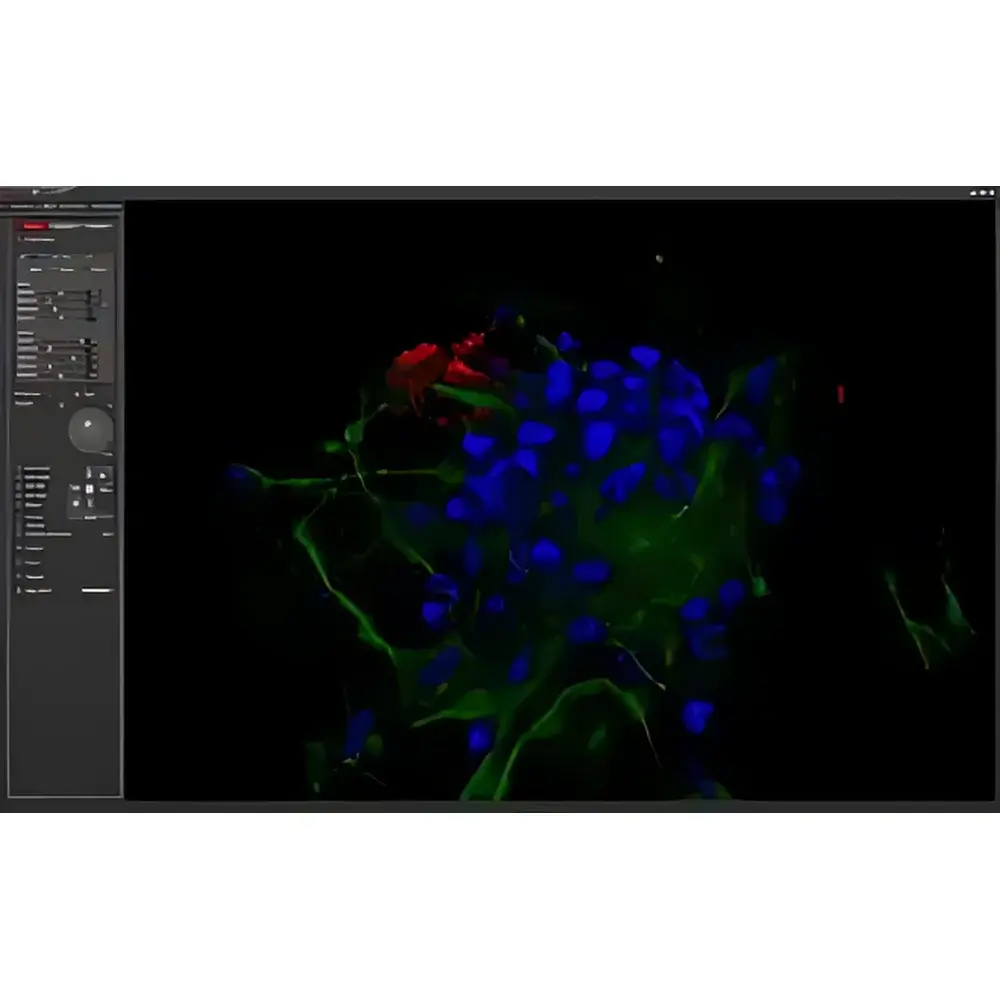
Leica LAS X Software Module for Automated Microscope Control
| Brand | Leica |
|---|---|
| Origin | Germany |
| Manufacturer Type | Authorized Distributor |
| Import Status | Imported |
| Model | LAS X Automation Module |
| Microscope Type | Upright |
| Integrated Image Analysis System | Yes |
| Price Range | USD 7,000 – 14,000 (FOB Hamburg) |
Overview
The Leica LAS X Automation Module is a comprehensive software platform engineered for precise, repeatable, and fully integrated control of Leica upright metallurgical microscopes—specifically designed for industrial metallography, failure analysis, and materials science laboratories. Built upon Leica’s proprietary imaging architecture, LAS X implements deterministic command protocols over USB 3.0 and Ethernet interfaces to synchronize hardware subsystems—including motorized illumination units, encoded nosepieces, motorized focus drives, and high-speed sCMOS/CCD cameras—in strict compliance with deterministic timing requirements for quantitative microscopy. Its core functionality is grounded in programmable workflow orchestration: users define acquisition sequences not as isolated actions, but as auditable, version-controlled protocols that enforce metrological traceability across instrument configurations, exposure parameters, and Z-stack geometries. This architecture ensures alignment with ISO/IEC 17025 calibration management frameworks and supports audit-ready documentation for GLP-compliant quality control environments.
Key Features
- Hardware-Integrated Parameter Control: Direct digital control of transmitted/reflected light intensity, aperture diaphragm position, field diaphragm position, objective turret selection, and observation mode (brightfield, darkfield, DIC, polarized) via bidirectional communication with Leica DM series upright metallurgical microscopes.
- Camera Parameter Orchestration: Programmable control of exposure time (10 µs–60 s), analog/digital gain, color space (sRGB, Adobe RGB), white balance presets (manual, auto, illuminant-specific), and hardware-triggered frame acquisition with sub-millisecond jitter tolerance.
- Automated Image Capture Workflow: One-click acquisition with configurable resolution (up to 20 MP native sensor output), file format (TIFF, JPEG, PNG, Leica LIF), compression level, and metadata embedding (EXIF, XMP, custom XML schemas).
- Persistent Configuration Management: User-defined parameter sets—including illumination profiles per objective magnification, diaphragm settings per contrast method, and camera gain/exposure pairings—are stored as encrypted .lasxconfig files with timestamped revision history and role-based access controls.
- Motorized Autofocus Implementation: Closed-loop focus optimization using contrast gradient maximization algorithms, compatible with Leica’s Z-drive systems (e.g., Z6000 or Z1200) and calibrated for thermal drift compensation over 8-hour continuous operation.
- Time-Lapse & Interval Imaging: Configurable acquisition schedules with start/stop triggers, minimum inter-frame intervals down to 100 ms, and automatic session logging including ambient temperature/humidity metadata (when interfaced with environmental sensors).
- Extended Depth of Field (EDOF) Reconstruction: Z-stack acquisition with user-defined step size (0.1–10 µm), number of slices (1–500), and focus algorithm (contrast-based or phase-gradient). EDOF fusion uses pixel-wise sharpness weighting and sub-pixel registration to eliminate motion artifacts.
- 3D Surface Visualization Engine: Depth-map rendering with false-color height encoding (16-bit linear scaling), interactive rotation (360° azimuth, ±90° elevation), orthographic projection export, and surface profile extraction along user-defined line segments.
- Spatial Annotation & Navigation: Coordinate-based region tagging with alphanumeric labels, geometric overlays (circles, polygons, arrows), and persistent stage-position memory for multi-session relocalization—fully interoperable with Leica’s TileScan hardware synchronization.
- Mosaic Imaging Suite: Automated XY tiling with overlap correction (5–20%), seam blending via Poisson editing, and XYZ volumetric stitching with Z-axis registration for serial section reconstruction (e.g., cross-sectioned weld joints or heat-affected zones).
Sample Compatibility & Compliance
The LAS X Automation Module operates exclusively with Leica DM2700 M, DM4 M, DM6 M, and DM2500 M upright metallurgical microscope platforms equipped with Leica motorized components and certified camera interfaces (e.g., DFC9000 GT, DFC7000 T). It supports standard metallographic sample formats: 25 mm, 30 mm, and 50 mm diameter mounts; flat, beveled, or embedded specimens up to 40 mm thickness. All image data generation adheres to ASTM E3–22 (Standard Guide for Preparation of Metallographic Specimens) and ISO 4967:2018 (Non-metallic inclusions in steels). The software’s audit trail functionality—including user login events, parameter change logs, and acquisition timestamps—meets FDA 21 CFR Part 11 requirements for electronic records when deployed on validated Windows 10/11 workstations with domain authentication.
Software & Data Management
LAS X employs a modular client-server architecture: the LAS X Client provides the GUI-driven workflow builder, while the LAS X Core Service runs as a Windows service handling low-level device communication and real-time data buffering. All acquisitions generate self-contained .lif files containing raw image data, metadata (DICOM-SR compliant schema), and full acquisition protocol definitions. Export options include TIFF stacks with OME-TIFF headers for Fiji/ImageJ compatibility, CSV reports for statistical process control (SPC) integration, and PDF annotation packages for internal QA reporting. Version 4.13+ includes built-in support for Leica’s LMS (Laboratory Management System) API, enabling direct integration with enterprise LIMS platforms via RESTful webhooks.
Applications
This module is routinely deployed in aerospace component inspection (turbine blade coating adhesion analysis), automotive powertrain metallurgy (gear tooth case depth quantification), semiconductor packaging failure analysis (wire bond void detection), and academic materials research (grain boundary mapping in additively manufactured Inconel 718). Its EDOF and 3D surface visualization capabilities are particularly critical for evaluating surface roughness (Ra, Rz per ISO 4287), inclusion morphology (ASTM E45), and phase distribution homogeneity in duplex stainless steels. The interval imaging function enables in-situ corrosion monitoring under controlled humidified atmospheres, while mosaic stitching supports full-field analysis of large-area weld seams per AWS D1.1 requirements.
FAQ
Is LAS X Automation Module compatible with non-Leica microscopes?
No. It requires Leica’s proprietary hardware interface firmware and motor control protocols, and is validated only on Leica DM-series upright metallurgical platforms.
Does LAS X support automated measurement of grain size or inclusion counts?
Yes—when paired with the optional Leica QWin or LAS X Quantitative Analysis modules, which provide ASTM E112-compliant grain sizing and ISO 4967-compliant inclusion classification algorithms.
Can acquisition protocols be exported and shared across laboratory sites?
Yes. Protocols (.lasxproto files) are portable between identical microscope configurations and retain all hardware parameter mappings, enabling standardized SOP deployment across global manufacturing facilities.
What cybersecurity standards does LAS X comply with?
It conforms to IEC 62443-3-3 SL2 requirements for industrial control systems, including TLS 1.2+ encrypted communications, Windows Defender Application Control (WDAC) policy enforcement, and regular security patching aligned with Leica’s PSIRT advisory cycle.
Is cloud-based data backup supported?
Native cloud sync is not implemented; however, .lif files and configuration archives are fully compatible with enterprise-grade NAS/SAN storage systems configured with SMB 3.1.1 encryption and snapshot-based versioning.




