
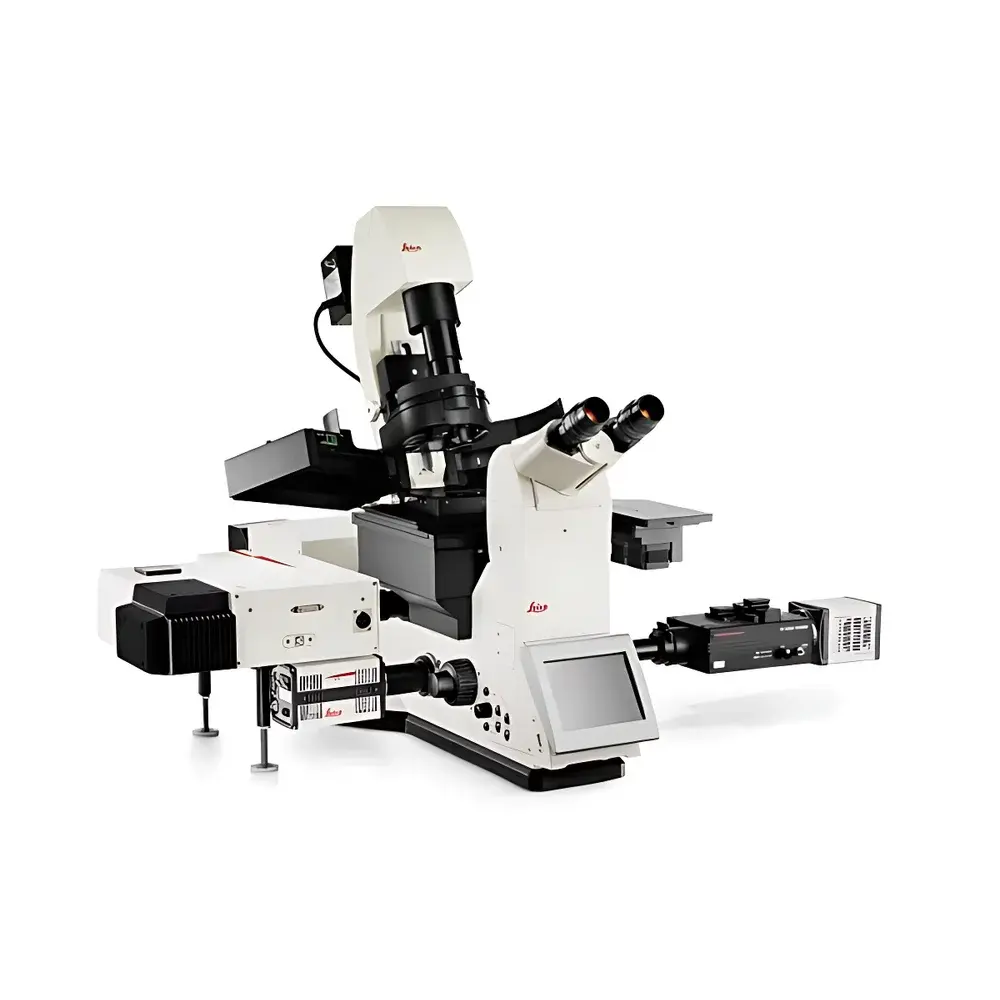
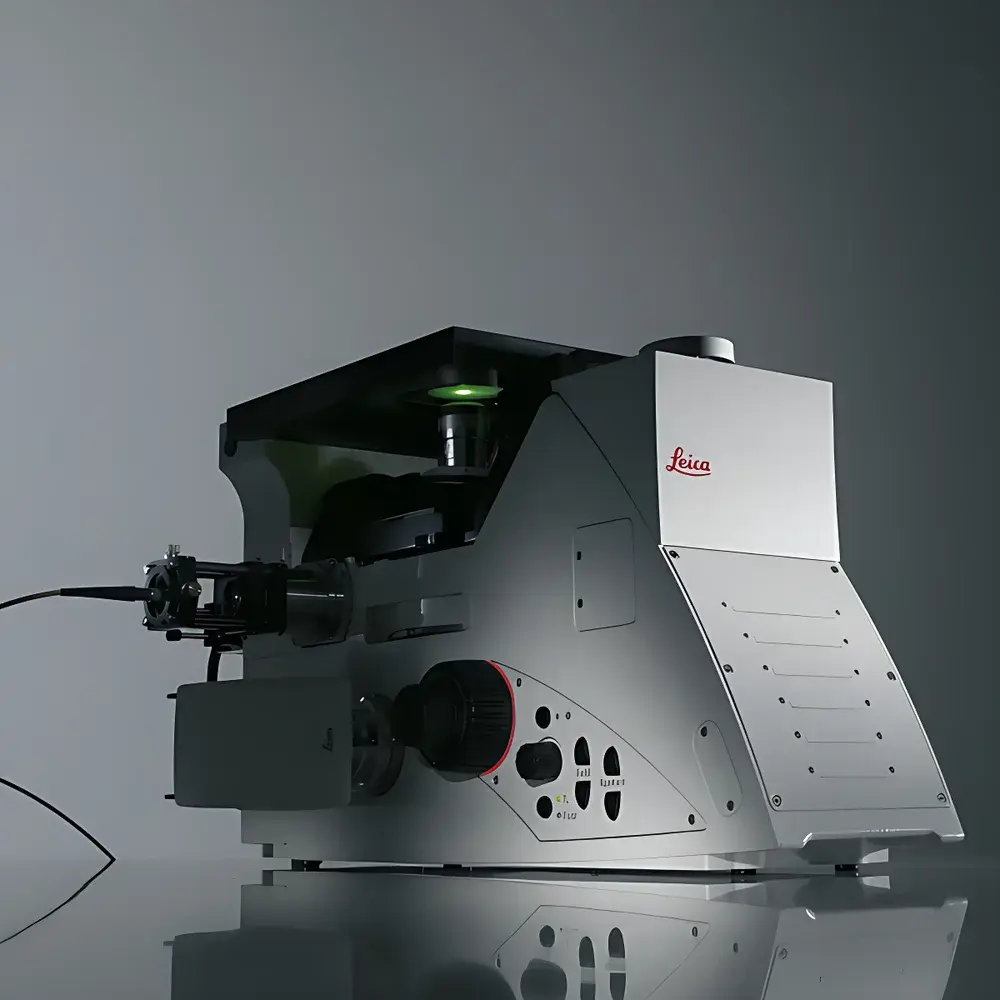
Leica DMi8 S High-Speed Live-Cell Imaging Platform
| Brand | Leica |
|---|---|
| Origin | Shanghai, China |
| Manufacturer Type | Authorized Distributor |
| Country of Assembly | China |
| Model | DMi8 S |
| Instrument Type | Inverted Fluorescence Microscope |
| Excitation Source | High-Power LED Illumination System |
| Classification | Research-Grade Fluorescence Microscope |
| Eyepiece Field of View | 5 mm |
| Imaging Sensor | Ultra-Low-Noise sCMOS Camera with Large Format Sensor (e.g., 6.5 µm pixel pitch, ≥2048 × 2048 resolution) |
| Fluorescence Pathway | Direct Access Modular Optical Path with Integrated Filter Turret & Beam Splitter Options |
| Optical Ports | Dual Infinity-Corrected Port Interfaces (for simultaneous multi-detector or multi-modality integration) |
| Focus Mechanism | Motorized Precision Z-Drive (≥1 nm step resolution, closed-loop feedback) |
| Observation Head | Binocular Ergonomic Viewing Head with Adjustable Interpupillary Distance |
| DIC Compatibility | Full Differential Interference Contrast (DIC) Module Support Across NA Range (0.3–1.4) |
| Stage | Motorized XY Stage with Sub-Micron Reproducibility (≥130 × 85 mm travel, 50 nm repeatability), Compatible with Multi-Well Plates, Petri Dishes & Slide Holders |
Overview
The Leica DMi8 S High-Speed Live-Cell Imaging Platform is a modular, research-grade inverted fluorescence microscope engineered for quantitative, time-resolved investigation of dynamic biological processes in living specimens. Built upon Leica’s proven DMi8 optical architecture, the S variant integrates high-speed hardware synchronization, advanced illumination control, and deterministic optical pathway design to support demanding widefield applications—including FRAP, photoactivation, optogenetics, single-molecule localization, and long-term multi-position time-lapse imaging. Its core measurement principle relies on high-fidelity widefield epifluorescence microscopy augmented by optional total internal reflection fluorescence (TIRF) via the Infinity TIRF module, enabling sub-diffraction membrane-proximal imaging with nanometer axial confinement. The platform conforms to ISO 9022-12 (optical instrument environmental testing) and supports GLP-compliant experimental documentation when used with LAS X software’s audit-trail-enabled workflows.
Key Features
- Motorized precision Z-drive with closed-loop feedback and ≤1 nm step resolution for stable focus maintenance during extended acquisitions
- Dual infinity-corrected optical ports enabling simultaneous dual-camera detection or integrated modality expansion (e.g., TIRF + widefield)
- Modular LED illumination system with programmable intensity control (0.1–100% in 0.1% increments), spectral stability <±0.5% over 8 hours, and TTL/Analog triggering compatibility
- Large-format sCMOS camera interface supporting ≥20 fps at full resolution (2048 × 2048) with read noise 82% at 550 nm
- Automated filter turret with ≥7-position capacity, motorized excitation/emission/dichroic selection, and <50 ms switching time
- Full DIC compatibility across objective NA range (0.3–1.4), including strain-free Nomarski prisms and bias retardation control
- Motorized XY stage with 130 × 85 mm travel range, 50 nm positional repeatability, and plate recognition via barcode or fiducial-based auto-alignment
Sample Compatibility & Compliance
The DMi8 S accommodates standard life science sample formats without mechanical adaptation: glass-bottom dishes (35 mm, 60 mm), multi-well plates (6–384-well), chambered coverslips, and custom microfluidic devices. Its stage design complies with ANSI/SCTE 127-2021 dimensional standards for automated plate handling. All optical components meet ISO 10110-7 surface quality specifications (scratch-dig 20-10), and LED light sources are certified per IEC 62471 for photobiological safety (Risk Group 1). When operated with LAS X Navigator and Synapse modules, the system supports FDA 21 CFR Part 11 compliance through electronic signatures, audit trails, and role-based access control—enabling use in regulated environments requiring GxP documentation.
Software & Data Management
LAS X software serves as the unified control and analysis environment, featuring three core modules: Navigator (for large-area mapping and multi-region acquisition planning), Synapse (for hardware-level synchronization of cameras, shutters, stages, and external devices via digital/analog I/O), and ARQ (for quantitative fluorescence intensity calibration and ratiometric analysis). Data output adheres to OME-TIFF format with embedded metadata (OME-XML schema v2020-06), ensuring compatibility with Fiji/ImageJ, Python-based analysis pipelines (e.g., Napari, DeepImageJ), and institutional LIMS systems. All acquisition parameters—including exposure time, gain, z-stack intervals, and stage coordinates—are stored in machine-readable JSON logs alongside raw image data.
Applications
- Long-term live-cell tracking of mitotic progression, organelle dynamics, or cell migration in 2D/3D culture models
- High-content screening (HCS) across multi-well plates using automated region-of-interest (ROI) definition and batch processing
- Quantitative FRAP, FLIP, and photoconversion assays with precise temporal control of laser/LED activation
- Membrane-proximal protein trafficking analysis via Infinity TIRF mode with <100 nm evanescent field depth
- Multi-modal correlation experiments combining widefield fluorescence, DIC contrast, and transmitted-light phase analysis
- Optogenetic stimulation synchronized with millisecond-resolution image capture using external TTL triggers
FAQ
Is the DMi8 S compatible with third-party cameras or detectors?
Yes—the platform provides standardized USB 3.2 Gen 2 and Camera Link HS interfaces, along with SDK documentation for custom driver integration.
Does the system support environmental chamber integration?
It includes dedicated mounting brackets and analog I/O channels for CO₂, temperature, and humidity controllers compliant with ASTM E1545-18 environmental monitoring standards.
Can LAS X generate compliant audit trails for regulatory submissions?
When configured with user authentication, electronic signatures, and change logging enabled, LAS X meets ALCOA+ data integrity principles and supports 21 CFR Part 11 validation protocols.
What is the maximum achievable frame rate in multi-position time-lapse mode?
With optimized sCMOS settings and LAS X Synapse hardware triggering, sustained acquisition rates exceed 15 fps across 100+ positions using 1024 × 1024 ROI binning.
How is optical alignment verified post-installation?
Leica provides factory-calibrated alignment certificates traceable to PTB (Physikalisch-Technische Bundesanstalt) standards, plus in-situ verification tools within LAS X for Köhler illumination and TIRF angle calibration.
Related Products




