
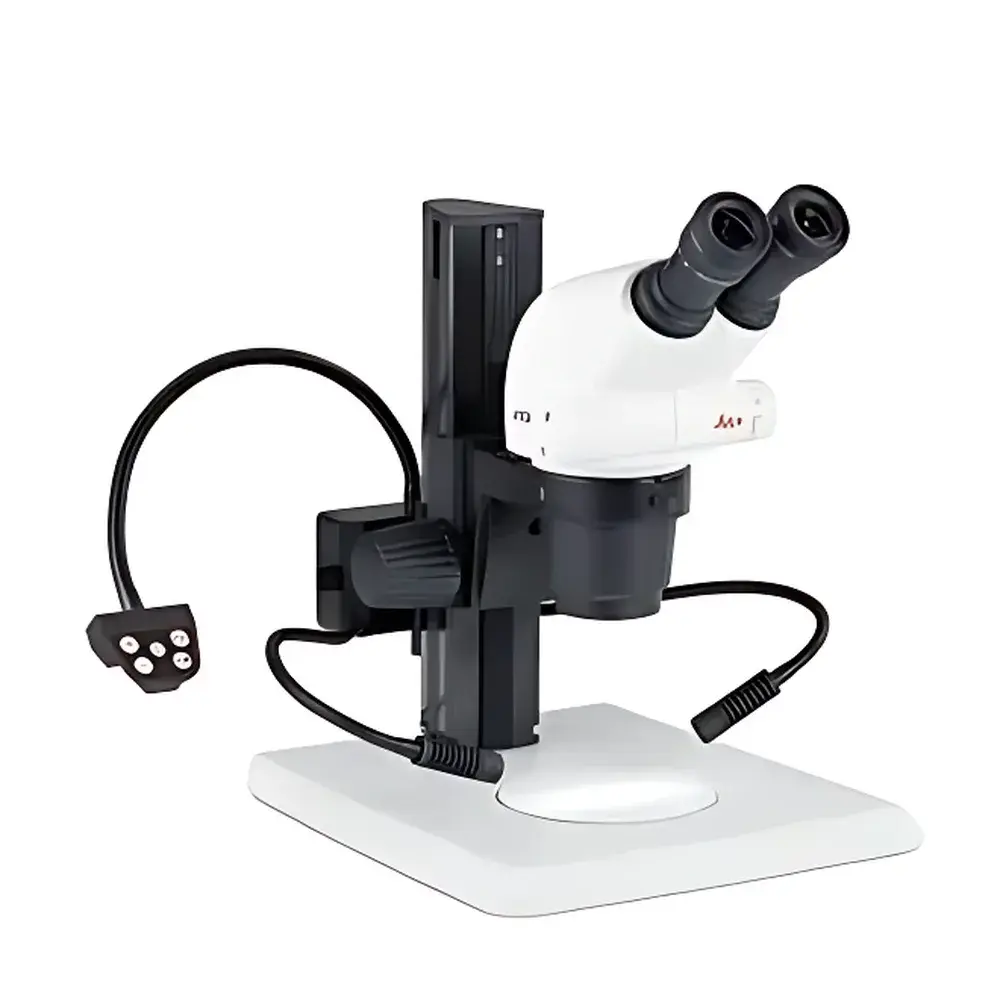
Leica LED3000 SLI Stereo Microscope Illuminator
| Brand | Leica |
|---|---|
| Origin | Germany |
| Model | LED3000 SLI |
| Light Source | Dual-integrated high-CRI white LEDs |
| Mounting | Dual flexible gooseneck arms with integrated controls |
| Illumination Modes | High-angle (diffuse, low-contrast) and oblique-angle (shadow-enhancing, high-contrast) |
| Compatibility | Leica M-series and Z-series stereo microscopes via Leica CAN bus interface |
| Diffuser | Removable frosted diffuser for glare reduction on reflective specimens |
| Control | Ergonomic single-unit tactile interface on gooseneck base |
| Connectivity | Leica CAN bus daisy-chain capable (supports cascading with LED3000 RL or NVI) |
| Certification | CE, RoHS, IEC 61000-6-3 |
Overview
The Leica LED3000 SLI is a purpose-engineered illuminator designed exclusively for stereo microscopy applications requiring dynamic, operator-controlled contrast modulation. Unlike conventional coaxial or ring-light solutions, the LED3000 SLI implements a dual-LED architecture mounted on independently adjustable gooseneck arms—each LED positioned at a fixed, calibrated angle to deliver reproducible illumination geometries. One LED is oriented at an oblique incidence (typically ~45°), generating directional shadows that accentuate surface topography, edge definition, and micro-textural features in opaque or semi-reflective specimens. The second LED operates at a near-vertical, high-angle configuration (~75–80°), delivering soft, diffuse illumination ideal for uniform brightness across low-relief or translucent samples. This dual-geometry approach enables real-time contrast optimization without mechanical repositioning of the microscope or specimen—critical for QC inspection, precision assembly, failure analysis, and biological dissection workflows where lighting-induced visual artifacts must be systematically controlled.
Key Features
- Dual-integrated high-color-rendering-index (CRI >90) white LEDs ensure accurate color fidelity and minimal metamerism during visual assessment and digital documentation.
- Ergonomically positioned tactile control unit mounted directly on the gooseneck base eliminates external power supplies, footswitches, or wall-mounted controllers—reducing cable clutter and improving benchtop spatial efficiency.
- Removable frosted diffuser lens attenuates specular reflections from polished metals, coated optics, PCBs, or injection-molded plastics—enabling consistent visual evaluation under standardized lighting conditions.
- Leica CAN bus interface allows seamless integration and synchronized dimming with other Leica illumination modules (e.g., LED3000 RL or NVI), supporting multi-source illumination strategies within a single control environment.
- Gooseneck arms feature nickel-plated brass construction with optimized torsional stiffness and memory retention—ensuring long-term positional stability after repeated adjustment cycles.
- No external power adapter required: integrated switching-mode power supply accepts 100–240 V AC, 50/60 Hz, compliant with IEC 61000-6-3 for electromagnetic compatibility in shared laboratory environments.
Sample Compatibility & Compliance
The LED3000 SLI is validated for use with Leica M80, M125, M165 C, M205 A/C, and Z6/Z16 stereo microscope platforms. Its illumination geometry supports ISO 10993-12-compliant visual inspection of medical device components, ASTM E2921-21 guidelines for optical characterization of surface defects, and USP recommendations for lighting uniformity in pharmaceutical packaging inspection. All electrical design complies with IEC 61010-1 (Safety Requirements for Electrical Equipment for Measurement, Control, and Laboratory Use) and carries CE marking per EU Directive 2014/30/EU (EMC) and 2011/65/EU (RoHS). Firmware supports audit-trail-capable operation when paired with Leica Application Suite (LAS X) under GLP/GMP-regulated environments.
Software & Data Management
While the LED3000 SLI operates as a standalone hardware module, its CAN bus interface enables bidirectional communication with Leica LAS X software (v3.7+). Users can log illumination parameters—including active LED channel, intensity level (0–100% in 1% increments), diffuser status, and timestamp—directly into acquisition metadata. When used in conjunction with Leica’s optional DFC9000 GT camera and automated stage systems, illumination state is automatically embedded in TIFF/OME-TIFF export files, ensuring full traceability for regulatory submissions. No proprietary drivers are required; native USB-CAN bridge support is included in standard Leica microscope control firmware.
Applications
- Electronics manufacturing: Inspection of solder joint integrity, PCB trace continuity, and conformal coating coverage under variable contrast modes.
- Medical device QA: Visual verification of laser-marked UDI codes, edge burr detection on stainless steel implants, and silicone gasket surface defect mapping.
- Materials science: Characterization of fracture surfaces, grain boundary delineation in cast alloys, and wear scar analysis on tribological test specimens.
- Entomology & botany: Dissection of delicate arthropod anatomy or leaf epidermal structures without heat-induced dehydration or photobleaching.
- Jewelry & watchmaking: Assessment of gemstone facet symmetry, engraving depth consistency, and plating uniformity on precious metal substrates.
FAQ
Can the LED3000 SLI be used with non-Leica stereo microscopes?
No—the CAN bus interface and mechanical mounting system are engineered specifically for Leica M- and Z-series platforms. Third-party adapters are not supported or certified.
Is intensity calibration traceable to NIST standards?
LED output intensity is factory-calibrated against photometric reference standards; however, absolute radiometric calibration (e.g., W/sr/m²) requires optional Leica-certified service calibration performed annually per ISO/IEC 17025-accredited procedures.
Does the diffuser affect color temperature?
Yes—the frosted diffuser reduces correlated color temperature by approximately 200 K (from 5700 K to ~5500 K) while maintaining CRI >88; this shift is documented in the instrument’s calibration certificate.
What is the expected LED lifetime under continuous operation?
Rated L70 lifetime exceeds 50,000 hours at 25°C ambient temperature, defined as the point at which luminous flux drops to 70% of initial output—per IES LM-80 testing protocol.
Can illumination settings be saved as presets within LAS X?
Yes—up to 16 user-defined illumination profiles (including LED channel selection, intensity, and diffuser state) can be stored and recalled via LAS X workflow templates, supporting SOP-driven microscopy operations.




