
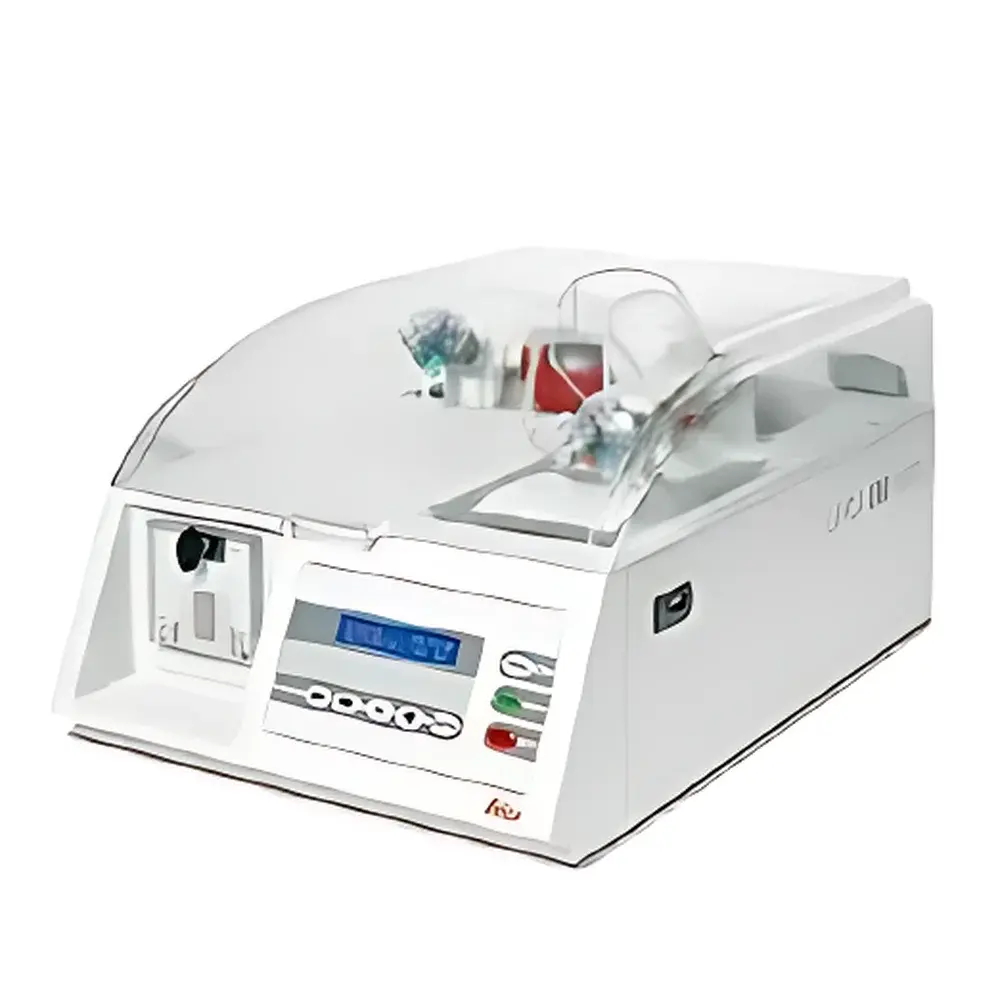
Leica EM AC20 Automatic Grid Stainer for Transmission Electron Microscopy
| Brand | Leica |
|---|---|
| Origin | Austria |
| Model | EM AC20 |
| Capacity | 20 grids per cycle |
| Reagent Consumption | ~6 mL per cycle (uranyl acetate + lead citrate) |
| Predefined Programs | 10 staining + 2 cleaning protocols |
| Temperature Control Range | 20–60 °C |
Overview
The Leica EM AC20 is a fully automated grid stainer engineered specifically for transmission electron microscopy (TEM) sample preparation. It implements standardized heavy-metal contrast enhancement—primarily via uranyl acetate and lead citrate double-staining—to increase electron scattering differentials in low-atomic-number biological specimens (e.g., proteins, membranes, nucleic acids). Unlike manual staining—a labor-intensive, operator-dependent process prone to variability in stain deposition, wash efficiency, and drying artifacts—the EM AC20 delivers reproducible, contamination-controlled staining through precisely timed fluid delivery, temperature-regulated incubation, and programmable immersion sequences. Its sealed chamber architecture eliminates ambient aerosol exposure, ensuring both operator safety and consistent reagent activity across cycles. Designed for integration into high-throughput TEM core facilities and structural biology labs, the EM AC20 conforms to routine workflow demands while maintaining strict alignment with GLP-compliant documentation practices.
Key Features
- Automated dual-stain processing: Sequential, programmable application of uranyl acetate and lead citrate with adjustable dwell times, rinse intervals, and blotting steps.
- 20-grid batch capacity per run: Optimized for standard 3.05 mm TEM copper or nickel grids; compatible with formvar-, carbon-, or continuous carbon-coated supports.
- Precise thermal control (20–60 °C): Enables temperature-sensitive protocols—for example, reduced lead citrate precipitation at lower temperatures or accelerated uranium binding kinetics at elevated setpoints.
- Low-reagent consumption design (~6 mL total per cycle): Minimizes cost-per-sample and reduces hazardous waste volume without compromising stain uniformity or penetration depth.
- Modular program architecture: 10 user-definable staining protocols and 2 dedicated cleaning routines support method development, validation, and cross-lab standardization.
- Physically segregated waste handling: Separate collection paths for uranium-containing and lead-containing effluents comply with institutional chemical hygiene plans and local hazardous waste disposal regulations.
Sample Compatibility & Compliance
The EM AC20 accommodates standard TEM grids used in cryo-EM, negative stain, and resin-embedded ultrastructural studies. It supports both aqueous and ethanol-based staining media and tolerates common grid surface modifications (e.g., glow-discharged, plasma-cleaned, or hydrophilized substrates). All fluid pathways are chemically resistant to acidic uranyl acetate solutions (pH ~4.5) and alkaline lead citrate buffers (pH ~12). The instrument meets CE marking requirements for laboratory equipment (2014/30/EU EMC Directive and 2014/35/EU LVD Directive) and incorporates engineering controls aligned with ISO 15190:2020 (laboratory safety) and ANSI Z9.5–2022 (ventilation for laboratories handling hazardous chemicals). While not FDA-cleared, its operational consistency supports compliance with ISO/IEC 17025:2017 (testing and calibration laboratories) when validated per internal SOPs.
Software & Data Management
Operation is managed via an intuitive, touch-enabled interface with real-time status monitoring—including reagent levels, temperature stability, cycle progress, and error diagnostics. Each run logs timestamped metadata (protocol ID, start/end time, temperature profile, fluid dispense volumes) to internal non-volatile memory. Export options include CSV-formatted audit trails suitable for integration into LIMS or electronic lab notebooks (ELN). Though the EM AC20 does not implement 21 CFR Part 11-compliant electronic signatures natively, its deterministic execution and immutable run logs provide foundational traceability required for GMP-aligned TEM sample preparation workflows. Firmware updates are delivered via USB and include version-controlled change logs.
Applications
- Routine negative stain screening of purified macromolecular complexes prior to cryo-EM data collection.
- Standardized contrast enhancement for diagnostic ultrastructural pathology (e.g., viral morphology, organelle integrity assessment).
- Method development for novel staining chemistries requiring precise temporal control (e.g., sequential metal chelator treatments).
- Training platform for new EM users: Eliminates inter-operator variability during technique acquisition.
- High-volume service labs supporting structural biology consortia where protocol harmonization across sites is essential.
FAQ
Does the EM AC20 support cryo-EM grid preparation?
No—it is designed exclusively for room-temperature or warmed aqueous/organic staining protocols and is not compatible with vitrification or plunge-freezing workflows.
Can custom staining reagents be used beyond uranyl acetate and lead citrate?
Yes, provided they are chemically compatible with stainless steel, PTFE, and fluorosilicone wetted materials; users must validate viscosity, volatility, and corrosion behavior prior to deployment.
Is remote monitoring or network connectivity available?
The EM AC20 operates as a standalone unit with no Ethernet/Wi-Fi interface; however, exported CSV logs enable offline analysis and centralized reporting.
What maintenance is required for long-term reliability?
Quarterly cleaning of fluid manifolds and waste traps is recommended; annual calibration of temperature sensors and dispensing pumps ensures continued metrological traceability.
How is operator safety ensured during uranium handling?
The enclosed chamber prevents aerosol generation; integrated HEPA-filtered exhaust (optional accessory) further mitigates airborne particulate risk in accordance with ICRP Publication 130 guidelines.





