
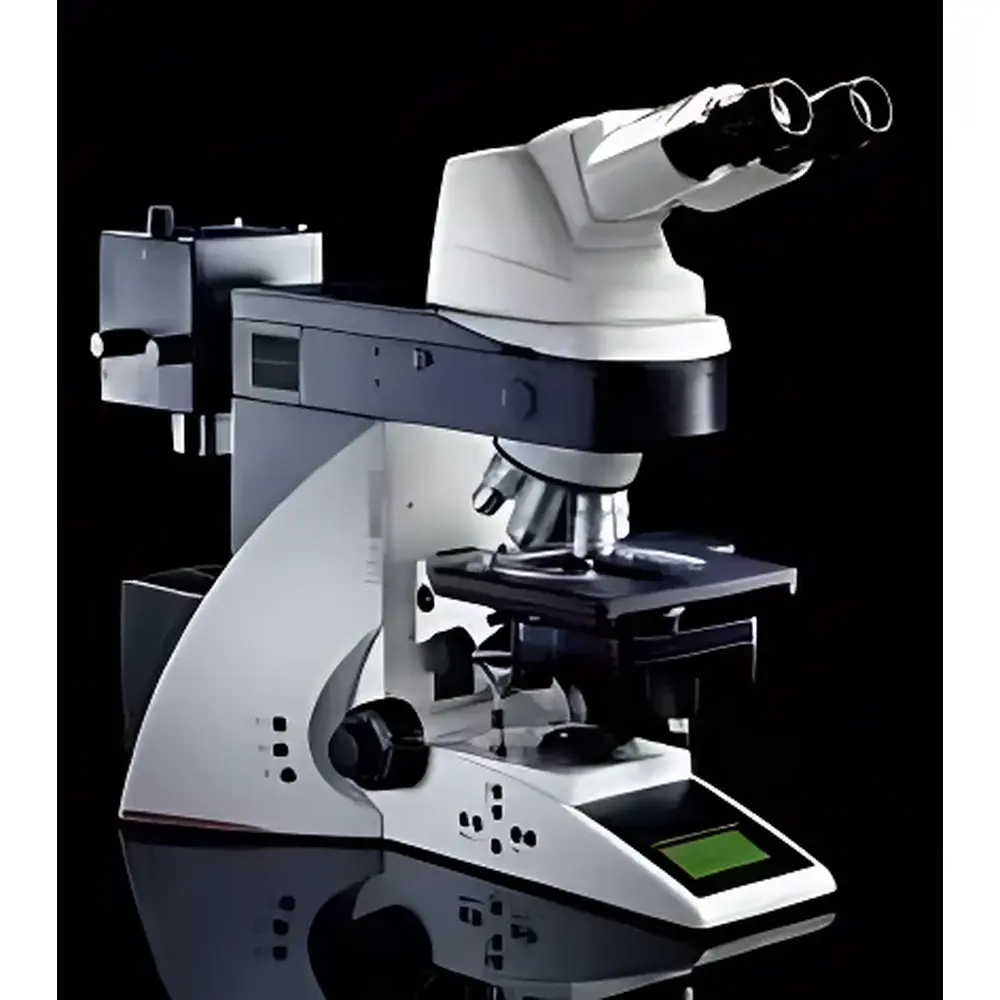
Leica DM 4000M Intelligent Semi-Automatic Upright Metallurgical Microscope
| Brand | Leica |
|---|---|
| Origin | Germany |
| Model | DM 4000M |
| Illumination | 12 V / 100 W Transmitted & Reflected Light Source |
| Optical Path | Achromatic-Corrected, 25 mm Field of View |
| Objective Turret | 6-Position, Accepts 32 mm Industrial Objectives |
| Observation Modes | Brightfield, Darkfield, Polarized Light, Differential Interference Contrast (DIC) |
| Automation Features | Motorized Illumination Intensity, Aperture Diaphragm, Condenser Positioning, and Observation Mode Recall |
| Integrated LCD Display | Real-time Status Monitoring of Microscope Components |
| Software Integration | Digital Image Capture, Calibration-Scale Annotation per Objective Magnification, Measurement & Analysis Compatibility |
| Optional Accessories | Fluorescence Module, High-Temperature Stage, Cathodoluminescence Detector, Photometer, Large-Format Stages (4×4 mm, 6×6 mm), Motorized XY Scanning Stage for Automated Inclusion & Particle Analysis |
Overview
The Leica DM 4000M is a research-grade, semi-automatic upright metallurgical microscope engineered for high-precision microstructural characterization of opaque and reflective specimens. Designed specifically for metallurgy, materials science, and advanced manufacturing QA/QC laboratories, it employs an optimized Köhler illumination path with integrated motorized control over critical optical parameters. Its modular architecture supports both reflected-light observation (standard for metals, ceramics, and composites) and optional transmitted-light configurations—enabling dual-mode analysis of semi-transparent or layered samples such as thin-film coatings or sintered ceramics. The system’s core optical design features a fully corrected achromatic light path compatible with a 25 mm field number, ensuring edge-to-edge image fidelity and chromatic aberration suppression across the full magnification range. Unlike conventional manual microscopes, the DM 4000M implements hardware-level automation for illumination intensity, aperture diaphragm position, condenser height, and observation mode selection—each parameter being stored and recalled in association with specific objective lenses and contrast methods.
Key Features
- Motorized 6-position objective turret accepting industry-standard 32 mm diameter metallurgical objectives, supporting magnifications from 5× to 100× with oil-immersion capability
- Integrated 12 V / 100 W halogen illumination system with color-temperature stabilization, minimizing thermal drift and spectral shift during extended imaging sessions
- Intelligent illumination management: automatic adjustment of light intensity, field and aperture diaphragms, and condenser alignment based on selected objective and contrast mode
- Embedded LCD status display showing real-time operational states—including objective position, illumination mode, lamp hours, and motorized component positions
- Dual-control interface: physical keypad operation alongside full RS-232/USB-based computer integration for remote parameter control and script-driven acquisition workflows
- Automated scale bar annotation: digital images are tagged with calibrated magnification markers corresponding to the active objective and camera pixel binning configuration
Sample Compatibility & Compliance
The DM 4000M accommodates a broad spectrum of industrial and academic sample types—including polished metallographic mounts, fracture surfaces, powder compacts, electronic solder joints, and semiconductor wafers. Its large-stage options (4×4 mm and 6×6 mm) support wafer-scale inspection and failure analysis of integrated circuits. Optional accessories extend analytical scope: a high-temperature stage enables in situ thermal microstructural evolution studies up to 1200 °C; a cathodoluminescence detector facilitates defect mapping in wide-bandgap semiconductors; and fluorescence modules permit surface contamination or coating uniformity assessment via tracer dyes. The instrument complies with ISO 9001 quality management requirements for calibration traceability and supports GLP/GMP documentation workflows through audit-trail-enabled software interfaces. All motorized functions meet IEC 61000-6-2 electromagnetic compatibility standards.
Software & Data Management
Leica Application Suite (LAS) X software provides native integration for image capture, measurement (grain size per ASTM E112, inclusion rating per ASTM E45, cleanliness per ISO 16232), and quantitative phase analysis. Raw image data is saved in TIFF or Leica’s proprietary LIF format with embedded metadata—including objective ID, illumination settings, exposure time, and spatial calibration. The system supports FDA 21 CFR Part 11–compliant user access control, electronic signatures, and immutable audit trails when deployed in regulated environments. Export formats include CSV for statistical process control (SPC) integration and XML for LIMS interoperability. Third-party software compatibility includes MATLAB® image processing toolboxes and Python-based OpenCV pipelines via standardized TWAIN and DirectShow drivers.
Applications
- Quantitative metallography: grain size distribution, phase fraction analysis, and second-phase particle characterization in steels, aluminum alloys, and titanium grades
- Failure analysis: crack propagation path mapping, void nucleation assessment, and interfacial delamination evaluation in solder joints and thermal barrier coatings
- Quality assurance in additive manufacturing: porosity quantification, melt pool morphology, and unmelted particle detection in Ti-6Al-4V and Inconel 718 builds
- Ceramic and composite microstructure evaluation: pore network topology, fiber-matrix interfacial integrity, and thermal cycling-induced microcracking
- Electronics reliability testing: wire bond integrity, die attach voiding, and electromigration-induced hillock formation in Cu/Al interconnects
FAQ
Does the DM 4000M support automated multi-field-of-view stitching for large-area analysis?
Yes—when paired with the optional motorized XY scanning stage and LAS X software, the system performs programmable tile-based acquisition with sub-pixel image registration and seamless mosaic reconstruction.
Can the microscope be integrated into an automated production line environment?
It supports industrial Ethernet (PROFINET) and Modbus TCP protocols via optional I/O modules, enabling synchronization with PLC-controlled sample handling and inline metrology systems.
Is the illumination system compliant with photometric stability requirements for ISO/IEC 17025 accredited labs?
Yes—the stabilized 12 V / 100 W halogen source maintains ±1.5% intensity repeatability over 10,000 hours and includes built-in lamp-hour tracking and predictive maintenance alerts.
What level of software validation support is provided for regulated industries?
Leica offers IQ/OQ documentation packages, installation qualification templates, and 21 CFR Part 11 configuration guides for validated deployment in pharmaceutical, aerospace, and medical device manufacturing settings.




