
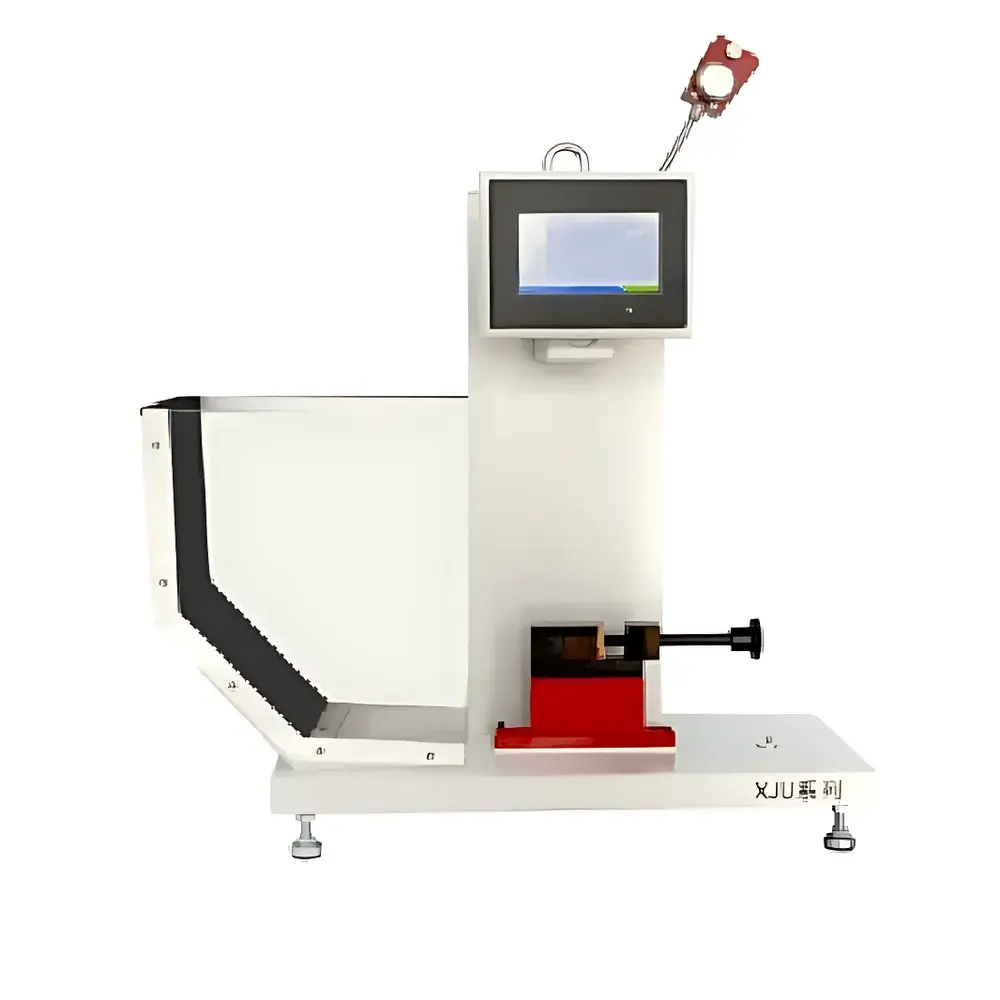
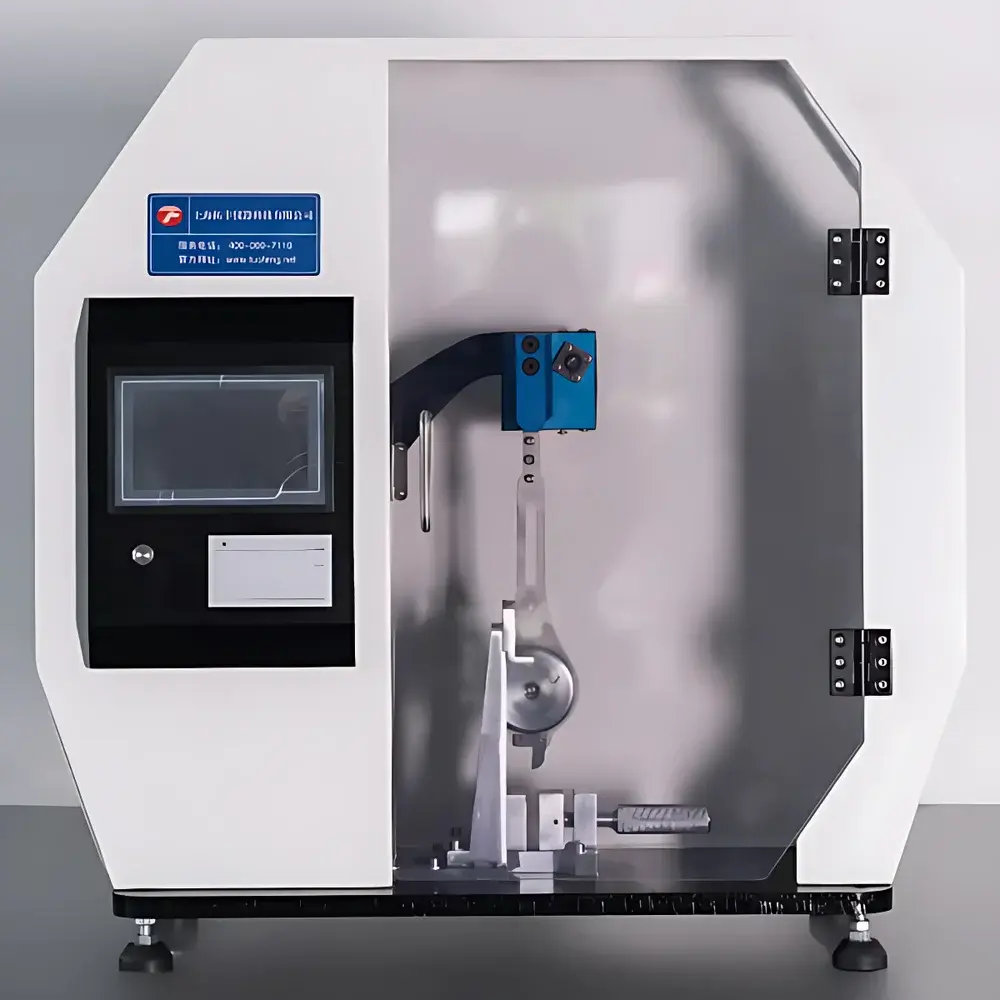
Tuofeng XJUD-5.5 Digital Display Cantilever Beam Impact Tester
| Brand | Tuofeng |
|---|---|
| Origin | Shanghai, China |
| Manufacturer Type | Direct Manufacturer |
| Instrument Type | Pendulum Impact Tester |
| Impact Energies | 1 J, 2.75 J, 5.5 J |
| Impact Velocity | 3.5 m/s |
| Pendulum Torques (Impact Constants) | Pd₁ = 0.53590 N·m, Pd₂.₇₅ = 1.47372 N·m, Pd₅.₅ = 2.94744 N·m |
| Anvil-to-Striking-Edge Distance | 22 ± 0.2 mm |
| Maximum Pendulum Lift Height | 150° |
| Striking Edge Radius | R = 0.8 ± 0.2 mm |
| Notch Types | Type A (45° ± 1°, root radius R = 0.25 ± 0.05 mm), Type B (45° ± 1°, root radius R = 1.0 ± 0.05 mm) |
| Test Temperature Range | 15–35 °C |
| Power Supply | AC 220 V, 50 Hz |
| Display Resolution | 0.001 J |
| Energy Loss (Empty Swing) | ≤2% at 1 J |
| Compliance | ISO 180, ASTM D256, GB/T 1843, GB/T 2611, JB/T 8761 |
Overview
The Tuofeng XJUD-5.5 Digital Display Cantilever Beam Impact Tester is a precision-engineered pendulum-type impact testing system designed for the quantitative determination of notched impact strength in rigid and semi-crystalline non-metallic materials. It operates on the fundamental principle of cantilever beam impact testing per ISO 180 and ASTM D256: a calibrated pendulum strikes a vertically clamped, notched specimen supported at one end, and the energy absorbed during fracture is calculated from the difference between initial potential energy and residual swing height. Unlike conventional analog impact testers, the XJUD-5.5 integrates microprocessor-based real-time compensation for mechanical friction and air resistance—eliminating reliance on empirical correction charts and enabling direct, traceable energy measurement with high reproducibility across its three selectable impact energy ranges (1 J, 2.75 J, 5.5 J).
Key Features
- Microprocessor-controlled digital compensation system that automatically corrects for energy loss due to bearing friction and aerodynamic drag during each test cycle—ensuring compliance with ISO 180 Annex B and ASTM D256 Section 8.3 requirements for energy loss verification.
- High-resolution LCD display with 0.001 J resolution and automatic angle recognition, enabling precise energy readout without manual interpolation or calibration lookup tables.
- Dual-notch compatibility (Type A and Type B per ISO 180/ASTM D256), supporting standardized specimen geometries for comparative evaluation of brittle-to-ductile transition behavior in thermoplastics, composites, and engineering polymers.
- Triple-range pendulum configuration with certified impact constants (Pd₁ = 0.53590 N·m, Pd₂.₇₅ = 1.47372 N·m, Pd₅.₅ = 2.94744 N·m), each independently validated for energy accuracy within ±1% uncertainty at rated capacity.
- Rigid cast-iron frame and precision-machined anvil assembly ensure minimal vibration transmission and long-term dimensional stability—critical for repeatable notch-tip stress concentration and consistent fracture initiation.
- Compliant striking edge geometry: 75° included angle, R = 0.8 ± 0.2 mm tip radius, and fixed anvil-to-edge distance of 22 ± 0.2 mm—fully aligned with dimensional tolerances specified in GB/T 1843 and ASTM D256.
Sample Compatibility & Compliance
The XJUD-5.5 is optimized for standardized specimens conforming to ISO 180 and ASTM D256 dimensions: nominal sizes include 80 × 10 × 4 mm, 63.5 × 12.7 × 12.7 mm, and 63.5 × 12.7 × 3.2 mm, with optional configurations up to 63.5 × 12.7 × 6.4 mm. It accommodates both Type A (sharper, R = 0.25 mm) and Type B (blunter, R = 1.0 mm) notches to differentiate sensitivity to crack propagation in materials such as ABS, PC, PA66-GF, GFRP, ceramic matrix composites, and insulating laminates. All mechanical and metrological parameters—including pendulum lift angle (150°), impact velocity (3.5 m/s), and empty-swing energy loss (≤2% at 1 J; ≤1% at higher ranges)—are verified against ISO 180:2019 Clause 6, ASTM D256–22 Section 7, and Chinese national standards GB/T 1843–2008 and JB/T 8761–1998. The instrument meets environmental operating requirements (15–35 °C, <80% RH) and supports GLP-compliant test documentation when integrated with external lab data management systems.
Software & Data Management
While the XJUD-5.5 operates as a standalone benchtop instrument with embedded firmware, its digital output interface (RS-232 or optional USB) enables seamless integration with laboratory information management systems (LIMS) or custom QA/QC software platforms. Raw impact energy values, test timestamps, pendulum angle data, and operator ID (via optional keypad input) are exportable in CSV format. When deployed in regulated environments—including ISO/IEC 17025-accredited testing labs or pharmaceutical packaging validation workflows—the instrument supports audit-ready data traceability. Though not natively 21 CFR Part 11 compliant, its deterministic measurement logic, tamper-evident energy calculation algorithm, and non-volatile memory storage of last 100 test results facilitate alignment with FDA expectations for electronic records integrity under GLP and GMP frameworks.
Applications
- Quality control of injection-molded plastic components in automotive and electronics manufacturing.
- Evaluation of notch sensitivity in fiber-reinforced thermosets (e.g., epoxy-glass laminates) per ASTM D7264.
- Comparative impact performance assessment of biodegradable polymers (PLA, PHA) under varying humidity and thermal conditioning.
- Research-grade fracture mechanics studies on ceramic matrix composites and polymer-derived ceramics.
- Validation of material substitutions in medical device housings requiring compliance with ISO 10993-1 biocompatibility screening protocols.
- Teaching laboratories for polymer physics courses covering yield criteria, craze formation, and energy dissipation mechanisms in glassy polymers.
FAQ
What standards does the XJUD-5.5 fully comply with?
It meets the mechanical, dimensional, and procedural requirements of ISO 180:2019, ASTM D256–22, GB/T 1843–2008, GB/T 2611–2007, and JB/T 8761–1998—including certified impact constants, energy loss limits, and notch geometry tolerances.
Can the instrument measure unnotched specimens?
No—the XJUD-5.5 is specifically configured for notched cantilever beam impact testing per ISO 180 and ASTM D256. Unnotched impact testing requires a different fixture design and is outside its certified scope.
Is calibration certification included with delivery?
Yes—each unit ships with a factory calibration certificate traceable to CNAS-accredited reference standards, documenting verification of pendulum torque, angle encoder linearity, and energy loss performance at all three impact levels.
What maintenance is required to sustain measurement accuracy?
Biannual verification of pendulum pivot bearing friction, periodic cleaning of the striking edge and anvil surfaces with isopropyl alcohol, and annual recalibration of the angular displacement sensor using optical encoder alignment tools are recommended per GB/T 2611–2007 Section 9.2.



