
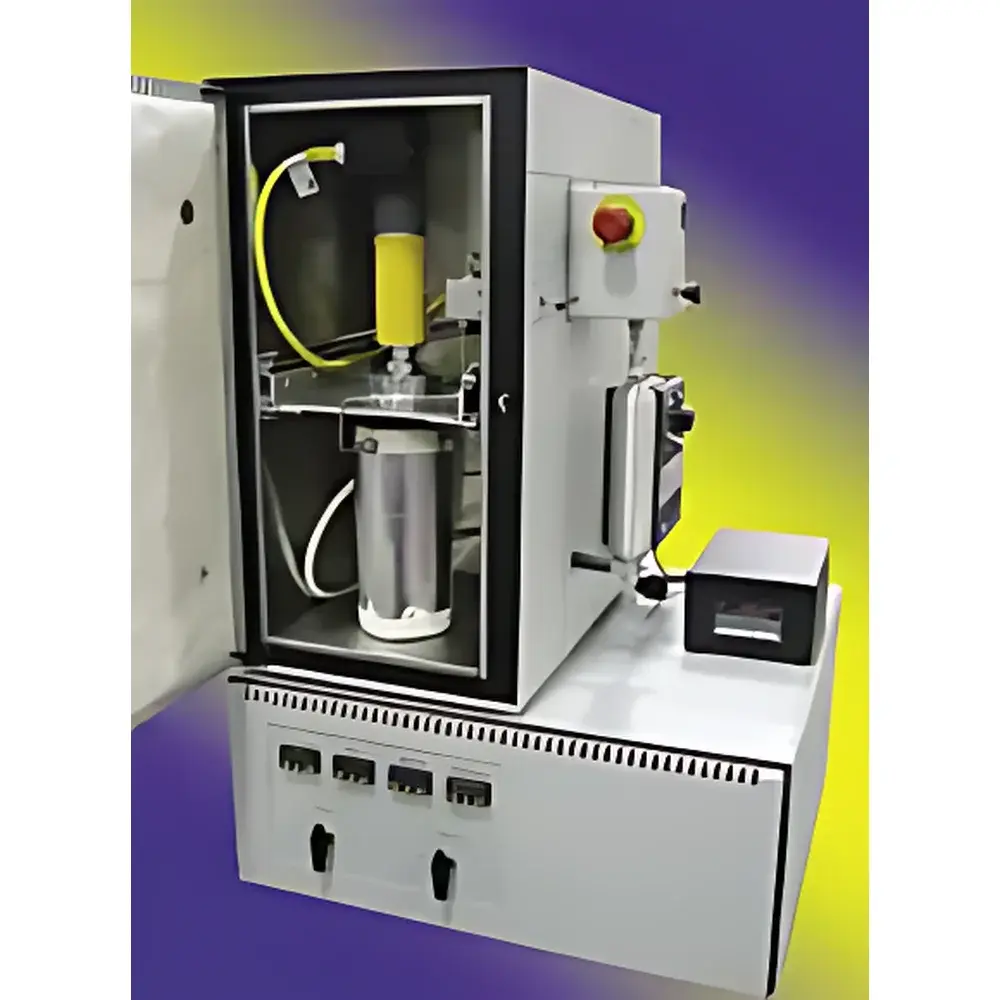
SFT SFT-250 Supercritical Fluid Extraction and Reaction System
| Brand | SFT |
|---|---|
| Origin | USA |
| Model | SFT-250 |
| Max Operating Pressure | 10,000 PSI (68.9 MPa) |
| Max Temperature | 200 °C |
| Extraction Vessel Capacity | Up to 4 L |
| Flow Rate Range | 1–330 mL/min (1–310 g/min) |
| CO₂ & Co-solvent Flow Capability | Enhanced |
| Control Architecture | 4-channel analog PID loop control |
| Heating Power | 4 kW total |
| Safety | Rupture disc for liquid CO₂ overpressure protection |
| Heating Method | Band heaters on all vessels |
| Restriction Valve Heating | Up to 250 °C |
| External Heated Collection Tube | Stainless steel |
| Dimensions (L×W×H) | 92 × 61 × 76 cm |
| Weight (excl. vessels) | 64 kg |
| Electrical Requirement | Universal input |
| Drive Air Supply | ~80 psi (regulated, flow-dependent) |
Overview
The SFT SFT-250 Supercritical Fluid Extraction and Reaction System is a modular, bench-scale platform engineered for precise, reproducible supercritical fluid processing under rigorously controlled thermodynamic conditions. Built upon the principles of supercritical fluid thermodynamics—leveraging carbon dioxide (CO₂) above its critical point (31.1 °C, 1,070 PSI)—the system enables tunable solvent strength via pressure and temperature modulation. Its design supports both extraction and in-situ chemical reaction workflows, making it suitable for method development, analytical sample preparation, natural product isolation, polymer impregnation, and catalyst testing. Unlike batch-only extractors, the SFT-250 integrates continuous-flow capability with programmable process sequencing, allowing users to define multi-step pressure ramps, temperature gradients, co-solvent addition profiles, and timed fraction collection—all while maintaining traceable, auditable parameter logging. The system operates within a validated pressure envelope up to 10,000 PSI (68.9 MPa) and temperature range from ambient to 200 °C, accommodating high-boiling analytes and thermally sensitive matrices without thermal degradation.
Key Features
- Robust stainless-steel construction with integrated band-heater arrays delivering uniform thermal distribution across all process vessels.
- Four independent analog PID controllers managing real-time regulation of temperature (±1 °C accuracy) and pressure—ensuring stability during dynamic process transitions.
- High-flow-capacity fluid delivery: CO₂ and co-solvent mass flow rates adjustable from 1 to 330 mL/min (1–310 g/min), optimized for scalability from lab screening to pilot-scale feasibility studies.
- Modular vessel architecture supporting user-swappable extraction/reactor vessels up to 4 L volume; optional windowed vessels enable visual monitoring of phase behavior and precipitation kinetics.
- Heated restriction valve (up to 250 °C) prevents CO₂ condensation and ensures stable back-pressure control during low-temperature, high-pressure operation.
- Externally mounted, electrically heated stainless-steel collection tube with independent temperature control for volatile or thermolabile compound recovery.
- Cabinet-style mechanical layout (92 × 61 × 76 cm) with centralized utility routing, minimizing footprint while maximizing service accessibility and operator safety.
Sample Compatibility & Compliance
The SFT-250 accommodates heterogeneous solid matrices—including botanicals, algae, microbial biomass, spent coffee grounds, and polymer composites—as well as liquid-phase substrates for reactive extraction (e.g., transesterification, oxidation). Its pressure-rated vessels meet ASME B31.3 process piping standards, and rupture disc safety systems comply with ISO 4126-2 for overpressure protection. All wetted surfaces are electropolished 316 stainless steel, ensuring compatibility with acidic co-solvents (e.g., ethanol, methanol, water) and eliminating metal leaching in pharmaceutical or nutraceutical applications. The system supports GLP/GMP-aligned workflows through optional data acquisition modules that record timestamped pressure, temperature, flow, and valve position data—fully traceable and exportable for regulatory submissions per FDA 21 CFR Part 11 requirements when paired with compliant software.
Software & Data Management
While the base configuration features LED-based local display of real-time operational parameters (pressure, temperature, flow, setpoints), optional PC-integrated control software provides advanced functionality: automated method scripting, multi-variable trending, alarm event logging, and CSV/Excel-compatible data export. The interface supports user-defined SOP templates, electronic signatures, and audit trail generation—including operator ID, parameter changes, and system state transitions. All digital records adhere to ALCOA+ principles (Attributable, Legible, Contemporaneous, Original, Accurate, Complete, Consistent, Enduring, Available) for quality assurance documentation in regulated environments.
Applications
- Isolation of thermolabile phytochemicals (e.g., cannabinoids, terpenes, polyphenols) from plant biomass with minimal oxidative degradation.
- Deproteinization and lipid removal from biological extracts prior to LC-MS analysis.
- In-situ enzymatic or acid-catalyzed reactions (e.g., esterification, hydrolysis) under supercritical CO₂ media.
- Microencapsulation of active pharmaceutical ingredients (APIs) using rapid expansion of supercritical solutions (RESS) or particles from gas-saturated solutions (PGSS).
- Recycling of critical metals from e-waste leachates using selective supercritical CO₂–chelant systems.
- Development of green chemistry protocols compliant with ACS GCI Principles and ISO 14040 lifecycle assessment frameworks.
FAQ
What is the maximum allowable operating pressure and how is overpressure protection implemented?
The system is rated for continuous operation up to 10,000 PSI (68.9 MPa); liquid CO₂ overpressure protection is provided by ASME-certified rupture discs installed upstream of the main control valve.
Can the SFT-250 be used for reactive supercritical processing—not just extraction?
Yes. The system supports in-vessel reactions via heated reactor vessels, co-solvent injection modules, and programmable pressure/temperature profiles required for kinetic studies and catalytic transformations.
Is the system compatible with non-CO₂ supercritical fluids such as ethane or nitrous oxide?
While optimized for CO₂, the hardware architecture permits adaptation to other supercritical solvents with appropriate material compatibility verification, pressure rating validation, and safety interlock recalibration.
Does the system support 21 CFR Part 11-compliant electronic records?
When configured with the optional data acquisition and control software package—including user authentication, electronic signatures, and immutable audit trails—the system meets core technical requirements for Part 11 compliance.
What utilities are required for installation?
Standard 120/240 VAC universal input power (4 kW total), compressed dry air (~80 psi) for pneumatic valve actuation, and commercially available liquid CO₂ supply with dip-tube-equipped cylinder.
Related Products



