
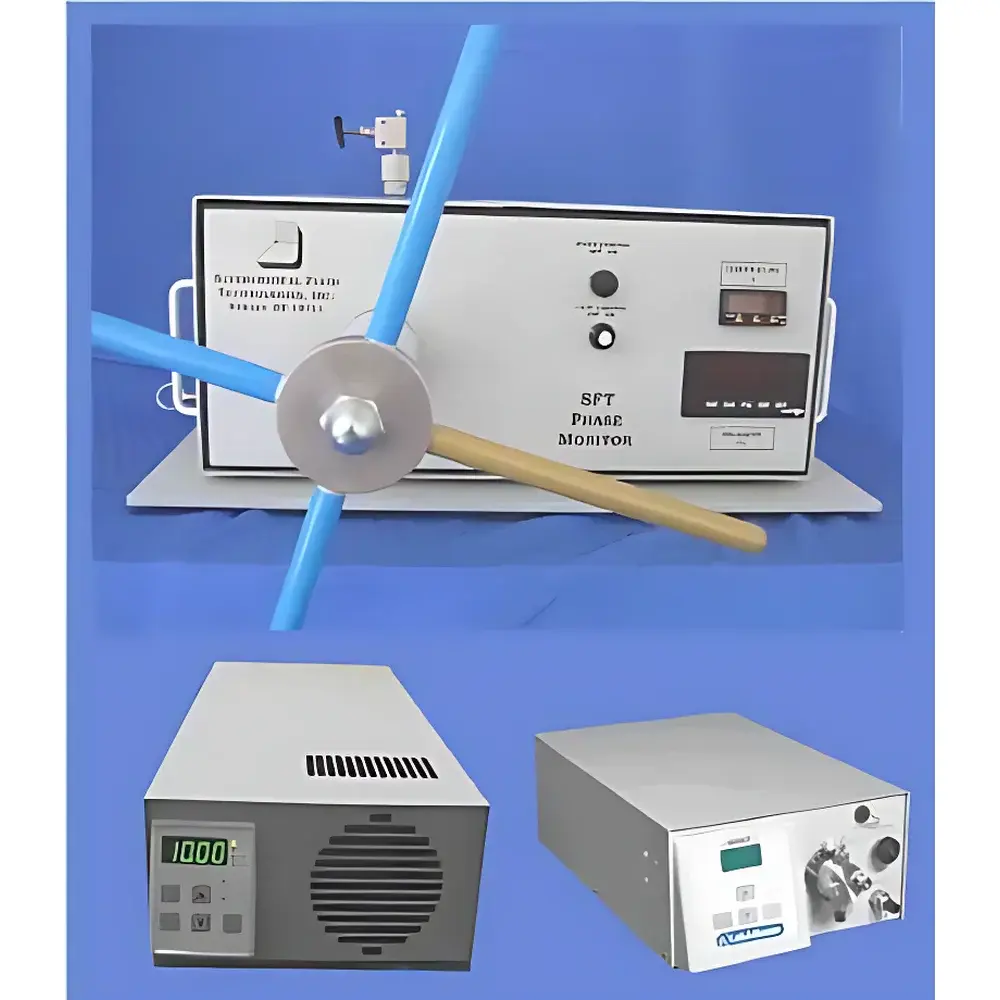
SFT PM-II Supercritical Fluid Extraction System with In-Situ Phase Detection
| Brand | SFT |
|---|---|
| Origin | USA |
| Model | PM-II with Phase Detection Capability |
| Max Temperature | 150 °C |
| Max Pressure | 10,000 psi (680 bar) |
| Extraction Vessel Volume | 30 mL |
| Flow Rate Range | 0–24.00 mL/min |
| Solvent Delivery | CO₂ + Co-solvent (e.g., methanol) |
| Vessel Construction | 316 Stainless Steel with 3/8″ Quartz Window |
| Pressure Accuracy | ±2 psi |
| Temperature Accuracy | ±0.5 °C |
| Video Monitoring | Color CCD Camera with NTSC Output |
| Power | 220 VAC, Single Phase |
| Dimensions (W×D×H) | 450×450×200 mm |
| Weight | 18.2 kg |
Overview
The SFT PM-II Supercritical Fluid Extraction System with In-Situ Phase Detection is an engineered platform for quantitative thermodynamic and kinetic investigation of supercritical fluid (SCF) processes. It operates on the principle of controlled phase behavior modulation—leveraging carbon dioxide (CO₂) as the primary supercritical solvent, tunable via precise independent regulation of pressure (up to 10,000 psi / 680 bar) and temperature (ambient to 150 °C). The system integrates real-time visual observation through a sapphire-reinforced quartz viewport and synchronized video documentation, enabling direct correlation between process parameters and phase transitions—including vapor–liquid, liquid–liquid, and solid–fluid equilibria. Designed for laboratory-scale process development, it supports fundamental studies in solubility modeling, co-solvent-assisted extraction efficiency, and reaction kinetics under supercritical conditions—applications critical to pharmaceutical purification, natural product isolation, polymer processing, and green chemistry R&D.
Key Features
- 30 mL high-pressure extraction vessel constructed from ASTM A240 316 stainless steel, rated to 10,000 psi with a certified burst disk at 11,500 psi
- Optically transparent 3/8″ diameter fused quartz viewport enabling direct visualization of phase boundaries, meniscus dynamics, and precipitate formation during extraction or depressurization
- Dual-pump architecture: SFT-10 CO₂ pump (0–24.00 mL/min, ±2% full-scale pressure accuracy) and dedicated co-solvent pump (0.01–10.00 mL/min, ±1% full-scale pressure accuracy, 0.5% RSD flow precision)
- Integrated variable-speed magnetic stirrer for homogeneous mixing of solid matrices and supercritical phases; configurable vertical orientation for solids or horizontal for liquids
- Real-time video monitoring system featuring auto-iris 1/3″ color CCD camera (5 lux minimum illumination), 12 mm manual focus lens, and 14″ NTSC diagonal monitor with VCR-compatible output for archival recording
- Onboard sampling loop with automated valve sequencing for non-intrusive, pressure-retained collection of extracted analytes directly into GC vials or cryogenic traps
- Heating band (250 W) with PID-controlled thermal regulation delivering ±0.5 °C stability across the full 10–150 °C operating range
Sample Compatibility & Compliance
The PM-II accommodates heterogeneous sample formats including powdered botanicals, polymer granules, catalyst pellets, and viscous liquid mixtures. Solid samples are loaded vertically into the vessel’s lower chamber using a sealed insertion port; liquid-phase experiments utilize horizontal orientation to ensure uniform wetting and interfacial contact. All wetted components comply with FDA-recommended materials for extractables/leachables testing (USP , ISO 10993-12). The system’s pressure containment design adheres to ASME Boiler and Pressure Vessel Code Section VIII, Division 1, with third-party hydrostatic certification. Data acquisition and instrument control meet GLP/GMP-aligned traceability requirements when integrated with compliant LIMS or ELN platforms—supporting audit-ready electronic records per 21 CFR Part 11 when paired with appropriate software validation packages.
Software & Data Management
While the base PM-II operates via front-panel digital controllers with analog readouts for pressure, temperature, and flow, it is fully compatible with SFT’s optional SCF-View™ data acquisition suite (Windows-based). This software provides synchronized logging of up to 16 analog channels—including transducer outputs from pressure sensors, RTDs, and flow meters—with timestamped metadata and user-defined alarm thresholds. Export formats include CSV, Excel, and XML for downstream statistical analysis (e.g., NIST ThermoData Engine integration). Video archives are saved in standard AVI format with embedded timecode overlays, permitting frame-by-frame correlation with thermodynamic state points. All configuration changes, calibration events, and operator logins are recorded in an immutable audit trail file—enabling full compliance with ISO/IEC 17025 clause 7.7 and ASTM E2500-18 verification protocols.
Applications
- Determination of solute solubility isotherms in CO₂–co-solvent systems across varying density regimes (e.g., caffeine in CO₂/methanol at 40 °C, 200–400 bar)
- In-situ observation of retrograde condensation during depressurization of ternary SCF mixtures
- Kinetic profiling of supercritical antisolvent (SAS) precipitation for nanoparticle synthesis
- Phase envelope mapping of bio-oil–CO₂ systems for upstream separation optimization
- Validation of equations of state (e.g., Peng–Robinson, PC-SAFT) against experimental cloud-point and plait-point data
- Extraction yield optimization for thermolabile compounds (e.g., carotenoids, terpenes) under subcritical-to-supercritical transition zones
FAQ
What safety certifications does the PM-II vessel carry?
The vessel is ASME Section VIII, Division 1 stamped and hydrostatically tested to 1.5× MAWP. Burst disk certification is provided by the manufacturer with traceable test reports.
Can the system operate with solvents other than CO₂?
Yes—while optimized for CO₂, the fluidic architecture supports alternative supercritical solvents (e.g., N₂O, ethane) provided compatibility with 316 SS and quartz is verified per ASTM G124 guidelines.
Is remote operation or automation possible?
The system supports 4–20 mA and RS-232 interfaces for integration into PLC-controlled pilot lines or centralized lab automation networks (e.g., LabVIEW, DeltaV). Custom scripting for sequential method execution is supported via SCF-View™ API.
How is temperature uniformity maintained within the 30 mL vessel?
A circumferential heating band with distributed thermocouple feedback ensures axial and radial thermal homogeneity; measured gradients remain ≤1.2 °C across the vessel volume at steady state.
What maintenance intervals are recommended for the CO₂ pump seals?
Furon® polymer seals and sapphire piston assemblies are rated for ≥5,000 hours of continuous operation at ≤8,000 psi; preventive replacement is advised every 12 months under typical academic usage profiles.



