
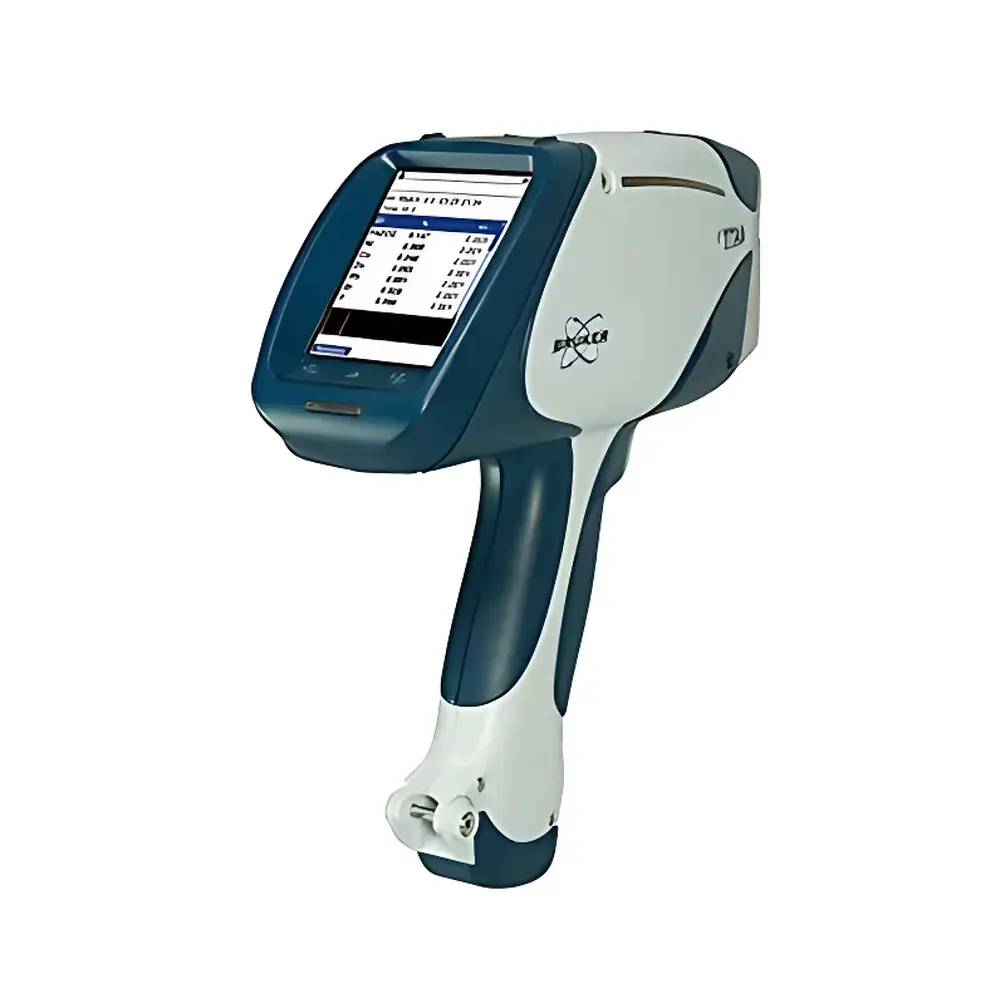
Bruker S1 TITAN Portable Energy Dispersive X-Ray Fluorescence (ED-XRF) Spectrometer
| Brand | Bruker |
|---|---|
| Origin | Germany |
| Instrument Type | Portable / Handheld |
| Application Domain | Positive Material Identification (PMI) for Ferrous Alloys |
| Elemental Range | Mg to U |
| Quantification Range | 1 ppm – 99.99% |
| Energy Resolution | <140 eV (Mn Kα) |
| Repeatability | ≤0.1% RSD |
| Detector | Silicon Drift Detector (SDD) |
| Weight | 1.5 kg |
| Compliance | Designed for API RP 578, ASTM E1621, ISO 3497, and GLP/GMP-aligned data integrity workflows |
Overview
The Bruker S1 TITAN is a field-deployable, handheld energy dispersive X-ray fluorescence (ED-XRF) spectrometer engineered for rapid, non-destructive elemental analysis and positive material identification (PMI) of metallic alloys in industrial environments. Operating on the fundamental principle of X-ray fluorescence—where primary X-rays excite atoms in the sample, inducing emission of characteristic secondary X-rays—the instrument quantifies elemental composition by measuring energy and intensity spectra using a high-resolution silicon drift detector (SDD). Its optimized excitation geometry, real-time spectrum processing, and factory-calibrated measurement curves enable reliable identification and quantification of up to 45 elements—from magnesium (Mg) to uranium (U)—within seconds. Designed specifically for demanding metallurgical applications, the S1 TITAN meets the analytical rigor required for compliance with API Recommended Practice 578, which mandates systematic PMI programs to prevent catastrophic failures caused by incorrect alloy usage in pressure-containing components.
Key Features
- Sub-140 eV energy resolution at Mn Kα ensures precise peak separation for overlapping transitions (e.g., Cr–Fe–Mn, Ni–Cu), critical for accurate low-concentration trace element detection in stainless steels and nickel-based superalloys.
- Continuous Automatic Gain Calibration (CAGC) maintains spectral stability across ambient temperature fluctuations (–10 °C to 50 °C) and extended operational cycles—essential for shift-to-shift consistency in refinery or pipeline inspection.
- Integrated dual-mode analysis: Fundamental Parameters (FP) quantification for unknown samples and empirically calibrated curve-based analysis for standardized alloys—including UNS, DIN, ASTM, and JIS specifications.
- Ruggedized titanium housing with IP54-rated ingress protection, drop-tested to 1 m, and equipped with Bruker’s proprietary “TITAN puncture-resistant detector window” for sustained performance in abrasive industrial settings.
- Onboard alloy library containing >400 certified grade definitions, supporting automatic pass/fail evaluation against user-defined specification limits (e.g., Cr ≥ 18.0%, Mo ≤ 0.08% for 316L SS).
- Optional micro-spot collimation (down to 3 mm diameter) and integrated HD camera for spatially resolved analysis of welds, heat-affected zones, or small-diameter piping components.
Sample Compatibility & Compliance
The S1 TITAN is validated for direct analysis of solid metallic surfaces—including castings, forgings, plates, pipes, valves, flanges, and fasteners—without sample preparation. It accommodates curved, rough, or oxidized surfaces typical of in-service infrastructure. All factory calibrations are traceable to NIST SRM standards (e.g., SRM 1250, 1251), and measurement uncertainty budgets conform to ISO/IEC 17025 requirements for accredited testing laboratories. Data acquisition and reporting support audit-ready workflows compliant with FDA 21 CFR Part 11 (electronic signatures, audit trails), EU Annex 11, and internal GLP/GMP documentation protocols. The instrument is routinely deployed in accordance with API RP 578 Section 5.3 for pre-commissioning PMI verification and post-weld inspection.
Software & Data Management
Powered by Bruker’s proprietary MSA (Mobile Spectral Analysis) software, the S1 TITAN delivers secure, encrypted local storage of spectra, calibration logs, operator IDs, GPS coordinates, and timestamped measurement records. Data export supports CSV, PDF, and XML formats compatible with LIMS integration. Remote firmware updates and spectral library expansion are managed via Bruker’s cloud-based S1 Connect portal—enabling centralized version control across multi-site fleets. Optional PC-based S1 Studio software provides advanced spectral deconvolution, matrix correction modeling, and statistical process control (SPC) charting for QA/QC trending.
Applications
- Refinery & Petrochemical: Verification of Cr-Mo steels in hydroprocessing units; detection of residual tantalum or hafnium in zirconium alloys used in acid service.
- Power Generation: PMI of Inconel 625 weld overlays on steam turbine blades; validation of cobalt content in Stellite hardfacing materials.
- Aerospace Manufacturing: Rapid screening of Ti-6Al-4V billets for interstitial oxygen and iron contamination prior to forging.
- Pharmaceutical Equipment Fabrication: Confirmation of 316L stainless steel passivation layer integrity and absence of leachable nickel or chromium.
- Scrap Recycling & Metal Trading: Sorting of mixed non-ferrous scrap (e.g., Cu–Ni–Zn brasses vs. Cu–Sn bronzes) with quantified Zn/Pb/Sn ratios.
FAQ
Does the S1 TITAN require annual recalibration by a certified service provider?
No—its CAGC system and factory-traceable reference sources maintain calibration stability for 12 months under normal use. However, daily verification using a supplied check standard is recommended per API RP 578 Section 6.2.
Can it analyze coated or painted metals?
Surface coatings thicker than ~25 µm may attenuate low-Z element signals (e.g., Mg, Al, Si). For coated substrates, optional vacuum mode or helium purge accessories improve light-element sensitivity.
Is regulatory documentation available for ISO 17025 accreditation?
Yes—Bruker provides full metrological traceability statements, uncertainty budgets, and validation reports aligned with ISO/IEC 17025:2017 Clause 7.8.2 for method verification.
How does it handle high-temperature measurements?
With the optional high-temp probe accessory (rated to 500 °C), the S1 TITAN enables in-situ analysis of insulated piping and furnace components without shutdown—reducing inspection downtime and thermal stress risks.
What cybersecurity measures protect stored measurement data?
All data is AES-256 encrypted at rest; user authentication uses role-based access control (RBAC); audit logs record every spectrum acquisition, modification, or deletion event with immutable timestamps.





