
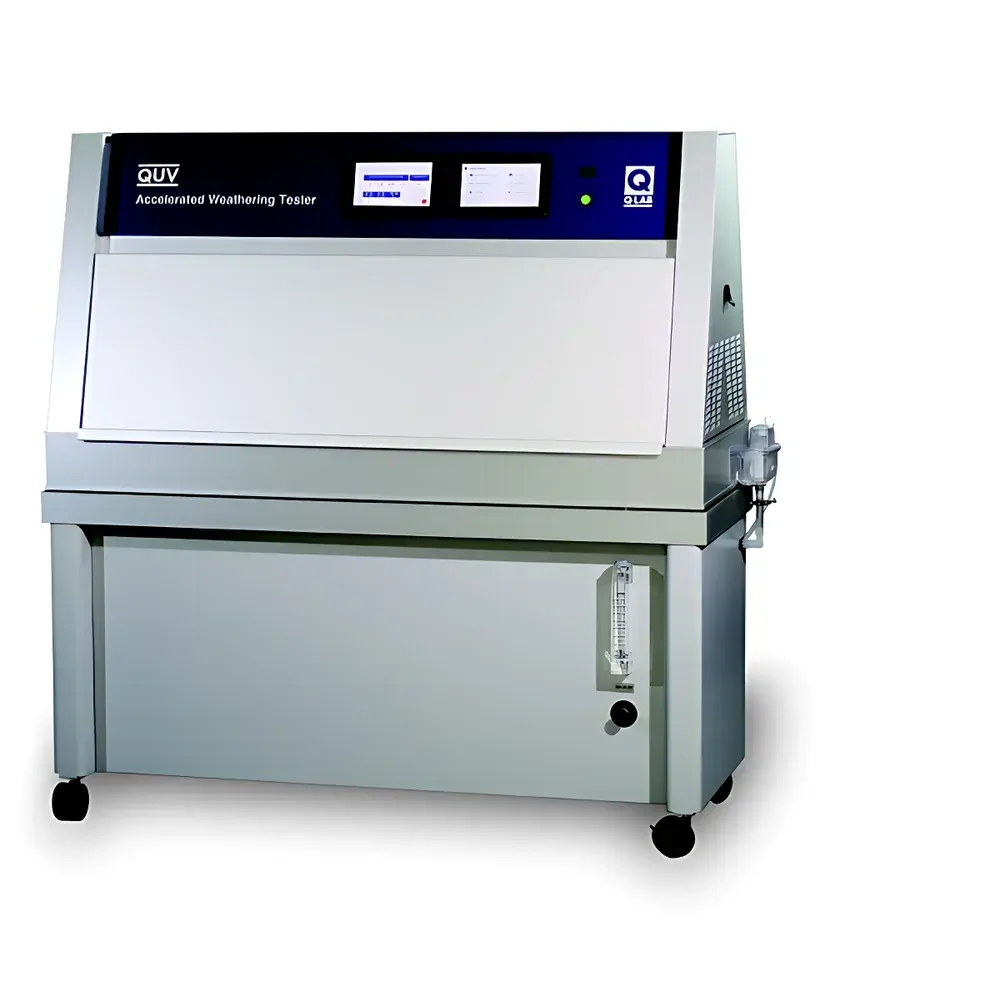
Q-LAB QUV/uvc Advanced UVC Accelerated Weathering Tester
| Brand | Q-LAB |
|---|---|
| Origin | USA |
| Model | QUV/uvc |
| Test Duration | 1–5000 h |
| UV Irradiance | 10 W/m² (at 254 nm) |
| UVC Wavelength | 254 nm |
| Black Panel Temperature | 63 ± 3 °C |
| Compliance | IEC 60335-1 |
Overview
The Q-LAB QUV/uvc is a purpose-engineered accelerated weathering tester designed specifically for evaluating material degradation under germicidal ultraviolet-C (UVC) irradiation at 254 nm. Unlike conventional QUV models optimized for solar-spectrum simulation (UVA/UVB), the QUV/uvc integrates low-pressure mercury lamps emitting >90% of their radiant energy within the 250–280 nm UVC band—with a dominant spectral peak precisely at 254 nm. This configuration replicates the optical output of commercial UVGI (Ultraviolet Germicidal Irradiation) systems widely deployed in healthcare, HVAC, surface disinfection, and airborne pathogen mitigation. The instrument operates on the principle of controlled photodegradation: high-energy UVC photons induce direct photochemical bond scission in organic polymers, pigments, coatings, and elastomers—mimicking real-world exposure in sterilization environments. It does not simulate natural outdoor weathering; instead, it delivers quantifiable, repeatable UVC dose exposure under tightly regulated thermal conditions—enabling predictive assessment of material service life in UVC-intensive applications such as PPE, medical device housings, aircraft cabin interiors, and HVAC filtration components.
Key Features
- UVC-Specific Low-Pressure Mercury Lamps: Emit >90% of radiant power at 254 nm; no phosphor coating ensures unaltered spectral output.
- Onboard UVC Radiometric Sensor: Integrated broadband sensor calibrated for 254 nm irradiance measurement (±5% traceable to NIST standards), enabling closed-loop irradiance control and cumulative dose tracking.
- Dedicated Thermal Control System: Maintains black panel temperature at 63 ± 3 °C—validated per IEC 60335-1 Annex B—to isolate UVC-driven degradation from humidity-mediated effects.
- Elimination of Condensation/Water Spray Functionality: Reflects the absence of moisture cycles in typical UVGI operational environments; simplifies chamber architecture and reduces maintenance overhead.
- Enhanced Safety Architecture: Interlocked door switch, redundant UVC shutoff circuitry, and real-time lamp-status monitoring prevent operator exposure—even at sub-threshold irradiance levels. Complies with Class 3R laser safety principles per IEC 60825-1.
- IEC 60335-1 Conformance: Validated for continuous operation at 10 W/m² irradiance (254 nm) and black panel temperature of 63 ± 3 °C—meeting requirements for household and similar electrical appliance safety testing related to UVC emission hazards.
Sample Compatibility & Compliance
The QUV/uvc accommodates flat or moderately curved specimens up to 75 mm × 150 mm × 10 mm (standard rack capacity: 48 samples). Compatible substrates include thermoplastics (e.g., polycarbonate, ABS, PP), fluoropolymers (e.g., PVDF, ETFE), silicone elastomers, acrylic coatings, and non-woven PPE fabrics. All test protocols adhere to internationally recognized frameworks: irradiance calibration follows ISO 17025-accredited procedures; thermal uniformity mapping satisfies ASTM G151 Class A criteria; and system validation aligns with GLP-compliant documentation requirements. While not intended for regulatory submission per se, data generated supports internal R&D, material qualification against OEM specifications (e.g., Boeing D6-17487, Airbus AITM 1-0004), and pre-submission technical dossiers for FDA 510(k) or CE marking where UVC stability is a critical performance parameter.
Software & Data Management
The QUV/uvc operates via Q-LAB’s proprietary QUVMonitor™ software (v5.2+), providing real-time irradiance logging, dose accumulation (J/m²), black panel temperature trending, and event-triggered alerts. All parameters are timestamped and stored in encrypted binary files compliant with 21 CFR Part 11 audit trail requirements—including user login history, method changes, and calibration events. Export options include CSV, PDF reports, and XML-compatible datasets for integration into LIMS or PLM platforms. Optional IQ/OQ documentation packages support GxP-regulated environments, including traceable sensor calibration certificates, temperature uniformity verification records, and irradiance spatial homogeneity maps (±10% across sample plane).
Applications
- Evaluation of UVC resistance in personal protective equipment (face shields, gowns, respirator straps)
- Stability screening of polymer-based medical device housings exposed to repeated UVGI cycles
- Accelerated aging of aircraft interior materials (seat fabrics, tray tables, overhead bins) subjected to onboard disinfection protocols
- Assessment of coating durability on HVAC duct liners and filter media under continuous UVC irradiation
- Comparative study of photostabilizer efficacy in UVC-targeted formulations (e.g., hindered amine light stabilizers vs. inorganic UV absorbers)
- Supporting ISO 15858 (UVC safety for germicidal equipment) and IEC TR 62471-2 (photobiological safety of lamps) risk assessments
FAQ
Does the QUV/uvc simulate natural sunlight?
No. It is engineered exclusively for UVC-specific degradation studies at 254 nm and does not replicate solar UV-A/UV-B spectra or environmental moisture cycles.
Can I use standard QUV accessories with the QUV/uvc?
No. Lamp holders, sensors, and sample racks are mechanically and optically optimized for UVC emission; cross-model interchangeability is not supported.
Is humidity control available?
No. Humidity functionality has been intentionally omitted to reflect operational conditions of most UVGI systems and to eliminate confounding variables in UVC-only degradation mechanisms.
What calibration standards apply to the UVC sensor?
The radiometric sensor is factory-calibrated traceable to NIST SRM 2032 (deuterium lamp standard) and verified annually using Q-LAB’s certified UVC reference lamp (NIST-traceable output at 254 nm).
How is compliance with IEC 60335-1 demonstrated?
Through third-party witnessed validation: irradiance mapping at 10 W/m² (±5%), black panel temperature stability at 63 ± 3 °C over 24 h, and full electrical safety testing per Clause 19 (UVC radiation hazard mitigation).
Related Products



