
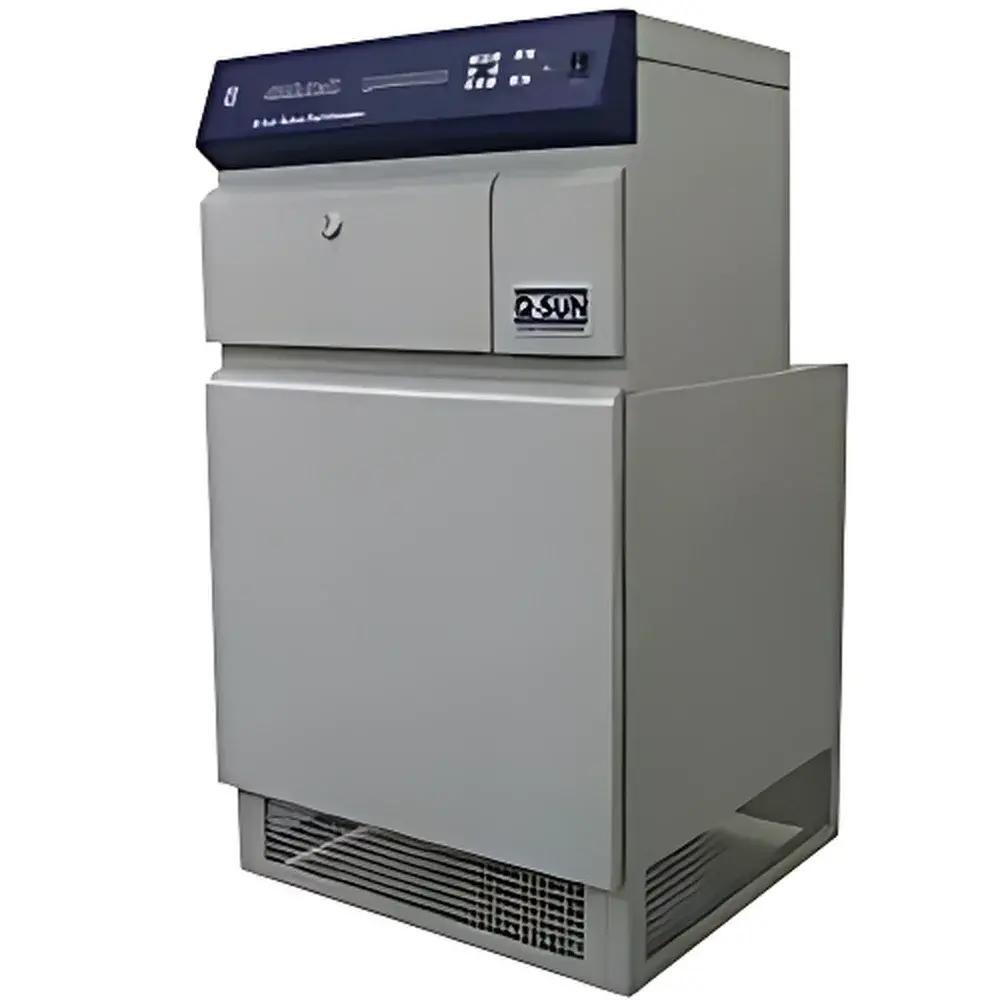
Q-LAB Q-SUN Xe-1-SC Xenon Arc Weathering Test Chamber
| Brand | Q-LAB |
|---|---|
| Origin | USA |
| Model | Q-SUN Xe-1-SC |
| Type | Benchtop Xenon Arc Exposure Chamber |
| Light Source | Single Xenon Arc Lamp |
| Irradiance Control | SOLAR EYE® Closed-Loop Radiometer System (340 nm, 420 nm or TUV selectable) |
| Humidity Control | Standard Relative Humidity (RH) Control |
| Cooling System | Integrated Refrigeration Unit |
| Temperature Range | 19–103 °C (dependent on sensor type, irradiance level, filter configuration, lamp age and ambient conditions) |
| Water Spray | Programmable Spray Cycle |
| Compliance | ASTM G155, ISO 4892-2, AATCC TM16, SAE J2527, and other photodegradation standards |
| Data Interface | Built-in Ethernet port for remote monitoring and data logging |
| Calibration | PATENTED AUTOCAL® Self-Calibration System |
| Diagnostic Capability | Onboard Self-Diagnostic Alerts and Maintenance Reminders |
Overview
The Q-LAB Q-SUN Xe-1-SC is a compact, benchtop xenon arc weathering test chamber engineered for accelerated simulation of solar radiation, moisture, and thermal stress—key environmental factors driving material degradation. It employs a single xenon arc lamp to reproduce the full-spectrum solar irradiance (290–800 nm), closely matching natural sunlight when filtered through appropriate optical filters (e.g., Daylight-Q/B, Window Glass-Q). Unlike UV fluorescent or metal halide sources, xenon arc technology delivers spectrally accurate exposure across UV, visible, and near-infrared wavelengths—enabling physiologically relevant photochemical aging of polymers, coatings, textiles, automotive interiors, pharmaceutical packaging, and cosmetics. The chamber operates under tightly controlled conditions: irradiance (monitored and regulated in real time via the SOLAR EYE® radiometer), relative humidity (RH), black panel temperature (BPT), and chamber air temperature. Its integrated refrigeration system allows precise low-temperature operation—critical for testing thermally sensitive products such as topical formulations or biologics where non-physiological thermal acceleration must be avoided.
Key Features
- Single xenon arc lamp with high spectral fidelity and long operational life (typical lamp life ≥ 1,500 hours)
- SOLAR EYE® closed-loop irradiance control system with user-selectable monitoring bands (340 nm for UV-driven degradation, 420 nm for broader spectrum relevance, or TUV for total ultraviolet)
- Standard RH control (10–95% RH, ±3% accuracy) with independent monitoring of black panel temperature (BPT) and chamber air temperature
- Integrated refrigeration unit enabling stable operation from 19 °C to 103 °C—essential for simulating indoor or temperate outdoor exposure profiles without artificial thermal overdrive
- Programmable water spray function for cyclic wet/dry exposure, inducing thermal shock and hydrolytic stress—particularly relevant for evaluating coating adhesion, pigment leaching, and substrate swelling
- Built-in Ethernet interface supporting remote configuration, real-time data streaming, and automated log export compliant with GLP/GMP audit requirements
- AUTOCAL® self-calibration system—eliminates manual radiometer recalibration; ensures traceable, repeatable irradiance delivery per ISO/IEC 17025-aligned practices
- Onboard diagnostics with proactive maintenance alerts (lamp aging, filter degradation, coolant status, sensor drift)
Sample Compatibility & Compliance
The Q-SUN Xe-1-SC accommodates flat, rigid, or flexible specimens up to 152 mm × 152 mm mounted horizontally on its standard sample tray. Optional fixtures—including textile clamps (X-10255-X), narrow/wide bottle holders (X-10183/X-10184), and遮盖-type masking frames (X-10264-K)—enable standardized testing of diverse geometries per AATCC, ISO, and ASTM protocols. The system meets or exceeds performance criteria defined in ASTM G155 (Practice for Operating Xenon Arc Light Apparatus for Exposure of Non-Metallic Materials), ISO 4892-2 (Plastics — Methods of Exposure to Laboratory Light Sources — Part 2: Xenon-Arc), and SAE J2527 (Approved Automotive Interior Materials Exposure). It supports full compliance with FDA 21 CFR Part 11 for electronic records and signatures when paired with validated LIMS or QMS software. All irradiance, temperature, and humidity data are timestamped, non-erasable, and exportable in CSV or XML format—facilitating regulatory submissions under ICH Q5C (Stability Testing of Biotechnological/Biological Products) and USP (Photostability Testing).
Software & Data Management
The Q-SUN Xe-1-SC operates via Q-LAB’s proprietary Q-Sun Controller firmware, accessible through a local touchscreen interface or remotely via Ethernet-connected PCs. Exposure cycles—including irradiance setpoints, RH profiles, spray timing, and temperature ramps—are defined using intuitive step-based programming. All operational parameters are logged at user-defined intervals (minimum 1-minute resolution) with automatic checksum validation. Data files include metadata (operator ID, sample ID, calibration date, lamp serial number) and support digital signature workflows. Integration with third-party laboratory information management systems (LIMS) is enabled through Modbus TCP or RESTful API endpoints. Audit trails record all parameter changes, user logins, calibration events, and system errors—fully aligned with GLP (21 CFR Part 58) and GMP (21 CFR Part 211) documentation integrity requirements.
Applications
This chamber is routinely deployed in R&D and QC laboratories for predictive durability assessment across regulated and industrial sectors. In automotive engineering, it validates dashboard material fade resistance per SAE J2412 and interior component cracking per GMW14124. In textile development, it quantifies colorfastness to light per ISO 105-B02 and AATCC TM16. Pharmaceutical firms use it for ICH Q1B-compliant photostability screening of primary packaging and drug product formulations—especially where low-temperature exposure is mandated to avoid thermal artifact formation. Paint and coating manufacturers rely on it for ASTM D4355 (chalking resistance) and D4459 (gloss retention) evaluation. Additionally, it supports accelerated aging of medical device polymers (ISO 10993-12), cosmetic emulsions (ISO 24443), and architectural sealants (ASTM C1135).
FAQ
What spectral filters are available for the Q-SUN Xe-1-SC, and how do they affect test relevance?
The chamber accepts Daylight-Q/B (broadband, full-spectrum simulation) and Window Glass-Q (IR-filtered, replicating indoor through-glass exposure). Filter selection directly determines photon flux distribution and correlates to specific end-use environments—e.g., Window Glass-Q is required for automotive interior testing per SAE J2527.
Is the refrigeration system optional or permanently installed?
The refrigeration unit is factory-integrated and non-removable—ensuring consistent low-temperature capability across all operational modes without field modification.
How frequently does the SOLAR EYE® radiometer require recalibration?
AUTOCAL® enables daily self-validation; physical recalibration against NIST-traceable standards is recommended annually or after lamp replacement, per ISO/IEC 17025 Clause 6.5.
Can the Q-SUN Xe-1-SC meet ASTM G155 Cycle 1A for automotive exterior materials?
Yes—when configured with Daylight-Q/B filter, 0.35 W/m² @ 340 nm irradiance setpoint, 60% RH, and BPT of 63 °C, it fully satisfies the irradiance, temperature, and humidity tolerances specified in ASTM G155 Annex A1.
Does the system support unattended operation for extended test durations?
Yes—built-in diagnostics, email/SNMP alerting, and redundant thermal cutoffs enable safe 24/7 operation for multi-week exposures without operator intervention.



