
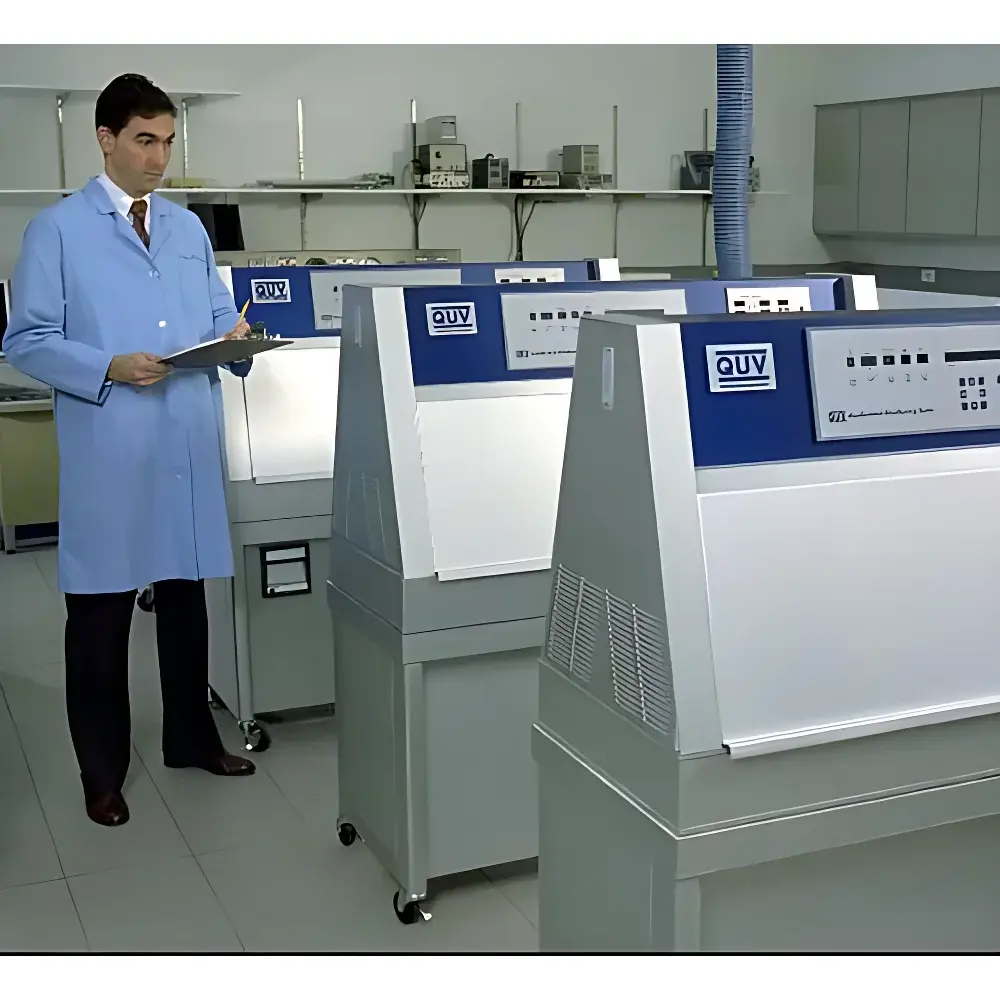
Q-Lab QUV/Spray Ultraviolet Weathering Test Chamber
| Brand | Q-LAB |
|---|---|
| Origin | USA |
| Model | QUV/Spray |
| Sample Capacity | Up to 48 specimens (75 mm × 150 mm) |
| UV Lamp Types | UVA-340, UVA-351, UVB-313 |
| Condensation System | Integrated water condensation with self-purifying distilled water cycle |
| Spray Function | Deionized water spray for thermal shock and mechanical erosion simulation |
| Compliance | ASTM G154, ISO 4892-3, JIS D0205, SAE J2020, GB/T 14522 |
| Calibration Support | AUTOCAL-compatible, UC1/UC10/CR10 irradiance calibration systems |
| Temperature Control | Black panel thermometer (BPT) and chamber air temperature monitoring |
| Optional Accessories | Pure Water Recycling System, Space-Saving Stacking Frame, Multi-geometry sample holders (lenses, 3D parts, textiles, vials) |
Overview
The Q-Lab QUV/Spray Ultraviolet Weathering Test Chamber is an industry-standard accelerated weathering instrument engineered for precision simulation of solar UV radiation, moisture condensation, and controlled water spray exposure. Unlike xenon arc or carbon arc testers, the QUV platform employs fluorescent UV lamps—specifically UVA-340 (matching terrestrial solar UV down to 295 nm), UVA-351 (simulating through window glass), and UVB-313 (for aggressive, short-wave UV stress)—to deliver reproducible, spectrally accurate ultraviolet irradiance. Its fundamental operating principle relies on controlled photochemical degradation kinetics: photons in the 290–400 nm range induce bond scission, oxidation, and polymer chain breakdown in organic materials, resulting in measurable changes such as color shift (ΔE), gloss loss, chalking, microcracking, embrittlement, and tensile strength reduction. The QUV/Spray variant extends this capability with a programmable deionized water spray system that introduces two distinct moisture stress mechanisms: brief spray cycles induce rapid thermal shock due to evaporative cooling, while extended spray durations apply mechanical shear and surface leaching—mimicking real-world rain-induced erosion. This tri-modal exposure profile (UV + condensation + spray) enables correlation with outdoor field performance under diverse climatic conditions, particularly for coatings, plastics, automotive trim, roofing membranes, and architectural finishes.
Key Features
- Triple-exposure capability: Independent or combined UV irradiation, condensation, and water spray cycles—fully programmable via intuitive touchscreen interface
- Self-purifying condensation system: Uses natural distillation—evaporation from heated water pan followed by condensation on cooler specimen surfaces—eliminating mineral buildup and ensuring consistent dew point control without external humidification
- UVA-340 lamp spectral match: Reproduces the most damaging portion of sunlight (295–365 nm) with ±2 nm wavelength tolerance, validated per ASTM G154 Annex A2
- Black panel thermometer (BPT) monitoring: Measures surface temperature of irradiated specimens in real time; user-calibratable against NIST-traceable reference thermometers
- AUTOCAL-compatible irradiance control: Supports both UC10/UV smart sensors and legacy CR10 calibrators for traceable, operator-independent UV intensity verification
- Modular sample mounting: Adjustable rack system accommodates specimens up to 20 mm thick; optional fixtures for lenses, textiles, vials, and irregular 3D components ensure compliance with ISO 4892-3 specimen geometry requirements
- Optional pure water recycling system: Reduces operational cost and environmental impact by reclaiming and reconditioning spray water—eliminating continuous DI water consumption
Sample Compatibility & Compliance
The QUV/Spray chamber accepts standard flat panels (75 mm × 150 mm), accommodating up to 48 specimens per test cycle. Non-planar geometries—including curved automotive fascias, optical lenses, and molded plastic housings—are supported via custom jigs certified for uniform irradiance distribution across critical surfaces. All exposure protocols align with internationally recognized standards for material durability assessment: ASTM G154 (Standard Practice for Operating Fluorescent Ultraviolet (UV) Lamp Apparatus for Exposure of Non-Metallic Materials), ISO 4892-3 (Plastics — Methods of exposure to laboratory light sources — Part 3: Fluorescent UV lamps), JIS D0205 (Automotive exterior materials), SAE J2020 (Accelerated exposure of automotive exterior materials using filtered xenon-arc and UV fluorescent lamps), and GB/T 14522 (Chinese national standard for UV aging of non-metallic materials). Data generated satisfies GLP audit requirements when paired with Q-Lab’s optional data logging and electronic signature modules compliant with FDA 21 CFR Part 11.
Software & Data Management
QUV/Spray units operate via embedded firmware with password-protected test programming, real-time parameter logging (irradiance mW/cm², BPT °C, chamber air °C, spray duration, condensation time), and USB export of CSV-formatted datasets. Optional Q-Lab’s Vantage™ software enables remote monitoring, multi-chamber fleet management, automated report generation (PDF/Excel), and statistical trend analysis across historical test runs. All calibration events—including BPT sensor verification and irradiance recalibration—are timestamped and logged with operator ID, supporting full traceability for ISO/IEC 17025-accredited laboratories. Audit trails retain uneditable records of parameter modifications, cycle interruptions, and alarm history—essential for regulatory submissions and internal quality audits.
Applications
- Automotive OEMs: Validating UV resistance of interior trim, dashboard polymers, headlight lenses, and exterior paint systems per SAE J2020 and OEM-specific specifications (e.g., GMW14124, Ford CETP)
- Coatings & Inks: Assessing chalk resistance of architectural paints, gloss retention of coil coatings, and photostability of inkjet inks under cyclic UV/condensation/spray
- Medical Device Packaging: Verifying integrity of Tyvek® pouches and PETG trays after accelerated aging per ISO 11607-1
- Renewable Energy: Screening UV stability of encapsulants and backsheets in photovoltaic modules per IEC 61215 and UL 1703
- Textiles & Geotextiles: Quantifying colorfastness and tensile decay in UV-exposed synthetic fibers and erosion-control fabrics
FAQ
What UV lamp types are compatible with the QUV/Spray?
UVA-340 (sunlight-simulating), UVA-351 (through-glass), and UVB-313 (high-intensity, accelerated testing). Cold white lamps are supported only for non-UV applications.
Why is deionized water required for the spray system?
Mineral deposits from tap water would clog nozzles and create uneven spray patterns, compromising test repeatability and introducing artifacts during thermal shock cycles.
How often must the black panel thermometer be calibrated?
Q-Lab recommends quarterly calibration using a NIST-traceable reference thermometer; frequency may increase based on lab SOPs or regulatory requirements (e.g., ISO/IEC 17025).



