
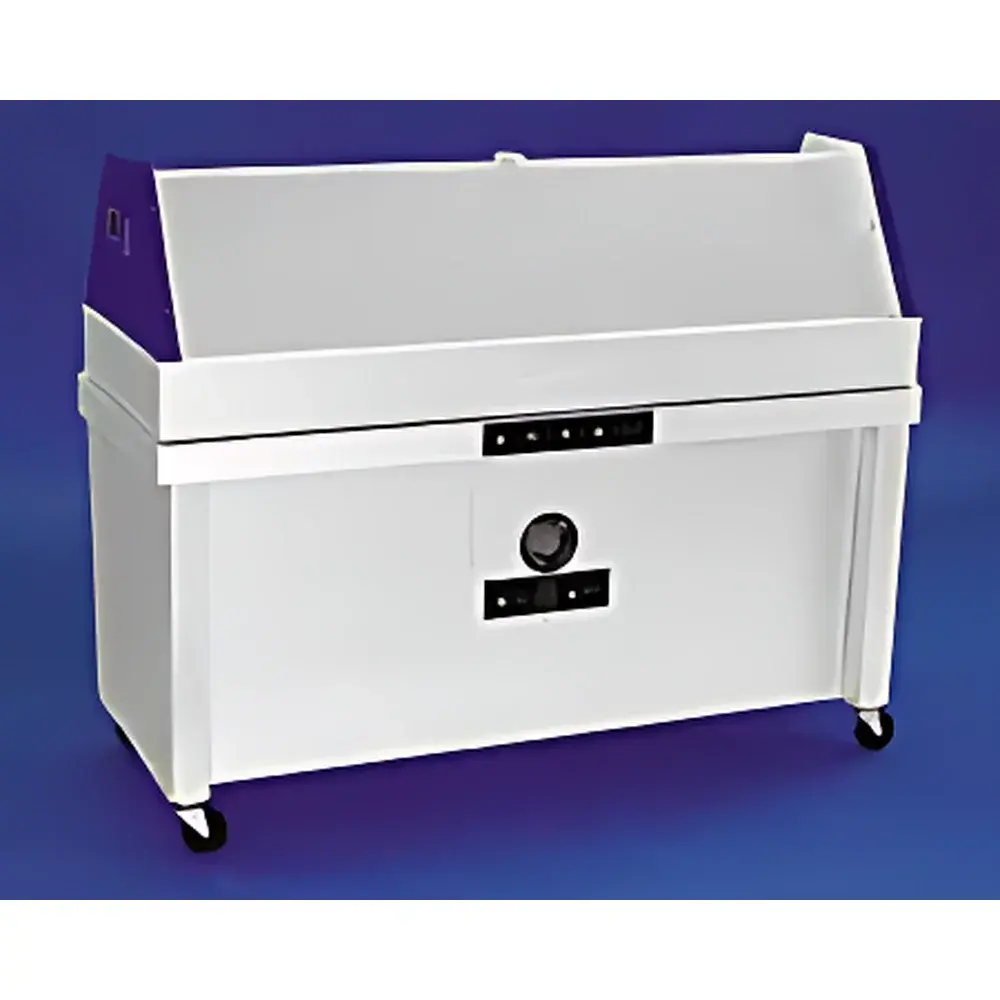
Q-LAB QCT Condensation Humidity Test Chamber
| Brand | Q-LAB |
|---|---|
| Origin | USA |
| Model | QCT |
| Temperature Range | Ambient to 72 °C |
| Sample Capacity | 62 pcs of 75 × 150 mm panels or 48 pcs of 100 × 150 mm panels |
| Condensate Generation | Continuous cold-surface condensation |
| Drying System | Heated forced-air circulation |
| Cycle Programming | 24-hr timer, up to 96 programmable 15-minute stages per day |
| Water Supply | 6 mm plastic tubing, ~2 L/day consumption |
| Compliance | Designed for ASTM D4585, ISO 6270-2, and JIS D0205 environmental corrosion testing protocols |
Overview
The Q-LAB QCT Condensation Humidity Test Chamber is an engineered environmental test system designed to replicate the natural formation of dew and rain-induced moisture exposure on material surfaces under controlled laboratory conditions. Unlike conventional humidity chambers relying solely on saturated vapor diffusion, the QCT employs a thermally regulated cold surface condensation principle: test specimens are mounted directly onto a temperature-controlled metal panel maintained below the dew point of the chamber’s ambient air. This induces continuous, uniform condensate formation—mimicking real-world dew accumulation and intermittent wetting events critical to evaluating coating durability, corrosion resistance, and substrate degradation. The system operates without雾化 nozzles or water spray mechanisms, eliminating droplet size variability and ensuring reproducible, film-like moisture deposition aligned with standardized cyclic corrosion test methodologies.
Key Features
- Condensation-driven wetting mechanism compliant with ASTM D4585 (Standard Practice for Testing Protective Coatings Using Condensing Humidity), ISO 6270-2 (Paints and varnishes — Determination of resistance to humidity — Part 2: Condensation test), and JIS D0205 (Automotive paint corrosion resistance test)
- Integrated forced-air drying subsystem delivering heated, filtered air directly into the test chamber to accelerate evaporation cycles while maintaining thermal uniformity across the specimen plane
- High-resolution 24-hour programmable controller enabling precise segmentation of wet/dry phases—up to 96 discrete 15-minute intervals per day—to emulate diurnal moisture cycling patterns
- Robust stainless-steel interior construction with insulated double-wall housing for stable thermal performance and minimal energy drift during extended operation
- Dedicated cold-panel mounting system accommodating standardized test substrates: up to 62 panels of 75 × 150 mm or 48 panels of 100 × 150 mm, all positioned perpendicular to condensate flow for consistent exposure geometry
- Auto-fill water supply interface (6 mm OD polymeric tubing) with integrated level monitoring and low-flow alarm to support unattended operation over multi-day test sequences
Sample Compatibility & Compliance
The QCT accommodates rigid flat specimens including painted metal panels, polymer films, automotive trim components, architectural coatings, and aerospace composite laminates. Its condensation geometry ensures uniform wetting independent of sample hydrophobicity or surface texture—critical for comparative aging studies requiring inter-laboratory reproducibility. The chamber meets functional requirements for GLP-compliant test execution when paired with validated calibration procedures and audit-ready data logging. While not a standalone certified device, its operational parameters align with regulatory expectations for environmental stress qualification under ISO/IEC 17025-accredited laboratories conducting ASTM-, ISO-, or JIS-referenced corrosion and weathering assessments.
Software & Data Management
The QCT utilizes a microprocessor-based digital controller with non-volatile memory for cycle retention during power interruption. Real-time temperature and elapsed time are displayed continuously; all programmed stages—including setpoint temperatures, dwell durations, and phase transitions—are stored with timestamped logs accessible via front-panel interface. For integration into enterprise quality management systems, optional RS-232 or Ethernet communication modules support external data acquisition and remote monitoring. All logged data comply with basic ALCOA+ principles (Attributable, Legible, Contemporaneous, Original, Accurate) and may be exported in CSV format for traceability in FDA 21 CFR Part 11–aligned environments when used with appropriate electronic signature controls.
Applications
- Evaluation of automotive OEM coating systems for cyclic corrosion resistance per SAE J2334 and GMW14872
- Qualification of architectural cladding materials under accelerated dew-rain exposure per AAMA 2604 and AAMA 2605
- Stability assessment of photovoltaic module encapsulants and backsheet polymers per IEC 61215-2 MQT 09
- Corrosion screening of galvanized steel, aluminum alloys, and stainless fasteners per ASTM B117 adjunct protocols
- Development validation of anti-fog and hydrophilic optical coatings subjected to repeated condensation/evaporation stress
FAQ
How does the QCT differ from salt spray (fog) chambers like the Q-Fog?
The QCT generates pure water condensate without added electrolytes, focusing on humidity-driven degradation mechanisms such as blistering, adhesion loss, and hygroscopic swelling—whereas salt fog chambers emphasize electrochemical corrosion pathways.
Can the QCT operate continuously without manual refilling?
Yes—the integrated auto-fill system supports unattended operation for up to 7 days assuming standard water consumption (~2 L/day) and proper connection to a pressurized municipal or deionized water source.
Is calibration documentation available for ISO/IEC 17025 compliance?
Q-LAB provides NIST-traceable calibration certificates for temperature sensors and controller verification reports; users must perform periodic in-house verification per their laboratory’s scope of accreditation.
What maintenance is required for long-term reliability?
Routine tasks include quarterly inspection of condensate drain lines, biannual cleaning of the cold panel surface with isopropyl alcohol, and annual verification of heater element resistance and airflow sensor response.
Does the QCT meet UL or CE safety certification standards?
The QCT is constructed and tested to UL 61010-1 and EN 61010-1 safety requirements for laboratory equipment and carries the CE marking for EMC and Low Voltage Directive conformity.



