
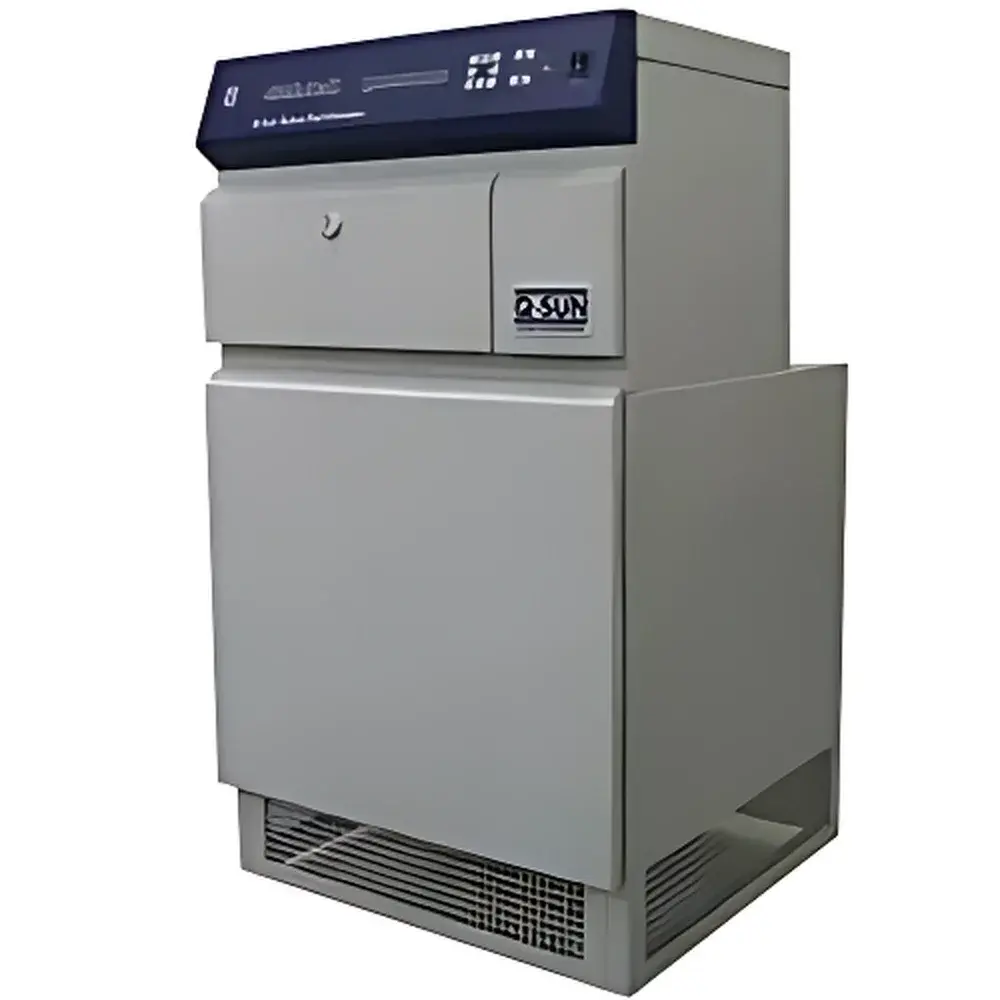
Q-Lab Xe-1-BC Benchtop Xenon Arc Weathering Test Chamber
| Brand | Q-Lab |
|---|---|
| Origin | USA |
| Model | Xe-1-BC |
| Cooling Option | Integrated Refrigeration System |
| Light Source | Air-Cooled Xenon Arc Lamp (1500 h typical life) |
| Irradiance Control | SOLAR EYE Spectral Radiometer (340 nm, 420 nm or TUV) |
| Temperature Control | Black Panel Thermometer (35–103 °C), optional Air Temperature Sensor |
| Sample Tray | 251 mm × 457 mm, accommodates up to fifteen 51 mm × 102 mm specimens |
| Filter Options | Daylight, Window Glass, Window-IR (replacement required) |
| Compliance | ASTM G155, ISO 4892-2, SAE J2527, AATCC TM16, IEC 60068-2-9 |
Overview
The Q-Lab Xe-1-BC Benchtop Xenon Arc Weathering Test Chamber is an engineered solution for accelerated light stability and weathering evaluation of materials under controlled, reproducible solar-spectrum irradiation. Utilizing a single air-cooled xenon arc lamp, the system delivers full-spectrum radiation—spanning UV (295–400 nm), visible (400–800 nm), and near-infrared (800–1100 nm) wavelengths—to closely replicate natural sunlight exposure conditions. Unlike UV fluorescent or metal halide systems, xenon arc technology provides spectrally accurate irradiance essential for evaluating photodegradation mechanisms involving color shift, gloss loss, polymer chain scission, and pigment fading. The Xe-1-BC integrates a permanently installed refrigeration unit, enabling precise thermal management down to 19 °C black panel temperature—critical for thermally sensitive formulations such as pharmaceuticals, cosmetics, and certain organic coatings where non-photochemical thermal degradation must be minimized during testing.
Key Features
- Integrated refrigeration system enables stable operation across a black panel temperature range of 19–103 °C, supporting low-temperature protocols per ASTM D7869 and ISO 11341 Annex B.
- Air-cooled xenon lamp (1500 h rated life) eliminates water cooling infrastructure, reducing installation complexity, maintenance frequency, and long-term operational cost.
- SOLAR EYE irradiance control system continuously monitors and regulates spectral output at user-selectable wavelengths: 340 nm (UV-B dominant), 420 nm (broad UV-A/visible), or TUV (300–400 nm integrated).
- Standard black panel thermometer (BPT) with optional air temperature sensor allows dual-mode thermal control strategies aligned with ISO 4892-2 Clause 7.2 and ASTM G155 Section 6.3.
- Sliding sample tray (251 mm × 457 mm) supports flat, contoured, or three-dimensional specimens; accommodates up to fifteen 51 mm × 102 mm test coupons without reconfiguration.
- Patented AUTOCAL calibration interface simplifies traceable recalibration using Q-Lab CR20 radiometer (340 nm, 420 nm, or TUV configuration) and CT202 black panel thermometer calibrator.
- Embedded Ethernet port enables remote monitoring, automated data logging, and integration into laboratory LIMS or QA/QC workflows compliant with 21 CFR Part 11 audit trail requirements.
Sample Compatibility & Compliance
The Xe-1-BC accommodates diverse material forms—including films, textiles, painted panels, plastic injection-molded parts, and coated substrates—without requiring custom fixtures. Its horizontal sample orientation and optional water spray module replicate realistic wet/dry cycling conditions per ISO 4892-2 Annex C and ASTM D7869 Section 8. Filter selection determines spectral cutoff: Daylight filters simulate direct terrestrial sunlight; Window Glass filters emulate indoor exposure behind standard architectural glazing; Window-IR filters extend infrared transmission for automotive interior testing. All filter sets are manufactured to Q-Lab’s proprietary optical specifications and retain spectral integrity throughout lamp life—except Window-IR, which requires scheduled replacement per ISO 4892-2 Clause 5.4. The system meets essential regulatory alignment for product development in FDA-regulated sectors (e.g., USP , ICH Q1B), automotive OEM specifications (GMW 14124, Ford CETP 00.00-L-467), and textile durability standards (AATCC TM16, ISO 105-B02).
Software & Data Management
The Xe-1-BC operates via an embedded touchscreen interface with intuitive menu navigation and password-protected parameter locking. All exposure parameters—including irradiance setpoint, temperature profile, cycle duration, and spray timing—are stored in non-volatile memory with timestamped event logging. Internal data storage retains ≥30 days of high-resolution (1-min interval) irradiance, black panel temperature, chamber humidity, and fault diagnostics. Export is supported via USB or Ethernet to CSV or XML formats compatible with statistical process control (SPC) platforms. When deployed in GLP/GMP environments, the system supports electronic signature capture, user access levels (operator, supervisor, administrator), and immutable audit trails meeting ALCOA+ principles. Optional Q-Lab’s SUNTEST® Software Suite provides advanced scheduling, multi-chamber synchronization, and automated report generation aligned with ISO/IEC 17025 documentation requirements.
Applications
This chamber serves laboratories conducting comparative aging studies on light-sensitive materials where thermal fidelity is non-negotiable. Key application domains include: stability testing of topical pharmaceuticals and OTC cosmetic formulations per ICH Q1A(R2); evaluation of automotive interior trim materials exposed to filtered sunlight through laminated windshields; qualification of aerospace polymer composites under cyclic UV/thermal stress; validation of inkjet-printed packaging for retail shelf-life prediction; and assessment of textile dye fastness under simulated museum lighting conditions (CIE S 012/E:2021). Its compact footprint and plug-and-play installation make it suitable for university research labs, contract testing facilities, and R&D departments with limited floor space but rigorous metrological demands.
FAQ
What is the recommended recalibration interval for the SOLAR EYE sensor?
Q-Lab recommends annual recalibration of the CR20 radiometer at an accredited Q-Lab service center; field verification using the built-in AUTOCAL routine should be performed before each test campaign.
Can the Xe-1-BC operate without the refrigeration option?
Yes—the refrigeration system is factory-integrated but not active by default; thermal control defaults to ambient-assisted heating/cooling unless low-temperature protocols are selected.
Is the Window-IR filter mandatory for all tests?
No—Window-IR is only required when simulating infrared-rich exposures such as automotive cabin interiors; its use necessitates scheduled replacement every 1,000 hours of lamp operation per ISO 4892-2.
How does black panel temperature differ from chamber air temperature in practice?
Black panel temperature measures surface-absorbed radiant heat on a standardized sensor mimicking dark-colored test specimens; air temperature reflects ambient convective conditions—both are independently configurable per test method requirements.
Does the Xe-1-BC support humidity control?
No—this model does not include active humidity regulation; relative humidity is passively influenced by ambient lab conditions and spray cycle duration, consistent with ASTM G155 Cycle 1 and ISO 4892-2 Method A.



