
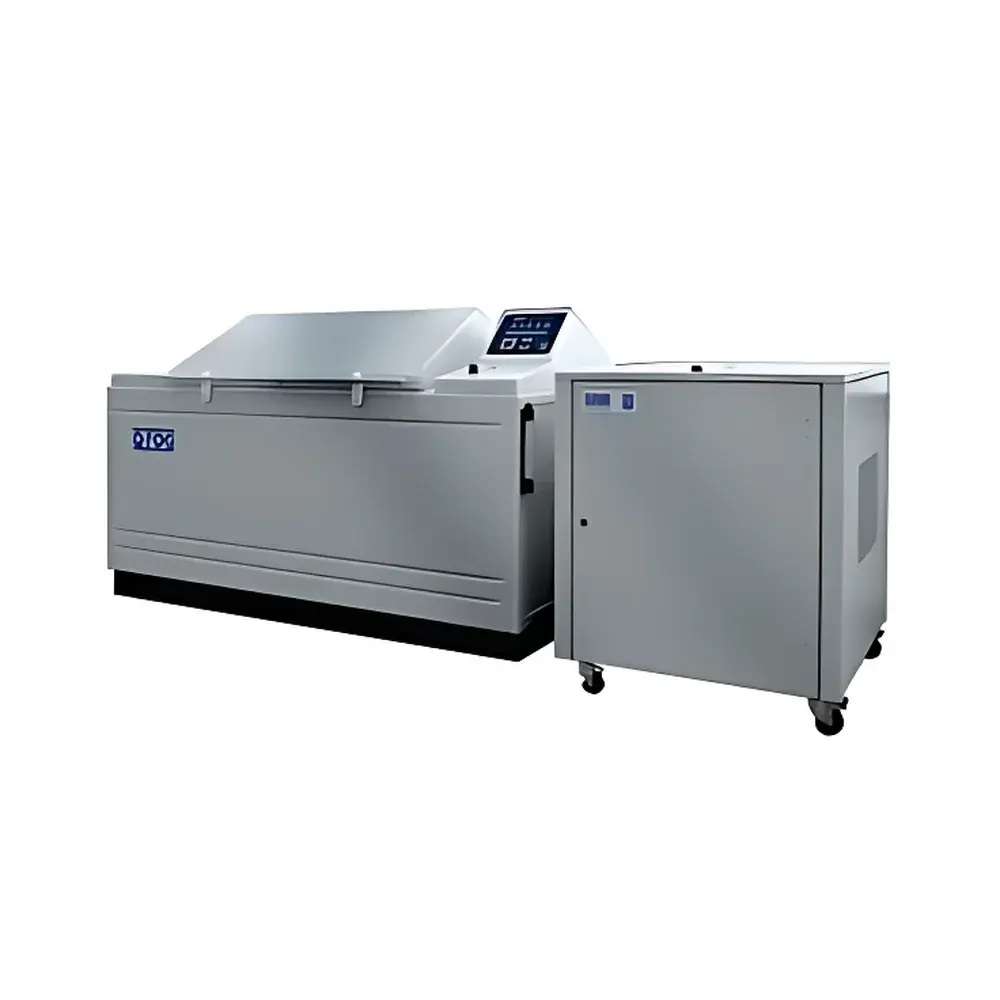
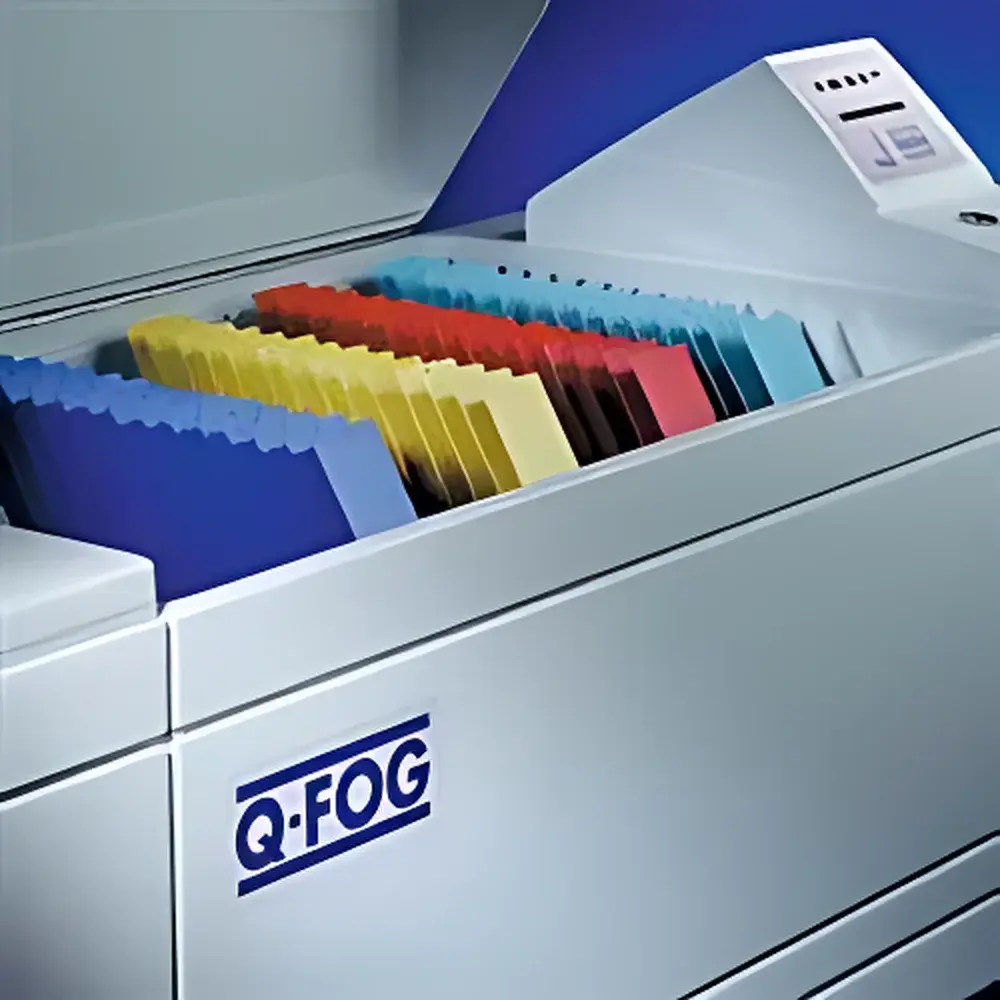
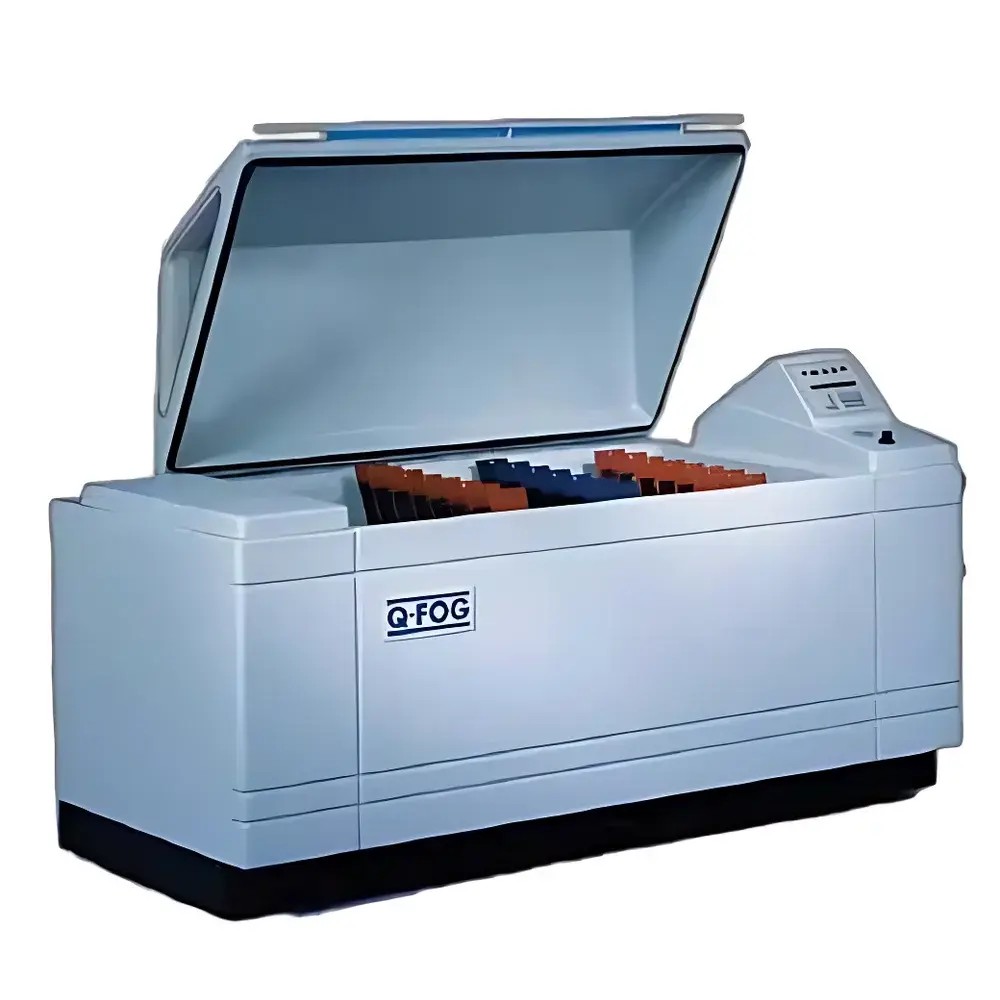
Q-Lab Q-FOG CRH Cyclic Corrosion Test Chamber
| Brand | Q-Lab |
|---|---|
| Origin | USA |
| Model | Q-FOG CRH1100 |
| Spray Mode | Continuous Atomization |
| Spray Rate | 1–5 L/h per 180 cm² |
| Nozzle Pressure | 0.7–1 kg/cm² |
| De-misting Method | Air-pressurized Exhaust |
| Temperature Range | 20–60 °C |
| Humidity Control | Integrated Air Pre-conditioning System with RH Regulation |
| Optional Spray Module | Programmable High-Volume Liquid Spray |
| Internal Solution Reservoir | 120 L (≥7-day autonomy) |
| Chamber Capacity | 1103 L |
| Sample Capacity | 240 × 75 mm × 150 mm test panels |
| Structural Load Capacity | 544 kg (uniformly distributed) |
| Compliance | ASTM B117, ISO 9227, ISO 11997-1/2, SAE J2334, GMW 14872, Ford CETP, VW PV1210, Renault D17 2025, GB/T 10125, VDA 621-415 |
Overview
The Q-Lab Q-FOG CRH1100 is an advanced cyclic corrosion test chamber engineered for high-fidelity simulation of real-world atmospheric degradation mechanisms in automotive, aerospace, and industrial component development. Unlike conventional salt spray chambers operating under static conditions, the Q-FOG CRH1100 implements a rigorously controlled sequence of exposure phases—including neutral salt fog (NSF), dry-off, humidity hold, and optional high-volume liquid spray—each governed by independent thermodynamic parameters. Its core measurement architecture relies on closed-loop regulation of chamber air temperature (20–60 °C) and relative humidity (RH) via a dedicated air pre-conditioning module, enabling precise replication of hygrothermal stress profiles defined in modern OEM specifications. The system employs a dual-path fluid delivery architecture: a corrosion solution is metered via a variable-speed peristaltic pump to a precision atomizer, while compressed air pressure (0.7–1 kg/cm²) governs droplet dispersion geometry and settling uniformity across the test surface. All internal wetted components are constructed from non-reactive, corrosion-resistant materials—including PVC-coated stainless steel and fluoropolymer-lined reservoirs—to ensure long-term metrological stability and solution integrity.
Key Features
- Integrated RH control system using air pre-conditioning and high-efficiency misting nozzles, compliant with ISO 11997-1 and GMW 14872 humidity hold requirements
- Dual-mode exposure capability: programmable salt fog (ASTM B117-compliant) and high-flow liquid spray (SAE J2334, Ford CETP)
- 120 L built-in deionized water reservoir with particulate filtration, low-level alarm, and ≥7-day operational autonomy
- Self-cleaning nozzle assembly with automated purge cycle to prevent crystalline clogging—eliminating manual maintenance downtime
- Rapid thermal transition enabled by internal resistive heaters and high-CFM cooling/drying fans; achieves <15-minute transitions between 25 °C/50% RH and 60 °C/30% RH
- Modular sample support system: ten adjustable 15°-tilt test panel racks (240 × 75 mm × 150 mm specimens), plus optional 20 mm diameter suspension rods and load-rated grating kits (544 kg max uniform load)
- Q-FOG controller with GLP-compliant audit trail, password-protected user levels, and embedded self-diagnostic routines including predictive service alerts
Sample Compatibility & Compliance
The Q-FOG CRH1100 accommodates flat, curved, and three-dimensional specimens up to 544 kg total mass, with mechanical mounting options including standardized Q-PANEL fixtures, custom suspension rods, and structural grating assemblies for engine blocks or wheel hubs. Its environmental profile satisfies full-cycle validation against ISO 9227 (NSS, AASS, CASS), ISO 11997-1/2 (cyclic corrosion testing), ASTM G85 Annexes A1–A5, SAE J2334 (multi-phase humidity cycling), GMW 14872 (controlled RH ramping), Ford CETP 00.00-L-467 (spray + humidity), VW PV1210, Renault D17 2025, and China’s GB/T 10125. For regulatory traceability, the chamber supports periodic in-situ calibration of its Class A platinum RTD temperature sensors and capacitive RH transducers—calibration intervals align with ISO/IEC 17025 recommendations and require only a NIST-traceable reference thermometer and saturated salt solution kit.
Software & Data Management
The embedded Q-FOG controller runs firmware compliant with FDA 21 CFR Part 11 requirements for electronic records and signatures. It maintains immutable, time-stamped logs of all setpoint changes, alarm events, sensor readings, and maintenance actions—including operator ID, timestamp, and parameter delta. Data export is supported via USB 2.0 to CSV or XML formats compatible with LIMS integration. Remote monitoring is available through optional Ethernet connectivity and Q-Lab’s proprietary Q-Support software, which provides real-time graphing of chamber temperature, RH, and spray status—without requiring third-party SCADA middleware. All test programs are stored in non-volatile memory and survive power interruption; the controller automatically resumes execution from the last validated step upon recovery.
Applications
The Q-FOG CRH1100 is deployed extensively in Tier 1 automotive supplier labs for accelerated validation of electroplated fasteners, coated chassis components, brake calipers, and aluminum die-cast housings. Its ability to replicate condensation-driven chloride ingress during humidity holds makes it critical for evaluating organic coating adhesion loss (ISO 2813, ASTM D3359) and cathodic delamination kinetics. In aerospace R&D, it supports qualification of Alclad aluminum alloys per Boeing D6-17487 and Airbus ABD0031. Industrial applications include corrosion resistance assessment of marine-grade stainless steels (ASTM A967), galvanized steel sheet (ISO 1461), and polymer-coated architectural cladding systems (AAMA 2604). The optional spray module enables direct simulation of road-salt slurry impact on underbody components—a key requirement in OEM winter durability protocols.
FAQ
What deionized water specifications are required for stable RH control?
The system requires Type II deionized water per ASTM D1193, with resistivity ≥1 MΩ·cm and total silica <0.1 ppm. Conductivity above 1 µS/cm will compromise RH sensor accuracy and accelerate nozzle scaling.
Can the Q-FOG CRH1100 operate without the RH control module?
Yes—the base configuration supports ASTM B117 salt fog and Prohesion cycling. RH functionality is hardware-integrated but can be disabled via software configuration for legacy test methods.
How frequently must temperature and RH sensors be calibrated?
Q-Lab recommends biannual verification using a NIST-traceable reference thermometer and saturated salt standard (e.g., Mg(NO₃)₂ for 54% RH at 25 °C). Full recalibration is required if deviation exceeds ±0.5 °C or ±3% RH.
Is the spray module compatible with non-chloride electrolytes?
Yes—provided the solution is filtered to ≤5 µm and has viscosity <10 mPa·s. Common alternatives include dilute sulfuric acid (ISO 6988) and synthetic seawater (ASTM D1141).
Does the controller support custom test sequences beyond preloaded standards?
Yes—users may define up to 999-step cycles with independent dwell times, ramp rates, and phase-specific setpoints. Each step includes conditional branching based on elapsed time or sensor thresholds.



