
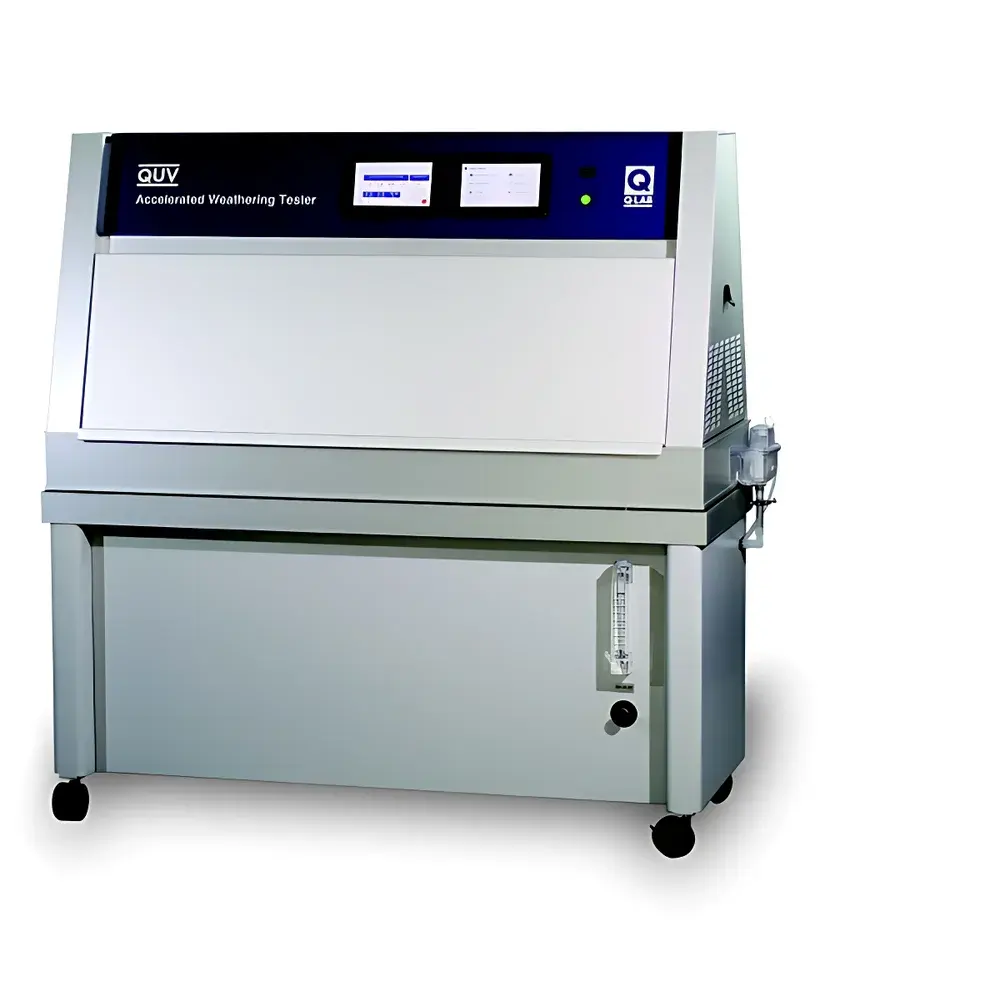
Q-LAB QUV/UVC Advanced UV Germicidal Irradiation Aging Chamber
| Brand | Q-LAB |
|---|---|
| Origin | USA |
| Model | QUV/UVC |
| Test Duration Range | 1–9999 hours (adjustable) |
| UVC Irradiance Range | 10 W/m² (nominal, calibrated at 254 nm) |
| Spectral Peak | 254 nm |
| Black Panel Temperature Range | 63 ± 3 °C |
| Compliance | IEC 60335-1 (UVC-specific safety and performance requirements) |
Overview
The Q-LAB QUV/UVC Advanced UV Germicidal Irradiation Aging Chamber is a purpose-engineered environmental test system designed to evaluate material degradation under controlled, high-energy UVC irradiation—specifically at the 254 nm mercury-line emission wavelength. Unlike conventional UV aging chambers that simulate solar UV (UVA/UVB), the QUV/UVC replicates the spectral output of low-pressure mercury lamps used in ultraviolet germicidal irradiation (UVGI) applications. This enables rigorous, reproducible assessment of polymer stability, coating integrity, filtration media, personal protective equipment (PPE), and interior surface materials exposed to repeated UVGI disinfection cycles in healthcare facilities, aircraft cabins, HVAC ducts, and public transit environments. The chamber operates on a non-weathering principle: it excludes water spray and condensation cycles, focusing exclusively on photochemical degradation driven by 254 nm photons—known for their high quantum efficiency in breaking molecular bonds in organic polymers and nucleic acids.
Key Features
- Optimized UVC optical architecture: Equipped with proprietary low-pressure mercury lamps emitting >90% of total radiant power within the 250–280 nm band, centered precisely at 254 nm—matching industrial UVGI lamp spectral profiles.
- Dedicated UVC radiometric monitoring: Integrated, NIST-traceable broadband UVC sensors (240–280 nm) enable real-time irradiance measurement and closed-loop feedback control—ensuring dose accuracy and repeatability across test runs.
- Enhanced operator safety system: Dual interlocked access doors, automatic lamp shutoff upon door opening, and UVC-specific photodiode-based leakage detection (sensitivity < 0.1 µW/cm²) exceed baseline requirements of IEC 60335-1 for Class II electrical appliances.
- Thermal stabilization: Precision-controlled black panel temperature regulation at 63 ± 3 °C, independently verified per ASTM G154 Annex A3 for UVC exposure protocols.
- Modular test chamber design: Removable sample racks accommodate standard 75 × 150 mm specimens or custom fixtures; internal reflective aluminum surfaces maximize UVC uniformity (±15% across specimen plane per ISO 4892-3).
Sample Compatibility & Compliance
The QUV/UVC accommodates rigid and semi-rigid flat specimens—including thermoplastics (e.g., polycarbonate, ABS), elastomers (silicone, nitrile), coated metals, textile laminates, and medical-grade films—without requiring humidity conditioning or water exposure. It supports testing per emerging industry guidelines including ASTM WK76276 (Proposed Standard Practice for UVC Exposure Testing of Materials Used in UVGI Systems) and aligns with functional safety expectations outlined in IEC 62471 (Photobiological Safety of Lamps). While not intended for weathering simulation, its irradiance control architecture satisfies GLP-compliant data traceability requirements when paired with optional audit-trail-enabled software modules.
Software & Data Management
The QUV/UVC integrates with Q-LAB’s QUVMaster™ v5.2 control software, providing full programmability of exposure duration, irradiance setpoints, and thermal setpoints. All sensor readings—including real-time UVC irradiance (W/m²), accumulated fluence (J/m²), black panel temperature, and system status—are logged with timestamped, encrypted records. Data export complies with FDA 21 CFR Part 11 requirements when configured with electronic signatures and audit trail activation. Optional IQ/OQ documentation packages support laboratory validation under ISO/IEC 17025 and GMP environments.
Applications
- Evaluation of PPE durability (face shields, gowns, respirator straps) under repeated UVGI decontamination cycles.
- Accelerated aging of aircraft interior components (armrests, tray tables, overhead bins) subjected to cabin UVGI systems.
- Stability screening of UV-curable adhesives, optical filters, and antimicrobial coatings exposed to 254 nm irradiation.
- Qualification of HVAC filter media and duct lining materials for long-term UVC exposure without embrittlement or VOC off-gassing.
- Comparative study of polymer photooxidation kinetics under monochromatic 254 nm vs. broadband UVA/UVB stress.
FAQ
What distinguishes the QUV/UVC from standard QUV models (e.g., QUV/se or QUV/sp)?
The QUV/UVC replaces fluorescent UVA-340 or UVB-313 lamps with low-pressure mercury UVC lamps peaking at 254 nm—and removes all water-based exposure functions (spray, condensation) to focus exclusively on photochemical degradation mechanisms relevant to UVGI applications.
Is calibration of the UVC sensor traceable to national standards?
Yes—each UVC irradiance sensor is factory-calibrated against NIST-traceable reference detectors and includes a certificate of calibration valid for 12 months.
Can the QUV/UVC be used for biological inactivation studies?
No—the chamber is designed for material durability assessment only; it does not meet biosafety containment requirements for pathogen handling or quantification of microbial log-reduction.
Does the system comply with electromagnetic compatibility (EMC) directives?
Yes—certified to IEC 61000-6-3 (Emission) and IEC 61000-6-2 (Immunity) for industrial environments.
What maintenance intervals are recommended for UVC lamp replacement?
Lamp lifetime is rated at 1,000 hours at nominal output; Q-LAB recommends scheduled replacement after 900 hours to maintain irradiance consistency within ±5% of initial specification.



