
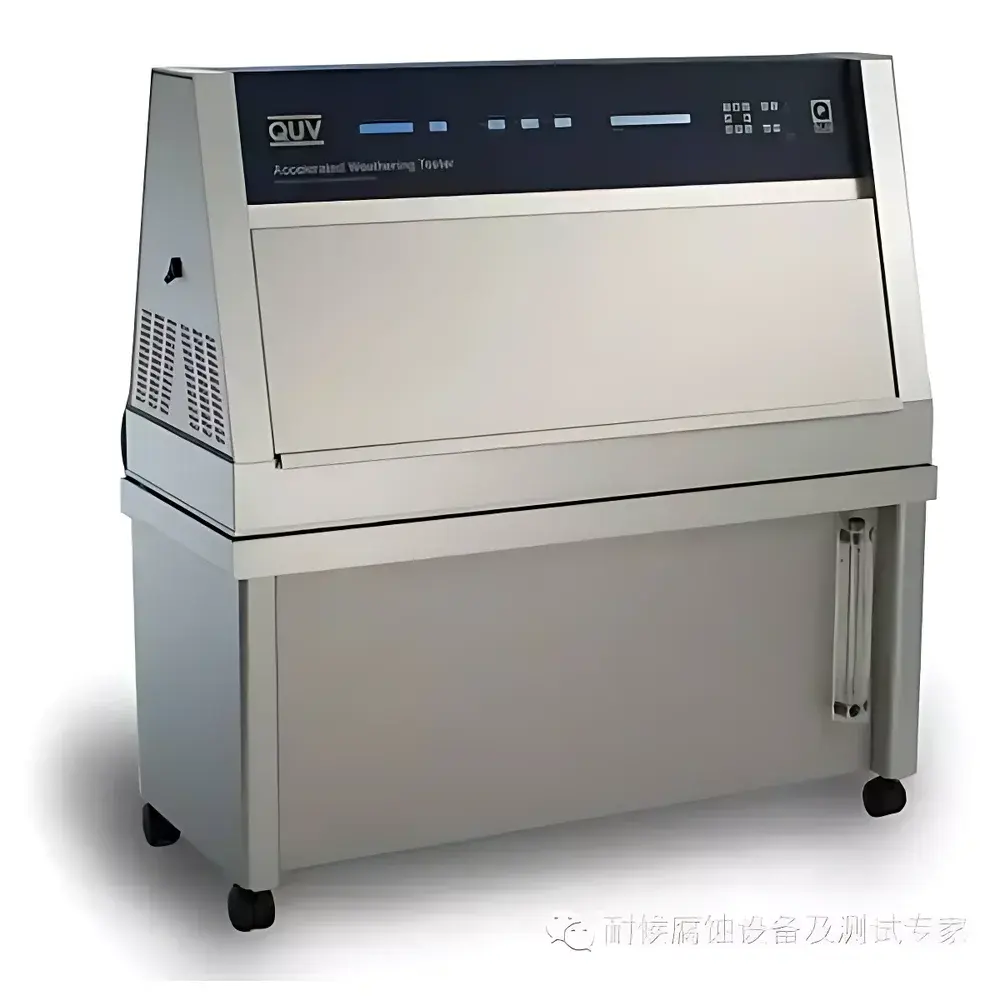
Q-Lab QUV/CW UV Weathering Test Chamber
| Brand | Q-LAB |
|---|---|
| Origin | USA |
| Model | QUV/CW |
| UV Wavelength Range | 280–400 nm |
| Sample Capacity | 24 specimens (75 mm × 300 mm) or 48 specimens (75 mm × 150 mm) |
| Compliance | ASTM G154, ISO 4892-3, SAE J2020, IEC 61215, GB/T 14522 |
| Calibration Support | CR-10/CW Radiometer with traceable NIST-calibrated reference sensor |
| Condensation System | Gravity-fed distilled/deionized water reservoir with external level indicator |
| Irradiance Control | “SunEye” closed-loop feedback system with real-time spectral irradiance monitoring and auto-compensation |
| Lamp Type | UVA-340 or UVB-313 EL (CW-specific), rated lifetime ≥1600 h under controlled irradiance |
Overview
The Q-Lab QUV/CW UV Weathering Test Chamber is an engineered solution for accelerated material degradation testing under controlled ultraviolet (UV) radiation, temperature, and moisture conditions. Based on the fundamental principle of photochemical degradation—where UV photons induce bond scission, oxidation, and crosslinking in polymers, coatings, and composites—the QUV/CW replicates key outdoor exposure stressors in a reproducible laboratory environment. Unlike broad-spectrum xenon arc testers, the QUV/CW employs fluorescent UV lamps (UVA-340 or UVB-313 EL) to deliver spectrally defined irradiance closely matching terrestrial solar UV below 400 nm. Its proprietary “SunEye” irradiance control system continuously monitors spectral output via a calibrated photodiode sensor mounted adjacent to test specimens, enabling real-time feedback adjustment of lamp power to maintain setpoint irradiance (e.g., 0.68 W/m² @ 340 nm) within ±3% tolerance. This closed-loop architecture ensures metrological traceability to NIST standards when used with the CR-10/CW radiometer—a critical requirement for GLP-compliant quality assurance programs.
Key Features
- Integrated condensation cycle simulates nocturnal dew formation using gravity-fed, ambient-temperature distilled or deionized water—no external chiller required.
- Front-access, upward-swinging door design minimizes footprint and enhances operator ergonomics during specimen loading/unloading.
- Modular specimen racks accommodate standardized sample formats: up to 24 pieces of 75 mm × 300 mm or 48 pieces of 75 mm × 150 mm, with adjustable mounting depth for varying substrate thicknesses.
- Externally mounted water-level indicator and bottom-mounted heating element extend service life and simplify preventive maintenance.
- Four-wheel casters (standard) enable repositioning without disassembly; all electrical connections are rear-panel mounted for clean integration into controlled lab environments.
- Programmable test sequences support multi-step protocols—including UV irradiation, condensation hold, and optional water spray—with user-defined dwell times, ramp rates, and irradiance setpoints.
- Automatic irradiance calibration routine (patented) compensates for lamp aging, reducing manual intervention and extending effective lamp service life beyond 1600 hours.
Sample Compatibility & Compliance
The QUV/CW accommodates rigid and semi-rigid flat specimens up to 12 mm thick, including painted metal panels, plastic injection-molded parts, automotive trim, architectural sealants, photovoltaic encapsulants, and textile laminates. It conforms to internationally recognized weathering standards including ASTM G154 (Standard Practice for Operating Fluorescent Ultraviolet (UV) Lamp Apparatus for Exposure of Non-Metallic Materials), ISO 4892-3 (Plastics — Methods of exposure to laboratory light sources — Part 3: Fluorescent UV lamps), SAE J2020 (Laboratory Accelerated Weathering of Automotive Exterior Materials), and IEC 61215 (Terrestrial Photovoltaic Modules). Its irradiance control architecture supports FDA 21 CFR Part 11–compliant data integrity when paired with Q-Lab’s optional QUV Software Suite, which logs timestamped irradiance, black panel temperature, chamber humidity, and condensation duration with full audit trail functionality.
Software & Data Management
The QUV/CW operates via an embedded microprocessor controller with intuitive membrane keypad interface and backlit LCD display. Optional QUV Software Suite (Windows-based) enables remote monitoring, automated report generation (PDF/CSV), and secure user-role management (administrator, technician, reviewer). All measurement parameters—including irradiance (W/m² @ 340 nm), black panel temperature (°C), condensation duration (min), and elapsed test time—are recorded at user-configurable intervals (1–60 min). Raw data files include digital signatures and tamper-evident metadata compliant with GLP/GMP documentation requirements. Calibration events—executed using the CR-10/CW radiometer—are automatically timestamped and archived with instrument ID, operator ID, and reference standard traceability.
Applications
This chamber is routinely deployed in R&D laboratories and QC departments for comparative durability assessment of UV-stabilized resins, automotive clearcoats, aerospace composites, roofing membranes, and medical device packaging. It supports failure mode analysis such as chalking, gloss loss, color shift (ΔE*), cracking, and adhesion loss—correlating strongly with field performance in subtropical and desert climates. In photovoltaic manufacturing, it validates encapsulant yellowing resistance per IEC 61215 Annex A. For regulatory submissions, its adherence to ASTM and ISO protocols provides defensible evidence of material robustness under UV-driven aging mechanisms.
FAQ
What UV spectra does the QUV/CW generate?
The QUV/CW uses UVA-340 lamps to replicate solar UV from 295–365 nm, or UVB-313 EL lamps for enhanced short-wavelength output (280–360 nm), both conforming to ASTM G154 spectral requirements.
How is temperature measured and controlled?
Black panel temperature sensors (ASTM D6695-compliant) are mounted directly behind specimens to capture surface-relevant thermal loading; chamber air temperature is monitored separately but not actively controlled.
Is distilled water mandatory for condensation cycles?
Yes—distilled or deionized water is required to prevent mineral deposition on lamp surfaces and specimen holders, ensuring optical consistency and long-term system reliability.
Can the QUV/CW perform cyclic testing with spray?
No—the QUV/CW model excludes spray functionality; for combined UV/spray protocols, the QUV/se or Q-SUN Xe-1 models are recommended.
What documentation accompanies calibration?
Each CR-10/CW radiometer includes a NIST-traceable calibration certificate with uncertainty budget, valid for 12 months; Q-Lab provides annual recalibration services with certified turnaround.



