
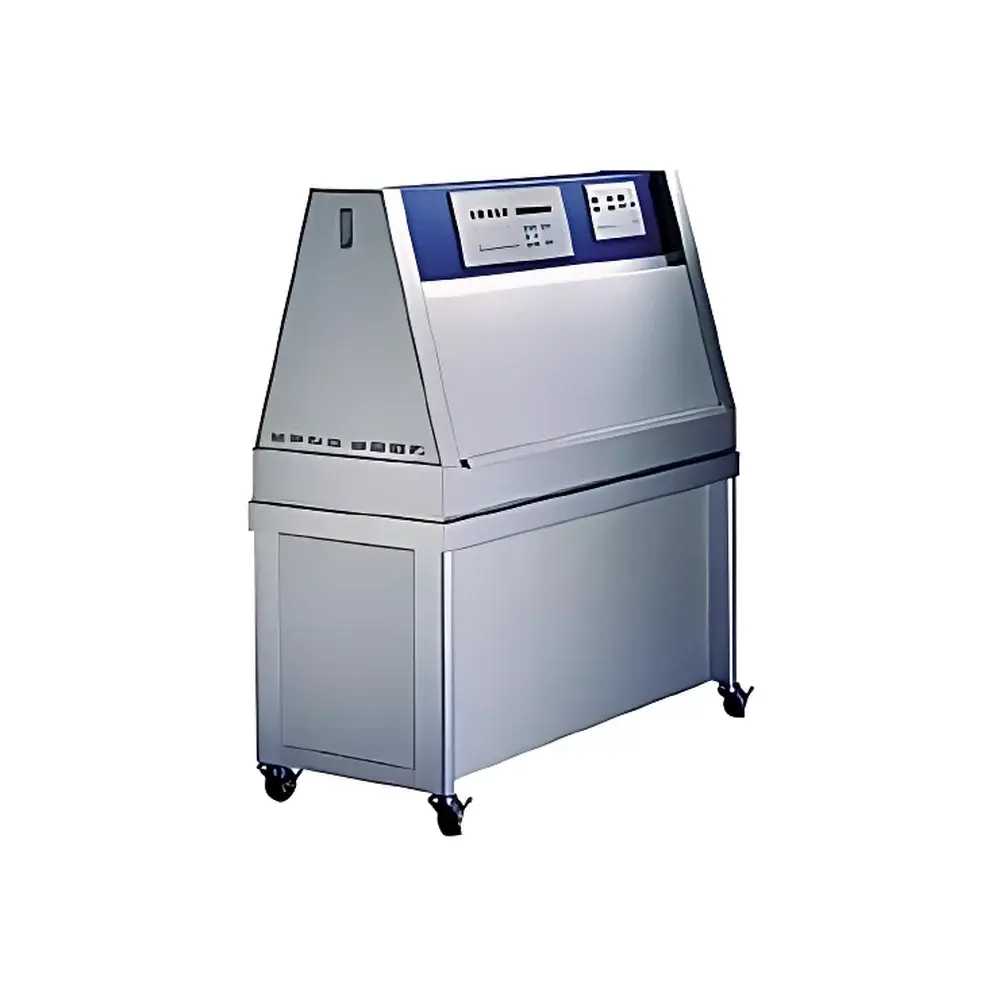
Q-LAB QUV/basic UV Aging Test Chamber
| Brand | Q-LAB |
|---|---|
| Origin | USA |
| Model | QUV/basic |
| UV Wavelength Range | 320–400 nm (UVA-340 & UVB-313 lamp options standard) |
| Sample Capacity | 24 specimens (75 mm × 300 mm) or 48 specimens (75 mm × 150 mm) |
| Condensation Cycle | Simulated dew via heated water reservoir and controlled chamber humidity |
| Irradiance Control | Optional CR-10 radiometer-based feedback system with NIST-traceable calibration |
| Compliance | ASTM G154, ISO 4892-3, JIS D0205, SAE J2020, GB/T 14522, and other international UV exposure standards |
| Black Panel Temperature Range | 40–75 °C (adjustable per test protocol) |
| Operating Ambient | 10–30 °C, < 80% RH non-condensing |
| Cabinet Dimensions (approx.) | 1100 mm (L) × 600 mm (W) × 500 mm (H) |
| Weight | ~90 kg (net) |
Overview
The Q-LAB QUV/basic UV Aging Test Chamber is an engineered environmental test system designed to accelerate material degradation under controlled ultraviolet (UV) radiation, temperature, and moisture conditions. Based on the well-established QUV platform—developed and validated by Q-LAB Corporation in Westlake, Ohio—the QUV/basic implements the fundamental principles of xenon-free UV exposure testing using fluorescent UV lamps (UVA-340 or UVB-313) to replicate critical short-wave solar spectral regions responsible for polymer photochemical degradation. Unlike broad-spectrum xenon arc systems, the QUV/basic delivers high-intensity, spectrally stable UV output within the 320–400 nm range—covering the most damaging portion of terrestrial sunlight. Its core architecture integrates three synchronized stress factors: UV irradiance, black panel temperature control, and condensation-driven humidity cycling—enabling reproducible simulation of outdoor weathering mechanisms including photolysis, thermal oxidation, and hydrolytic surface erosion. The system operates without requiring chilled water, compressed air, or external exhaust ducting, making it suitable for standard laboratory environments compliant with ANSI/ASHRAE 110 and ISO 17025 facility guidelines.
Key Features
- Microprocessor-based controller with intuitive menu navigation, real-time parameter display, and programmable test profiles—including multi-step irradiance, temperature, and condensation cycles.
- Patented black panel temperature sensor mounted directly behind specimen holders ensures accurate surface temperature measurement aligned with ASTM G154 Annex A2 requirements.
- Condensation mechanism utilizes heated distilled or deionized water reservoir (not submerged heater elements), enabling stable dew-point simulation without mineral buildup or premature heater failure.
- Front-accessible water level indicator and external fill port simplify routine maintenance and reduce operational downtime.
- Top-hinged, upward-opening door design minimizes floor space footprint and allows unobstructed specimen loading—even in confined lab settings.
- Integrated error-detection logic provides audible/visual alarms and automatic shutdown upon sensor fault, overtemperature, or low-water condition.
- Standard sample capacity accommodates either 24 specimens (75 mm × 300 mm) or 48 specimens (75 mm × 150 mm), conforming to ASTM D7869 and ISO 4892-3 specimen mounting conventions.
- Optional irradiance monitoring via CR-10 radiometer enables closed-loop intensity regulation and traceable calibration per NIST SRM 2242 protocols.
- Rolling casters (standard) support safe relocation without disassembly; leveling feet ensure stability during extended exposure runs.
Sample Compatibility & Compliance
The QUV/basic accepts flat, rigid specimens up to 4 mm thickness and is routinely used for evaluating coatings, plastics, automotive trim, architectural sealants, textile fibers, and photovoltaic encapsulants. Specimen mounting fixtures comply with ASTM D6675 and ISO 4892-3 dimensional tolerances. All operational modes meet the regulatory and methodological requirements of ASTM G154 (Cycle 1–6), ISO 4892-3 (Method A & B), JIS D0205, SAE J2020, GB/T 14522, and DIN 53387. When configured with optional irradiance control and audit trail logging, the system supports GLP-compliant data integrity frameworks aligned with FDA 21 CFR Part 11 Annex 11 expectations for electronic records and signatures.
Software & Data Management
The embedded controller stores up to 100 test programs with timestamped cycle logs, including irradiance setpoints, black panel temperature history, condensation duration, and runtime diagnostics. Data export is supported via USB flash drive (CSV format) for post-processing in Excel or LIMS integration. Optional Q-LAB’s SolarEye™ software (v5.2+) provides remote monitoring, automated report generation, and trend analysis across multiple QUV units—supporting ISO/IEC 17025 accredited laboratories’ documentation workflows. All firmware updates are distributed through Q-LAB’s secure customer portal and include version-controlled release notes and validation summaries.
Applications
Typical use cases include accelerated weathering qualification of automotive clearcoats per GMW14872, durability assessment of exterior building materials per ASTM D4798, UV resistance screening of medical device polymers (ISO 10993-12), and long-term stability evaluation of OLED encapsulation layers. Research institutions utilize the QUV/basic for mechanistic studies of photooxidative chain scission in polyolefins, while QC labs deploy it for incoming raw material verification against supplier specifications. Its deterministic UV spectrum and tightly controlled thermal-hygrometric environment make it particularly valuable for comparative ranking of stabilizer packages and pigment dispersion performance.
FAQ
What UV lamp types are compatible with the QUV/basic?
The system supports UVA-340 (best match to solar UV below 365 nm) and UVB-313 (enhanced degradation for rapid screening) fluorescent lamps—both manufactured and certified by Q-LAB.
Is the QUV/basic compliant with ASTM G154 Cycle 4 (condensation only)?
Yes—condensation-only operation is fully supported via independent control of water reservoir temperature and chamber ambient conditions.
Can I retrofit irradiance control to an existing QUV/basic unit?
Retrofit kits—including CR-10 sensor, mounting hardware, and firmware upgrade—are available directly from Q-LAB authorized service centers.
What maintenance intervals are recommended for optimal lamp life?
Lamps should be replaced every 1,500–2,000 hours of operation; periodic irradiance verification using a calibrated radiometer is advised every 500 hours.
Does the QUV/basic require a dedicated electrical circuit?
A single-phase 120 VAC / 60 Hz (or 230 VAC / 50 Hz) 15 A circuit with grounded outlet is sufficient; no special grounding beyond standard lab infrastructure is required.



