
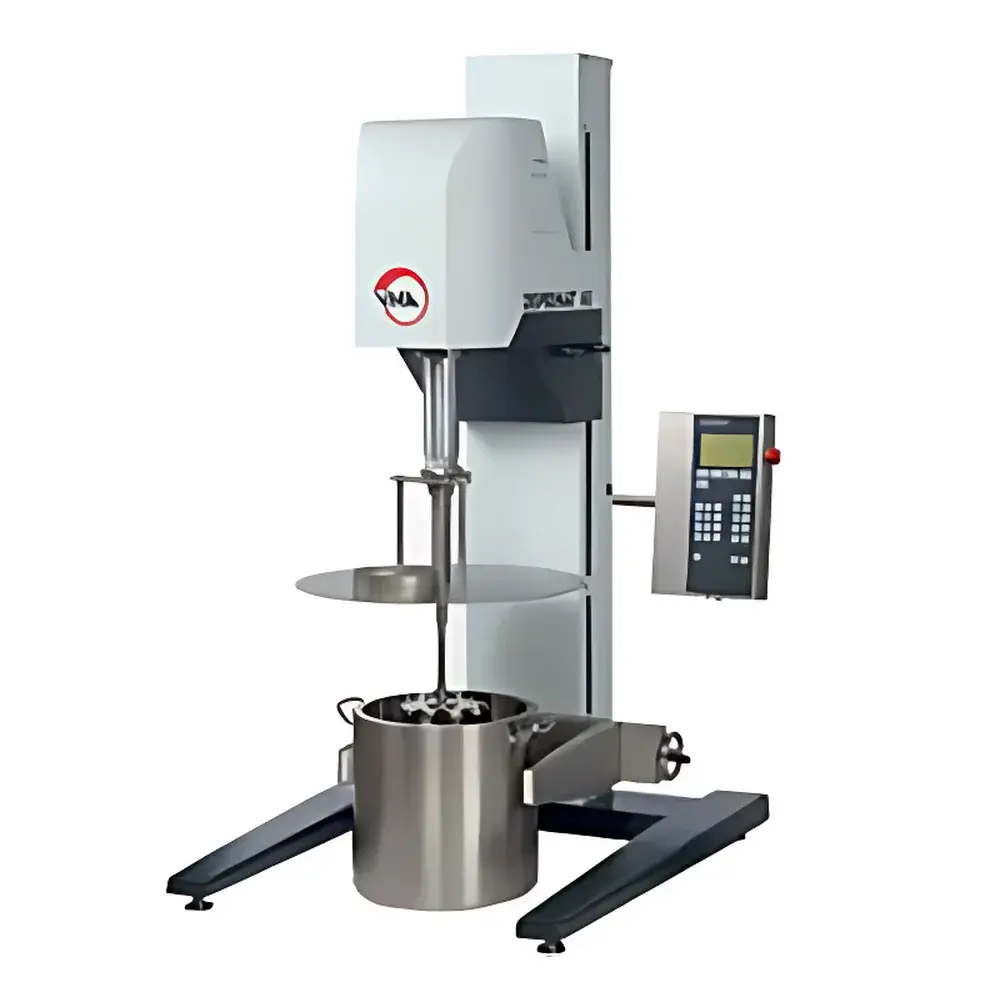
VMA AE12 High-Speed Homogenizer & Dispersion System
| Brand | VMA |
|---|---|
| Origin | Germany |
| Model | AE12 |
| Drive Type | Electrically Actuated Height Adjustment |
| Safety System | Integrated Mechanical/Electronic Interlock |
| Control Interface | C-Process Digital Panel with Real-Time Parameter Monitoring |
| Dispersion Geometry | Dual-Function Rotor-Stator + ASC Scraping Blade for High-Viscosity Homogenization |
| Compliance | CE, ISO 13849-1 (PL e), EN 61000-6-2/6-4 |
Overview
The VMA AE12 High-Speed Homogenizer & Dispersion System is an industrial-grade laboratory instrument engineered for reproducible, scalable processing of complex dispersions, emulsions, suspensions, and high-viscosity pastes. Operating on the principle of controlled rotor-stator shear combined with dynamic mechanical scraping, the AE12 delivers precise energy input across a wide viscosity range—from low-shear pre-mixing to high-intensity homogenization (up to 50,000 s⁻¹ local shear rate at the stator edge). Its modular architecture integrates a vertically adjustable dispersion shaft driven by a brushless DC motor, enabling consistent gap control between rotor and stator—critical for achieving narrow particle size distributions in nanoparticle synthesis, pigment dispersion, or pharmaceutical suspension development. Designed for routine QC, R&D formulation, and pilot-scale process transfer, the AE12 meets the operational rigor required in GLP-compliant laboratories and GMP-aligned development environments.
Key Features
- Electrically actuated height adjustment via BK3 precision bracket—enabling repeatable immersion depth control (±0.1 mm resolution) without manual recalibration.
- ASC (Adaptive Scraping Concept) dual-blade system: A rotating scraper blade maintains continuous contact with vessel walls and bottom, eliminating dead zones and ensuring uniform treatment of high-viscosity materials (>50,000 mPa·s).
- C-Process digital control panel with real-time display of rotational speed (0–6,000 rpm), torque (0–15 N·m), elapsed time, material temperature (via integrated Pt100 sensor), and instantaneous power draw (kW).
- Configurable limit thresholds for torque, temperature, and power—triggering automatic shutdown or speed reduction to prevent thermal degradation or mechanical overload.
- Integrated safety architecture compliant with ISO 13849-1 (Performance Level e): Includes guarded lid interlock, emergency stop circuit, and stall-detection logic that halts rotation within <100 ms upon abnormal load surge.
- Linear motion system with hardened stainless-steel guide rails and anti-backlash drive—ensuring long-term positional stability and minimal vibration transmission during extended operation.
Sample Compatibility & Compliance
The AE12 accommodates sample volumes from 50 mL to 5 L using interchangeable dispersing tools (e.g., toothed discs, saw-tooth rotors, fine-gap stators) and vessel geometries (cylindrical, conical, jacketed). It supports aqueous, solvent-based, and reactive systems—including shear-sensitive biopolymers, thermosetting resins, and nanocomposite slurries. All wetted parts are electropolished AISI 316L stainless steel or PTFE-coated, meeting USP Class VI and FDA 21 CFR Part 11 requirements for data integrity when paired with optional audit-trail-enabled software. The system conforms to CE marking directives (2006/42/EC Machinery Directive, 2014/30/EU EMC Directive) and supports IQ/OQ documentation packages for regulated environments.
Software & Data Management
Raw operational data—including timestamped speed, torque, temperature, and power—is logged at 10 Hz via RS485 or Ethernet interface and exported as CSV or XML files for post-processing in MATLAB, Python, or LIMS platforms. The C-Process interface allows creation, editing, and secure storage of up to ten user-defined protocols with password protection. Each protocol stores target parameters, ramp profiles, hold durations, and safety limits. Optional VMA Connect software enables remote monitoring, multi-instrument synchronization, and automated report generation aligned with ISO/IEC 17025 documentation standards.
Applications
- Pharmaceutical: Preparation of nanoemulsions for oral delivery, homogenization of API suspensions prior to lyophilization, and dispersion of excipients in semi-solid formulations.
- Materials Science: Exfoliation of 2D materials (e.g., graphene, MXenes), dispersion of carbon nanotubes in polymer matrices, and stabilization of quantum dot colloids.
- Coatings & Inks: Deagglomeration of pigment concentrates, rheological conditioning of waterborne acrylics, and viscosity-controlled dispersion of TiO₂ nanoparticles.
- Food & Cosmetics: Cold homogenization of plant-based dairy alternatives, stabilization of oil-in-water emulsions (e.g., mayonnaise analogues), and uniform incorporation of functional ingredients (vitamins, probiotics).
- Electrochemical: Slurry preparation for Li-ion battery cathodes/anodes, ensuring homogeneous distribution of active material, conductive carbon, and binder without gelation or shear-induced degradation.
FAQ
What is the maximum recommended viscosity for continuous operation with the ASC scraping blade?
The ASC system is rated for continuous operation up to 50,000 mPa·s at 25°C; above this, intermittent duty cycles with cooling intervals are advised to maintain thermal stability.
Can the AE12 be integrated into an automated lab workflow via PLC or SCADA?
Yes—the device supports Modbus RTU/TCP and EtherNet/IP protocols for seamless integration with programmable logic controllers and central lab automation systems.
Is validation support available for GMP environments?
VMA provides IQ/OQ templates, calibration certificates traceable to DKD/DAkkS standards, and assistance with risk-based validation planning per ASTM E2500 and ICH Q9 guidelines.
How often does the stator-rotor set require replacement under standard use conditions?
With proper cleaning and avoidance of abrasive fillers, typical service life exceeds 1,200 operating hours; wear inspection is recommended every 200 hours for critical applications.
Does the system comply with noise emission limits for ISO 14001-certified facilities?
Yes—the AE12 operates at ≤62 dB(A) at 1 m distance under full load, satisfying ISO 7779 and EU Directive 2000/14/EC noise labeling requirements.
Related Products



