
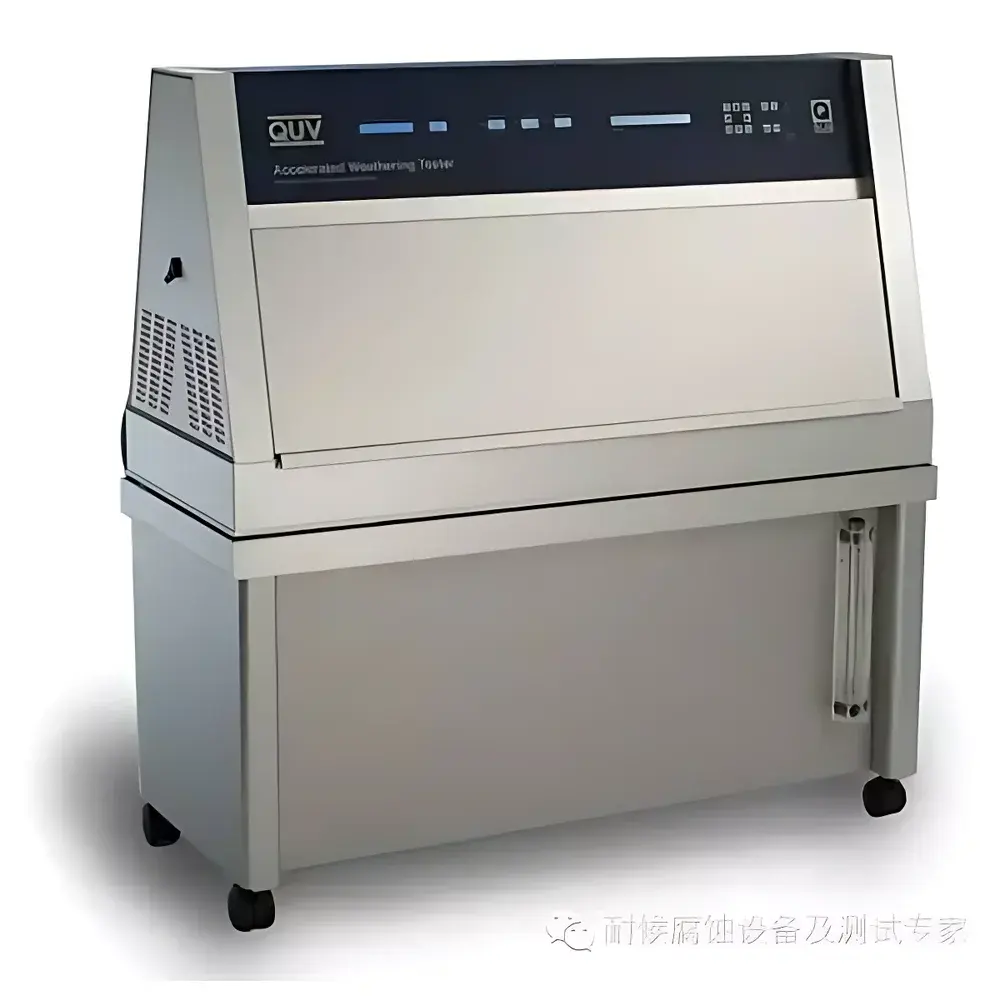
Q-LAB QUV Accelerated UV Weathering Tester
| Brand | Q-LAB |
|---|---|
| Origin | Canada |
| Manufacturer Type | Authorized Distributor |
| Origin Category | Imported |
| Model | QUV (Imported from USA) |
| Quotation | Upon Request |
| Illuminant Temperature Range (°C) | Configurable per test standard |
| Black Panel Temperature Range (°C) | 35–80 °C (typical operating range) |
| UV Wavelength Range (nm) | 295–400 nm (selectable via lamp type: UVA-340 or UVB-313) |
| Chamber Dimensions (L×W×H) | 1100 × 500 × 420 mm (standard QUV se model) |
Overview
The Q-LAB QUV Accelerated UV Weathering Tester is an industry-standard benchtop environmental test chamber engineered for precision simulation of solar ultraviolet radiation and associated moisture effects on polymeric, coating, and composite materials. Based on the fundamental principle of accelerated photochemical degradation—driven by controlled UV irradiance in the critical 295–400 nm spectral band—the QUV system replicates the primary weathering stressors responsible for surface deterioration: photolysis, oxidation, and hydrolysis. Unlike broad-spectrum xenon arc testers, the QUV employs fluorescent UV lamps to deliver highly reproducible, spectrally stable output that closely matches the short-wavelength cutoff of terrestrial sunlight (UVA-340) or provides aggressive acceleration (UVB-313). Its integrated condensation cycle mimics nocturnal dew formation through controlled water vapor saturation on cooled specimen surfaces, while optional water spray functionality simulates thermal shock and surface washing. This dual-stress architecture enables rigorous compliance with internationally recognized accelerated exposure protocols across R&D, quality assurance, and regulatory validation workflows.
Key Features
- Patented AUTOCAL irradiance calibration system enabling rapid, traceable recalibration without external sensors or downtime
- Dual-lamp compatibility: UVA-340 (spectral match to sunlight UV below 365 nm) and UVB-313 (enhanced short-wave output for accelerated failure mode induction)
- Black panel temperature control (35–80 °C) with high-stability PID regulation and real-time monitoring
- Condensation humidity cycle generated via heated water reservoir and cooled specimen plane—no external humidifier required
- Optional water spray module for cyclic thermal quenching and surface contamination simulation
- Self-diagnostic firmware with predictive maintenance alerts, error logging, and operational history tracking
- Intuitive touchscreen interface supporting five languages (English, French, Spanish, Italian, German) and continuous display of irradiance, temperature, and cycle phase
- Robust stainless-steel chamber construction with UV-resistant insulation and interlocked safety door
Sample Compatibility & Compliance
The QUV accommodates up to 48 standard specimens (75 mm × 150 mm) on removable sample racks, ensuring uniform irradiance distribution and unobstructed condensation contact. Specimen holders are compatible with ASTM D610, ISO 1514, and JIS K 5600-1 compliant mounting fixtures. The system meets the hardware and operational requirements of over 50 international standards—including ASTM G154 (fluorescent UV exposure), ASTM D4587 (coating durability), ISO 4892-3 (plastics—UV exposure), JIS D 0205 (automotive exterior materials), SAE J2020 (headlamp lens durability), and NACE TM0184 (corrosion protection systems). Its design supports GLP-compliant data integrity through audit-trail-capable software integration and conforms to FDA 21 CFR Part 11 when paired with validated Q-LAB’s SOLAR EYE™ or QUV PC software packages.
Software & Data Management
When interfaced with Q-LAB’s SOLAR EYE™ software (Windows-based), the QUV enables full remote monitoring, automated test method execution, and export of time-stamped irradiance, temperature, and humidity logs in CSV or PDF formats. All data records include operator ID, instrument serial number, lamp batch traceability, and calibration certificate references. The software supports electronic signatures, version-controlled method libraries, and automatic generation of test reports aligned with ISO/IEC 17025 documentation frameworks. Optional QUV PC software provides local data archiving with built-in backup scheduling and user-access-level permissions for multi-user laboratory environments.
Applications
- Automotive OEMs validating paint clearcoat resistance to chalking, gloss loss, and microcracking under South Florida or Arizona exposure conditions
- Coating manufacturers qualifying architectural acrylics and fluoropolymer topcoats per AAMA 2605 and ISO 20340 marine specifications
- Medical device polymer suppliers assessing UV-induced embrittlement of PVC tubing and silicone elastomers per ISO 10993-12
- Roofting membrane producers conducting ASTM D4799 cyclic aging to predict field service life of EPDM and TPO sheets
- Aerospace composites labs evaluating resin matrix stability in carbon fiber laminates exposed to high-altitude UV spectra
- Adhesive formulators testing bondline integrity under UV/moisture cycling per ASTM C1184 and ASTM D4674
FAQ
What UV lamp types are supported, and how do they differ?
The QUV accepts UVA-340 lamps (peak emission at 340 nm; best match to solar UV below atmospheric ozone cutoff) and UVB-313 lamps (peak at 313 nm; higher energy photons for accelerated screening). Lamp selection must align with target standard requirements.
Is black panel temperature the same as chamber air temperature?
No. Black panel temperature measures surface temperature of a thermally mass-loaded sensor mounted adjacent to specimens—critical for correlating thermal stress with photochemical reaction kinetics. Air temperature is not directly controlled or reported.
Can the QUV be used for non-standard or custom test profiles?
Yes. Through SOLAR EYE™ software, users may define multi-step irradiance/temperature/humidity sequences, including ramp rates, dwell times, and conditional triggers—subject to hardware limits and lamp spectral constraints.
How often does the system require recalibration?
Irradiance sensors should be verified every 500 hours of operation or quarterly (whichever occurs first); AUTOCAL reduces verification time to under 2 minutes. Black panel sensors are calibrated annually per ISO/IEC 17025 guidelines.
Does the QUV meet ISO/IEC 17025 accreditation requirements for testing laboratories?
Yes—when operated with documented procedures, traceable calibration artifacts, and validated software configurations, the QUV satisfies Clause 6.4 (Equipment) and Clause 7.7 (Reporting of Results) of ISO/IEC 17025:2017.



