
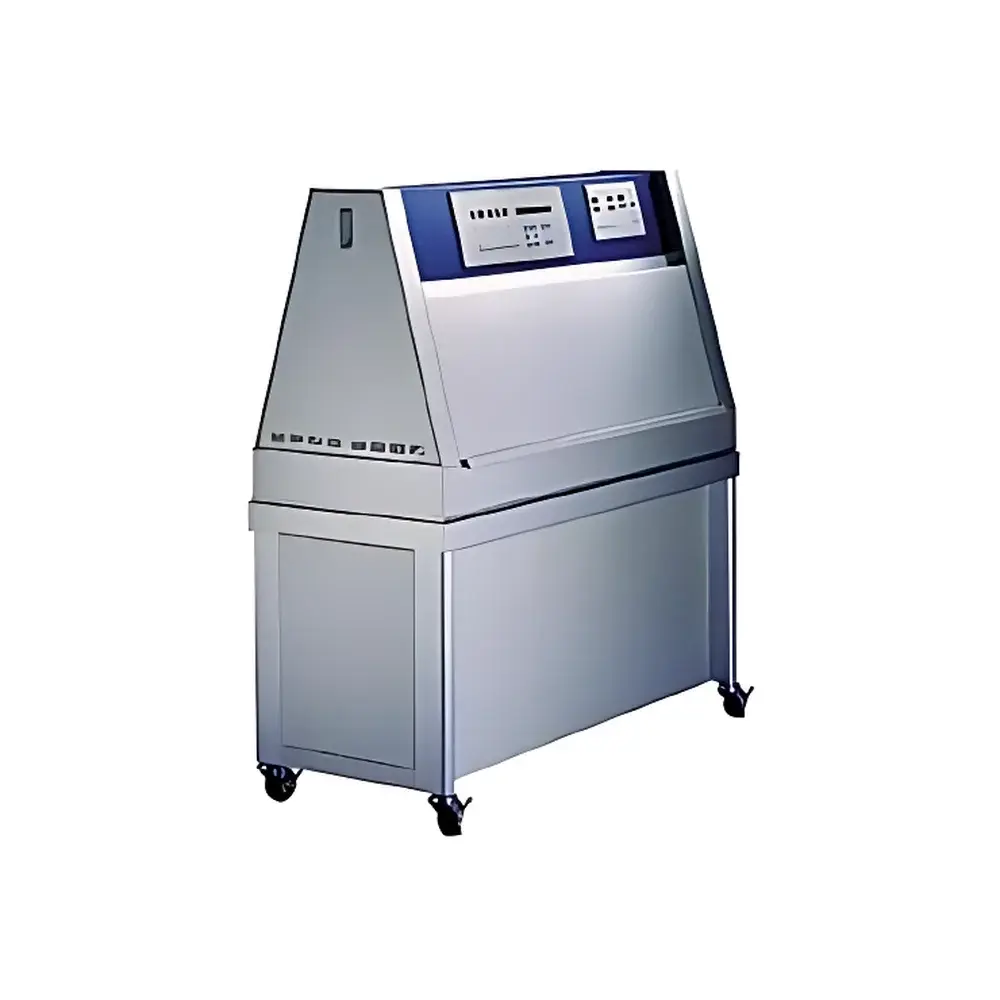
Q-LAB QUV/cw UV Aging Test Chamber
| Brand | Q-LAB |
|---|---|
| Origin | USA |
| Model | QUV/cw |
| UV Wavelength Range | 280–400 nm |
| Lamp Type | Cold White Fluorescent (CW) |
| Compliance | ISO 9000, ISO 4892-3, ASTM G154, IEC 60068-2-5 |
| Sample Mounting | Clip-in Rack System |
| Control System | Digital PID Controller with Manual/Programmable Modes |
| Chamber Construction | Stainless Steel Interior, Aluminum Exterior |
| Safety Features | Over-temperature Protection, UV Interlock Door Switch, Ground Fault Circuit Interrupter (GFCI) |
Overview
The Q-LAB QUV/cw UV Aging Test Chamber is an engineered environmental test system designed to simulate indoor light exposure conditions—specifically fluorescent lighting environments found in retail stores, museums, offices, and display settings. Unlike standard UV weathering chambers that replicate solar UV radiation (e.g., UVA-340 or UVB-313 lamps), the QUV/cw utilizes cold white fluorescent (CW) lamps emitting a broad-spectrum output centered around visible wavelengths (peaking near 435 nm), with minimal UV contribution below 320 nm. This spectral profile closely matches commercial fluorescent lighting used globally for product presentation, enabling realistic assessment of photodegradation mechanisms such as yellowing, gloss loss, color shift, and polymer embrittlement under non-solar illumination. The chamber operates on the principle of controlled photon exposure at regulated temperature and humidity conditions, facilitating reproducible accelerated aging tests aligned with international standards for indoor light stability evaluation.
Key Features
- Cold white fluorescent (CW) lamp array optimized for indoor lighting simulation—spectrally distinct from outdoor UV lamps (UVA-340/UVB-313)
- Digital PID-controlled black panel temperature regulation with independent monitoring and setpoint adjustment
- Stainless steel interior chamber with corrosion-resistant construction and seamless welds for long-term reliability
- Clip-in sample rack system allowing rapid, tool-free specimen loading and uniform exposure geometry
- Integrated UV interlock safety switch preventing lamp operation when door is open
- Over-temperature protection circuit and ground fault circuit interrupter (GFCI) compliant with UL 61010-1 and IEC 61010-1
- Compliance-ready design supporting audit trails for GLP/GMP-aligned laboratories
Sample Compatibility & Compliance
The QUV/cw accommodates flat, rigid specimens up to 12 mm thick and 150 mm × 75 mm in planar dimension, mounted vertically on standardized clip racks. It supports diverse material classes including thermoplastics (e.g., ABS, PC, PMMA), coated metals, printed inks, textiles, adhesives, and architectural finishes. Regulatory alignment includes full conformance with ASTM G154 (Standard Practice for Operating Fluorescent Ultraviolet (UV) Lamp Apparatus for Exposure of Non-Metallic Materials), ISO 4892-3 (Plastics — Methods of Exposure to Laboratory Light Sources — Part 3: Fluorescent UV Lamps), and IEC 60068-2-5 (Environmental Testing — Part 2-5: Tests — Test Sa: Simulated Solar Radiation at Ambient Temperature). While not intended for outdoor weathering correlation, its CW spectrum enables direct comparison against real-world indoor exposure data per ISO 11341 (Paints and Varnishes — Artificial Weathering and Exposure to Artificial Radiation — Exposure to Fluorescent UV Lamps and Water).
Software & Data Management
The QUV/cw operates via a dedicated digital controller with programmable cycle sequencing (UV exposure, dark condensation, temperature ramping) and real-time parameter logging. All operational data—including black panel temperature, elapsed exposure time, and lamp status—are stored internally with timestamping. Export is supported via USB interface in CSV format for traceability and post-test analysis. The system architecture supports 21 CFR Part 11-compliant configurations when integrated with validated third-party laboratory information management systems (LIMS), including electronic signature capability, audit trail generation, and user access control. Calibration of irradiance sensors follows ISO/IEC 17025 guidelines using NIST-traceable CR10 radiometers, with calibration records retained for ≥5 years per quality management system requirements.
Applications
This chamber is routinely deployed in R&D and QC laboratories for evaluating the photostability of products exposed to interior lighting environments—such as automotive interior trims, pharmaceutical packaging labels, museum artifact conservation materials, retail signage films, office furniture laminates, and consumer electronics housings. It supports comparative studies between formulations, validates shelf-life claims under ambient lighting, and informs material selection during early-stage design reviews. In regulatory contexts, test reports generated on the QUV/cw are accepted by notified bodies for CE marking documentation (EN ISO 10993-12) and FDA submission dossiers where indoor light-induced degradation is a critical performance criterion.
FAQ
What distinguishes the QUV/cw from other QUV models like QUV/se or QUV/spray?
The QUV/cw uses cold white fluorescent lamps instead of UV-specific lamps; it simulates indoor lighting, not solar UV exposure.
Can the QUV/cw be used for outdoor weathering correlation?
No—its spectral output does not replicate terrestrial solar UV and is not suitable for outdoor durability prediction.
Is irradiance control available on the QUV/cw model?
No—the QUV/cw lacks the “SunEye” irradiance feedback system; irradiance is fixed per lamp specification and requires periodic lamp replacement per manufacturer guidelines.
Does the QUV/cw support humidity control or water spray functionality?
No—only UV exposure and black panel temperature control are implemented; no condensation or spray modules are included.
What calibration documentation is provided with the instrument?
Each unit ships with a factory calibration certificate traceable to NIST standards, covering black panel temperature sensor accuracy and timer verification.



