
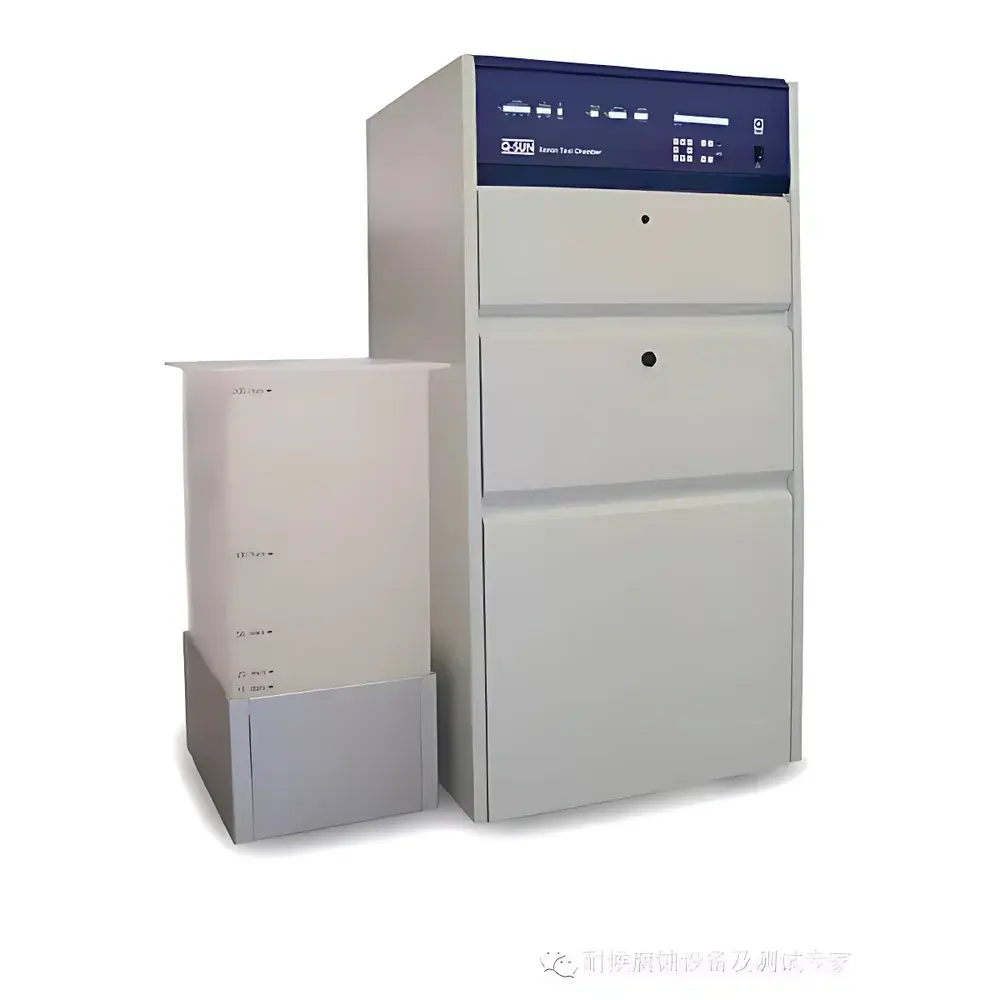
Q-Lab Xe-3-H Xenon Arc Weathering Test Chamber
| Brand | Q-Lab |
|---|---|
| Origin | USA |
| Model | Xe-3-H |
| Lamp Type | Air-Cooled Xenon Arc Lamp (3-lamp configuration) |
| Lamp Life | 1500 hours |
| Spectral Filtering Options | Daylight, Window Glass (Window-Q, Window-B/SL, Window-IR), Extended UV (UV-Q/B) |
| Irradiance Control | SOLAR EYE® broadband or narrowband (340 nm, 420 nm, TUV) |
| Temperature Control | Black Panel Temperature (42–120 °C), Chamber Air Temperature (ambient to ~80 °C) |
| Humidity Control | Relative Humidity (10–95% RH, standard) |
| Sample Tray Dimensions | 451 mm × 718 mm |
| Max Sample Capacity | 51 specimens (51 mm × 102 mm) |
| Calibration Support | CR20 Irradiance Calibrator, CT202 Black Panel Thermometer |
| Compliance Ready | ASTM G155, ISO 4892-2, SAE J2527, AATCC TM16, ISO 11341, GB/T 16422.2, FDA 21 CFR Part 11 (via optional software audit trail) |
Overview
The Q-Lab Xe-3-H Xenon Arc Weathering Test Chamber is an advanced, fully automated environmental test system engineered for accelerated weathering and light stability evaluation of materials under controlled solar-spectrum irradiation. It employs three air-cooled xenon arc lamps to reproduce the full solar spectrum—spanning ultraviolet (UV), visible, and near-infrared (NIR) wavelengths—with high fidelity. Unlike narrowband UV fluorescent systems, the Xe-3-H delivers photometrically accurate spectral power distribution (SPD) that closely matches terrestrial sunlight, enabling reliable correlation with real-world outdoor exposure. Its horizontal sample orientation, combined with programmable humidity control, black panel temperature regulation, and optional dual-spray functionality (including acid rain simulation), ensures physiologically relevant moisture cycling and thermal stress profiles. Designed for continuous unattended operation, the Xe-3-H supports GLP- and GMP-aligned testing workflows through integrated data logging, self-diagnostic alerts, and traceable calibration protocols.
Key Features
- Air-cooled triple-xenon lamp architecture—eliminates water cooling infrastructure, reduces operational cost, and simplifies maintenance.
- SOLAR EYE® irradiance feedback control system maintains precise spectral output at user-selected wavelengths (340 nm, 420 nm, or total UV/TUV), ensuring repeatability across test runs and laboratories.
- Independent black panel temperature (BPT) and chamber air temperature control—enabling simultaneous regulation of surface heating and ambient thermal conditions per ASTM G155 and ISO 4892-2 requirements.
- Standard relative humidity control (10–95% RH) with purified water requirement—supports realistic wet/dry cycling essential for evaluating hydrolytic degradation, blistering, and coating adhesion loss.
- Patented slide-out sample tray (451 mm × 718 mm) accommodates heterogeneous geometries—including 3D parts—and allows rapid specimen loading/unloading without interrupting test cycles.
- Dual-spray option enables sequential or concurrent application of deionized water and secondary reagents (e.g., synthetic acid rain), critical for automotive, aerospace, and architectural material qualification.
- AUTOCAL® automated calibration interface streamlines sensor verification; compatible with CR20 irradiance calibrators and CT202 black panel thermometers for field-level traceability.
Sample Compatibility & Compliance
The Xe-3-H accepts flat, curved, and three-dimensional specimens up to 25 mm in thickness, with no restriction on substrate composition—polymers, coatings, textiles, composites, elastomers, and pigmented films are routinely evaluated. Its standardized irradiance control, spectral filtering options (Daylight, Window Glass, Extended UV), and humidity/temperature coupling satisfy global regulatory and industry-standard test methods including ASTM G155 (Cycle A, B, C), ISO 4892-2, SAE J2527/J2412, AATCC TM16, ISO 11341, and GB/T 16422.2. The system’s architecture supports 21 CFR Part 11-compliant software upgrades for electronic signatures, audit trails, and data integrity—making it suitable for pharmaceutical packaging, medical device, and regulated automotive R&D environments. Filter durability is validated per Q-Lab’s long-term aging studies: non-IR filters exhibit negligible spectral shift over >5 years of normal use; Window-IR filters require scheduled replacement per manufacturer guidelines.
Software & Data Management
The embedded touchscreen interface provides intuitive programming of multi-step exposure cycles—including irradiance setpoints, temperature ramps, humidity profiles, spray intervals, and dark periods—with real-time monitoring of all critical parameters. Built-in Ethernet connectivity enables remote access via Q-Lab’s optional Q-Sun Software Suite for centralized fleet management, automated report generation (PDF/CSV), and integration into LIMS or MES platforms. All sensor readings—including irradiance, BPT, chamber air temperature, and RH—are timestamped and stored with checksum validation. Optional firmware modules support FDA 21 CFR Part 11 compliance, featuring role-based user authentication, electronic signatures, and immutable audit logs for GLP/GMP audits. Calibration events are automatically logged with operator ID, date/time, and reference instrument serial numbers.
Applications
The Xe-3-H is widely deployed in quality assurance, R&D, and regulatory submission testing across sectors where photostability and weather resistance are mission-critical. Typical applications include: colorfastness and gloss retention assessment of automotive interior trims and exterior paints; UV-induced embrittlement and chalking evaluation of roofing membranes and PVC siding; fade resistance testing of inkjet prints, textiles, and museum-grade archival materials; photodegradation kinetics of polymer additives and stabilizers; and accelerated aging of optical films, adhesives, and encapsulants used in photovoltaic modules. Its ability to replicate window-filtered spectra makes it indispensable for indoor product validation—such as office furniture, retail displays, and consumer electronics housings exposed to skylight.
FAQ
What spectral filters are included with the Xe-3-H by default?
The base configuration includes one Daylight filter and one Window-Q filter. Additional filters—Window-B/SL, Window-IR, and UV-Q/B—are available as options and selected based on application-specific test standards.
Is purified water mandatory for humidity control?
Yes. Continuous RH operation requires Type II or higher purified water (per ASTM D1193) to prevent mineral deposition on humidifier components and ensure stable vapor delivery.
How often must the xenon lamps be replaced?
Lamp replacement is recommended after 1500 hours of operation or when irradiance output falls below 90% of initial calibrated value—whichever occurs first. Lamp life is monitored via SOLAR EYE® diagnostics.
Can the Xe-3-H operate without humidity control?
Yes. Humidity control is standard but can be disabled in programming; however, many international weathering standards (e.g., ISO 4892-2 Cycle 1–3) mandate RH modulation for valid compliance.
Does the system support external data export for third-party analysis?
Yes. Raw parameter logs (CSV format) and summary reports (PDF) are exportable via USB or network transfer. API access is available through Q-Sun Software Suite for custom integration.



