
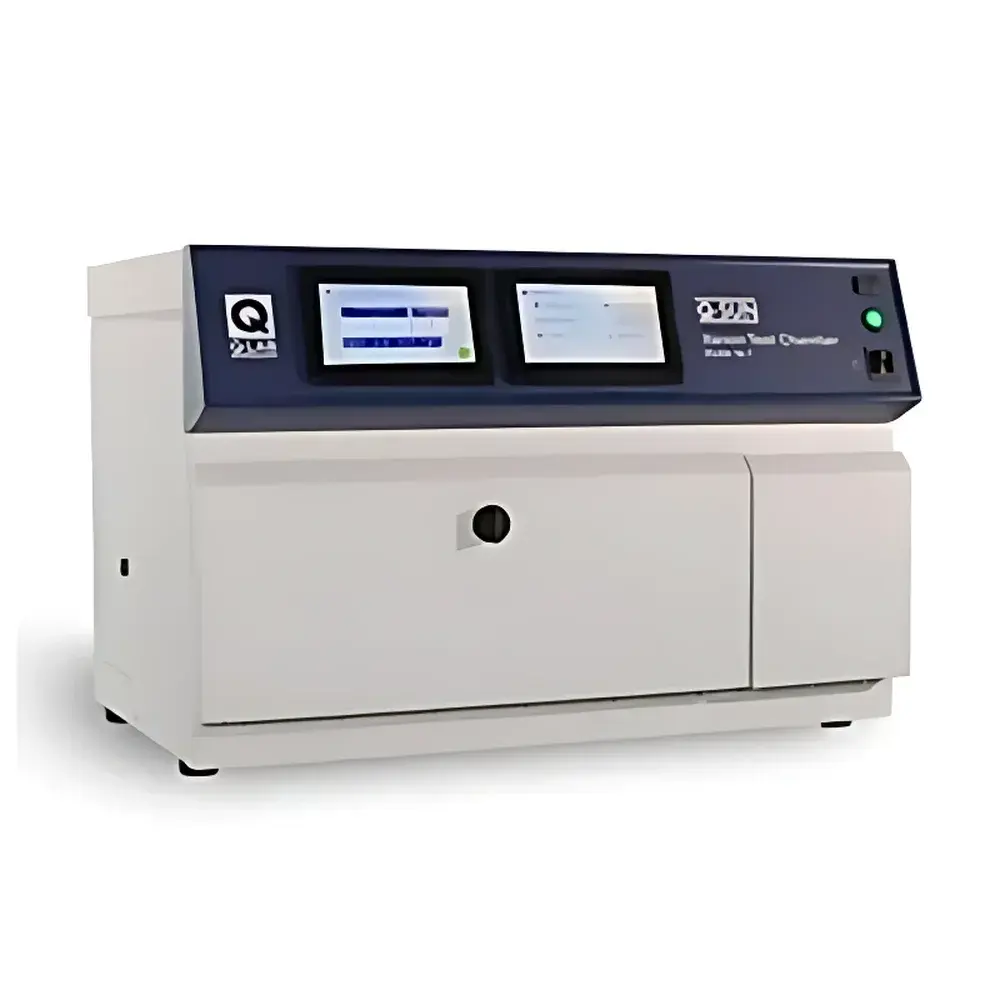
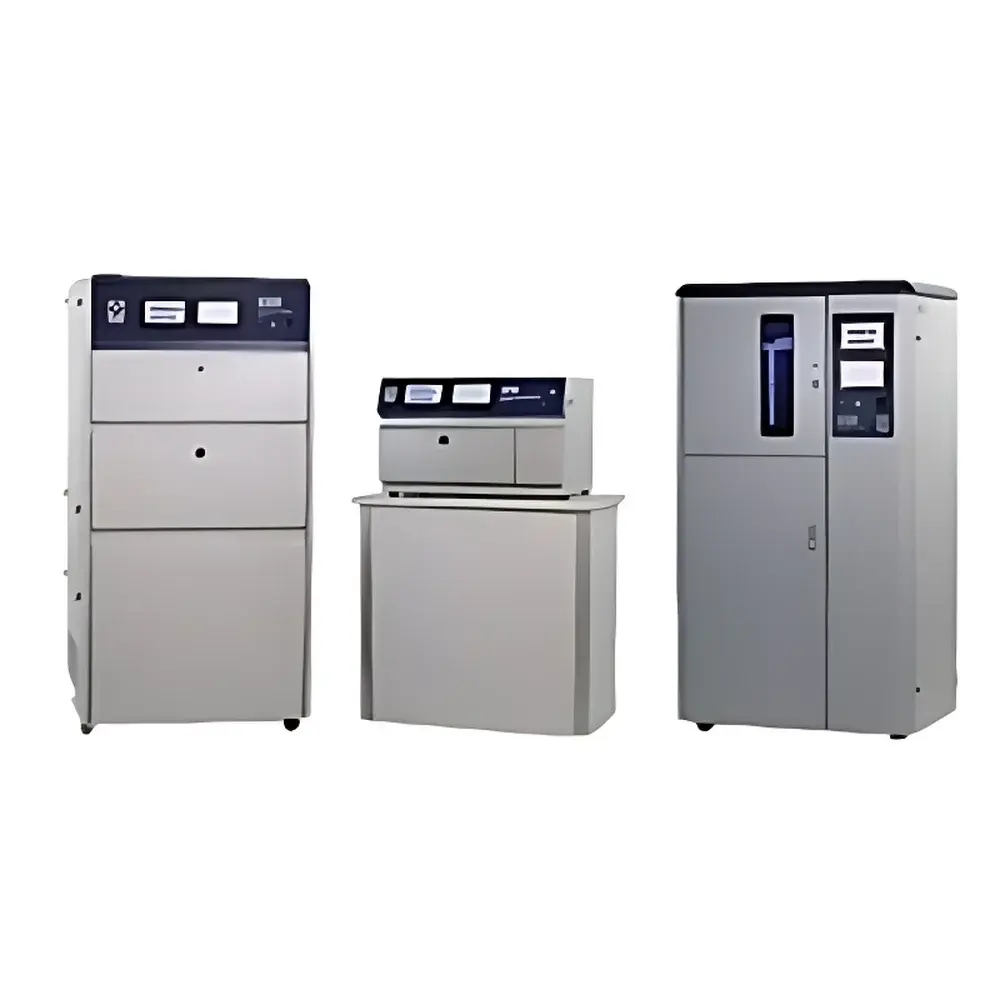
Q-LAB Q-SUN Xe-1-B Xenon Arc Weathering Test Chamber
| Brand | Q-LAB |
|---|---|
| Origin | USA |
| Model | Q-SUN Xe-1-B |
| Radiant Intensity | ≤1800 W/m² |
| Exposure Duration | 1–9999 h (continuously adjustable) |
| Humidity Range | Not specified in source |
| Lamp Type | Air-cooled xenon arc lamp |
| Lamp Life | 1500 h |
| Black Panel Temperature Control Range | 35–103 °C |
| Irradiance Control | SOLAR EYE broadband or narrowband (340 nm, 420 nm, TUV) |
| Sample Tray Dimensions | 251 mm × 457 mm |
| Max. Sample Capacity | 15 specimens of 51 mm × 102 mm |
| Filter Options | Daylight-Q/B, Extended UV-Q/B, Window-Q/B/SL/IR |
| Compliance | ASTM G155, ISO 4892-2, SAE J2527, ISO 11341, AATCC TM16, GB/T 16422.2 |
Overview
The Q-LAB Q-SUN Xe-1-B Xenon Arc Weathering Test Chamber is an entry-level, benchtop-scale accelerated weathering instrument engineered for precision simulation of solar radiation exposure under controlled environmental conditions. It employs a single air-cooled xenon arc lamp to generate a continuous, full-spectrum output spanning ultraviolet (UV), visible, and near-infrared (NIR) wavelengths—closely replicating natural sunlight. Unlike UV-only fluorescent systems, the xenon arc source enables photodegradation mechanisms driven by synergistic spectral energy distribution, thermal load, and moisture cycling—critical for evaluating polymer degradation, pigment stability, coating durability, and textile colorfastness. The chamber operates on the principle of controlled irradiance exposure, where radiant flux is actively monitored and regulated via the patented SOLAR EYE irradiance control system. This ensures reproducible photon dose delivery across test cycles, satisfying fundamental metrological requirements for comparative aging studies in R&D and QC laboratories.
Key Features
- Air-cooled xenon arc lamp with 1500-hour nominal service life—eliminates water chiller infrastructure, reduces operational complexity, and lowers total cost of ownership.
- Black panel temperature sensor as standard control parameter; optional air temperature sensor available for dual-mode thermal management.
- SOLAR EYE irradiance feedback system enabling real-time regulation at user-selectable wavelengths: 340 nm (UV-B dominant), 420 nm (broad UV-VIS), or TUV (total UV band).
- Stable optical filter architecture: Daylight-Q/B, Extended UV-Q/B, and Window-Q/B/SL/IR filters maintain spectral integrity over time; only Window-IR requires periodic replacement per manufacturer guidelines.
- Sliding sample tray (251 mm × 457 mm) supports flat and three-dimensional specimens; accommodates up to fifteen 51 mm × 102 mm coupons without reconfiguration.
- Integrated Ethernet interface for remote monitoring, data logging, and firmware updates; compliant with standard laboratory network protocols.
- Self-diagnostic subsystem with audible/visual alerts for lamp end-of-life, filter misalignment, temperature deviation, and irradiance drift.
- AUTOCAL calibration assist system streamlines radiometric verification using traceable NIST-traceable reference sensors—minimizing downtime during routine qualification.
Sample Compatibility & Compliance
The Q-SUN Xe-1-B accepts rigid, flexible, and textured substrates—including painted panels, plastic housings, textile swatches, automotive interior trim, and architectural coatings—without requiring custom fixtures. Its vertical sample orientation and open tray design facilitate rapid insertion, visual inspection, and post-test evaluation. The instrument is validated against internationally recognized weathering standards, including ASTM G155 (Practice for Operating Xenon Arc Light Apparatus for Exposure of Non-Metallic Materials), ISO 4892-2 (Plastics — Methods of Exposure to Laboratory Light Sources — Part 2: Xenon-Arc Sources), SAE J2527 (Surface Vehicle Recommended Practice for Accelerated Exposure of Automotive Exterior Materials Using a Controlled Irradiance Xenon-Arc Apparatus), and ISO 11341 (Paints and Varnishes — Artificial Weathering and Exposure to Artificial Radiation — Exposure to Filtered Xenon-Arc Radiation). While not inherently 21 CFR Part 11-compliant, its data export capabilities support integration into GLP/GMP-aligned quality management systems when paired with validated third-party LIMS or electronic lab notebook (ELN) platforms.
Software & Data Management
The Q-SUN Xe-1-B operates via an embedded touchscreen controller with intuitive icon-driven navigation—no external PC required for basic operation. All exposure parameters (irradiance setpoint, duration, black panel temperature, humidity profile if equipped, and filter selection) are stored in non-volatile memory with timestamped audit trails. Real-time irradiance, temperature, and runtime data are logged internally at user-defined intervals and exported via USB or Ethernet in CSV format. For advanced analysis, Q-LAB’s optional Q-Lab Software Suite (v5.x) provides trend visualization, statistical comparison across multiple test runs, and automated report generation compliant with ISO/IEC 17025 documentation requirements. Raw sensor outputs remain accessible for independent validation and uncertainty budgeting per ISO/IEC Guide 98-3 (GUM).
Applications
This chamber serves critical functions across materials science, product development, and regulatory compliance workflows. In automotive OEM supply chains, it validates dashboard material resistance to solar-induced embrittlement per GMW14124 or Ford CETP 00.00-L-467. In architectural coatings, it assesses chalk resistance and gloss retention per ASTM D4587 (QUV) correlation studies and ISO 11341 outdoor correlation protocols. Textile manufacturers use Window-filtered exposures to replicate indoor retail lighting degradation of printed fabrics per AATCC TM16. Packaging developers apply Extended UV filtration to accelerate photo-oxidative failure modes in polyolefin films. Academic researchers employ the Xe-1-B for fundamental studies of UV stabilizer efficacy, photocatalytic TiO₂ degradation kinetics, and wavelength-dependent quantum yield determination—leveraging its spectrally stable output and calibrated irradiance control.
FAQ
What is the typical calibration interval for the SOLAR EYE irradiance sensor?
Q-LAB recommends annual calibration using a NIST-traceable reference sensor; field verification with the included AUTOCAL check tool is advised before each high-stakes test campaign.
Can the Q-SUN Xe-1-B operate unattended for extended durations?
Yes—the system supports continuous 24/7 operation with automatic lamp shutdown at end-of-life and configurable alarm escalation to networked monitoring systems.
Is humidity control available on the Xe-1-B model?
No—humidity capability is exclusive to the larger Xe-2 and Xe-3 series models; the Xe-1-B relies on ambient lab humidity unless externally conditioned.
How does black panel temperature differ from chamber air temperature in weathering tests?
Black panel temperature approximates the surface temperature of a thermally absorbing, non-reflective substrate under irradiation—providing a more realistic thermal stress metric than ambient air for dark-colored materials.
Are Q-LAB xenon lamps compatible with other manufacturers’ test chambers?
No—Q-LAB lamps are mechanically and electrically proprietary; substitution voids warranty and compromises spectral fidelity and safety interlocks.



