
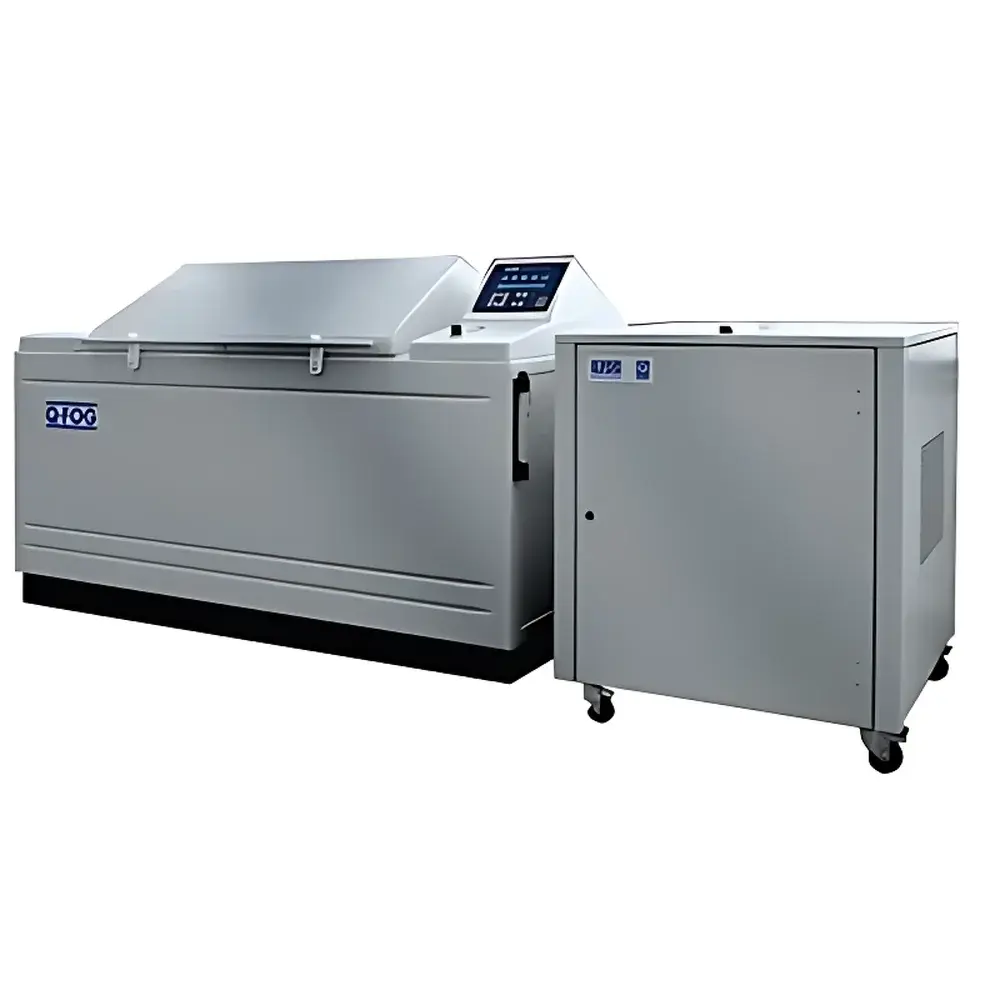
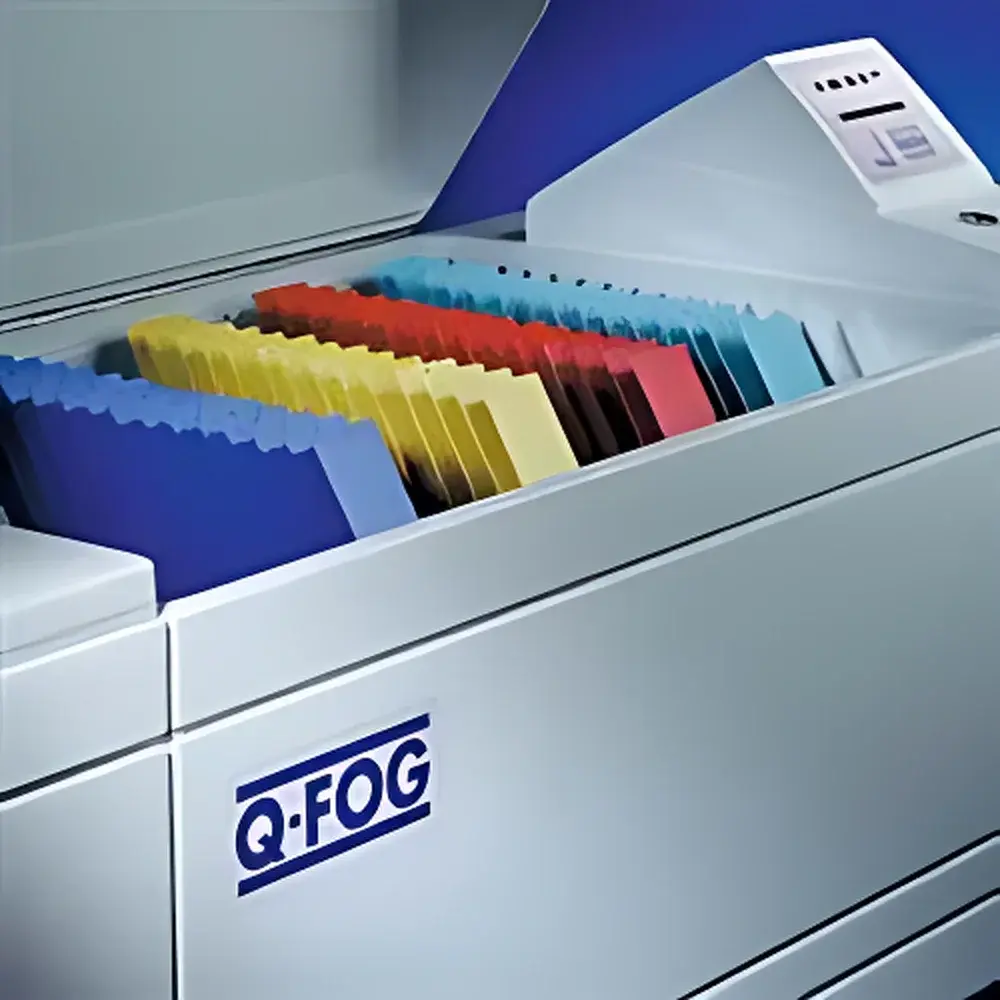
Q-LAB Q-FOG CRH600 Cyclic Corrosion Test Chamber
| Brand | Q-LAB |
|---|---|
| Origin | USA |
| Model | Q-FOG CRH600 |
| Spray Mode | Continuous Atomization |
| Spray Rate | 1–5 L/h per 180 cm² |
| Nozzle Pressure | 0.7–1 kg/cm² |
| Fog Removal Method | Air-Driven Mechanical Exhaust |
| Salt Deposit Rate | 1–2 mL / 80 cm²·h |
| Temperature Range | 20–60 °C |
| Humidity Control | Integrated Preconditioned Air System with Adjustable RH (20–95% RH, typical operating range) |
| Chamber Volume | 640 L |
| Compliance | ASTM B117, ISO 9227, ISO 11997-1/2, GMW 14872, SAE J2334, Ford CETP, VW PV1210, Volvo VCS 1027,000, Renault D17 2020, GB/T 10125 |
Overview
The Q-LAB Q-FOG CRH600 is a fully programmable cyclic corrosion test chamber engineered for high-fidelity simulation of real-world atmospheric degradation mechanisms. Unlike conventional salt spray chambers limited to static ASTM B117 conditions, the CRH600 implements a multi-phase corrosion cycle combining controlled salt fog, humid air exposure, drying stages, and optional solution spray—each phase independently adjustable in duration, temperature, and relative humidity. Its core architecture relies on a dual-path air management system: one path delivers pre-humidified, temperature-conditioned air via an integrated air preconditioner and misting humidifier; the other supplies compressed, moisture-saturated air to the twin atomizing nozzles for precise salt fog generation. This enables reproducible transitions between high-humidity soak (up to 95% RH), dry-off, and salt deposition phases—critical for evaluating coating adhesion, galvanic corrosion, and underfilm creep in automotive, aerospace, and infrastructure components.
Key Features
- Triple-mode operation: Salt fog (ASTM B117), Prohesion™ cycling (ASTM G85 Annex A5), and full CRH cycling (GMW 14872, SAE J2334)
- Independent control of temperature (20–60 °C) and relative humidity (20–95% RH) during non-fog phases, achieved via heated/cooled air preconditioning and ultrasonic humidification
- Programmable solution spray function with adjustable flow rate and on/off timing—designed to replicate direct electrolyte impingement per Ford CETP 00.00-L-467 and VW PV1210
- Self-cleaning nozzle system with automated purge cycles to prevent crystallization-induced clogging
- Corrosion-resistant chamber construction: PVC-coated steel interior, acid-resistant seals, and inert fluid pathways compliant with ISO 9227 material requirements
- Integrated fog removal mechanism using positive-pressure air displacement—eliminates condensate pooling and ensures consistent chamber atmosphere recovery between cycles
- 640 L working volume accommodating standard test panels (102 × 304 mm at 15° tilt) or custom 3D fixtures via 20 mm diameter support rods
Sample Compatibility & Compliance
The Q-FOG CRH600 supports flat-panel specimens, coated fasteners, stamped chassis parts, and complex geometric assemblies. Optional SSP-1100 panel racks (F-9011-K) enable standardized 15° angled mounting per ISO 11997-1, while F-9017-K hanging rod kits accommodate irregular or vertically oriented samples. The system meets full regulatory alignment with internationally recognized corrosion testing standards—including ISO 11997-1/-2 (cyclic corrosion), ASTM G85 (modified salt spray), GMW 14872 (condensation-controlled cyclic test), and Ford CETP 00.00-L-467 (multi-stage corrosion protocol). All operational parameters—including cycle sequencing, dwell times, and environmental setpoints—are logged with timestamped audit trails, supporting GLP-compliant data integrity and FDA 21 CFR Part 11 readiness when paired with Q-LAB’s optional Q-FOG Software Suite.
Software & Data Management
Control and monitoring are executed via Q-LAB’s proprietary Q-FOG Touch Interface—a 7-inch resistive touchscreen running embedded Linux with real-time graphical display of chamber temperature, RH, spray status, and cycle progression. The system stores up to 100 user-defined test programs with nested subcycles and conditional branching (e.g., “if RH > 90%, hold for 4 h before initiating dry phase”). Data export is available in CSV format via USB or Ethernet; optional Q-FOG Network Server enables remote access, centralized fleet monitoring, and integration into LIMS environments. All parameter changes, alarm events, and manual interventions are recorded with operator ID and timestamp, satisfying traceability requirements for ISO/IEC 17025-accredited laboratories.
Applications
This chamber is deployed in R&D and QA/QC labs for validating corrosion resistance of electrophoretic coatings, zinc-nickel plating, aluminum anodizing, and polymer-based anti-corrosion systems. It is routinely used for qualification testing of automotive body panels (per VW PV1210), brake calipers (Ford CETP), exhaust components (SAE J2334), and marine-grade fasteners (ISO 11997-2). Its ability to decouple humidity ramp rates from temperature profiles allows researchers to isolate the role of hygroscopic salt deliquescence versus thermal stress in intergranular corrosion initiation. Academic users apply it to study chloride ion diffusion kinetics in concrete-rebar interfaces and long-term passivation breakdown in stainless alloys under cyclic wet-dry conditions.
FAQ
What standards does the Q-FOG CRH600 fully support?
It natively executes ASTM B117, ISO 9227, ISO 11997-1/-2, GMW 14872, SAE J2334, Ford CETP 00.00-L-467, VW PV1210, Volvo VCS 1027,000, Renault D17 2020, and GB/T 10125.
Is deionized water required for RH control?
Yes—only Type II or higher purity deionized water (resistivity ≥ 1 MΩ·cm) may be used in the humidification system to prevent mineral buildup in the misting nozzles.
Can the CRH600 perform Prohesion™ testing?
Yes—the CRH600 includes factory-programmed Prohesion™ cycles (ASTM G85 Annex A5) with alternating Na₂SO₄ + NH₄Cl fog and UV-free drying phases.
How is calibration traceability maintained?
Temperature and RH sensors are NIST-traceable and field-calibratable using Q-LAB’s certified reference probes (Q-TRAC series); calibration logs are stored internally and exportable.
What maintenance intervals are recommended?
Daily: Visual inspection of nozzles and drain lines; Weekly: Cleaning of air preconditioner filters and saturation tower; Annually: Full sensor verification and compressed air dryer service.



