
Q-Lab QUV/Spray Advanced UV Accelerated Weathering Tester
| Brand | Q-Lab |
|---|---|
| Origin | USA |
| Model | QUV/Spray |
| Test Duration | 1–5000 h |
| Irradiance Range | Adjustable |
| Lamp Power | Adjustable |
| Humidity Range | 0–95% RH |
| Black Panel Temperature Range | 45–80 °C |
| UV Wavelength Range | 280–400 nm |
| Spray Nozzles | 12 (Total Flow Rate: 7 L/min) |
| Sample Capacity | 48 standard panels (75 × 150 mm) |
| Irradiance Control | Closed-loop “SunEye” system with ±0.01 W/m² @ 340 nm display resolution |
| Compliant Standards | ASTM G154, ISO 4892-3, JIS D0205, SAE J2020, GB/T 14522, DIN 50017, BS EN 60068-2-5 |
Overview
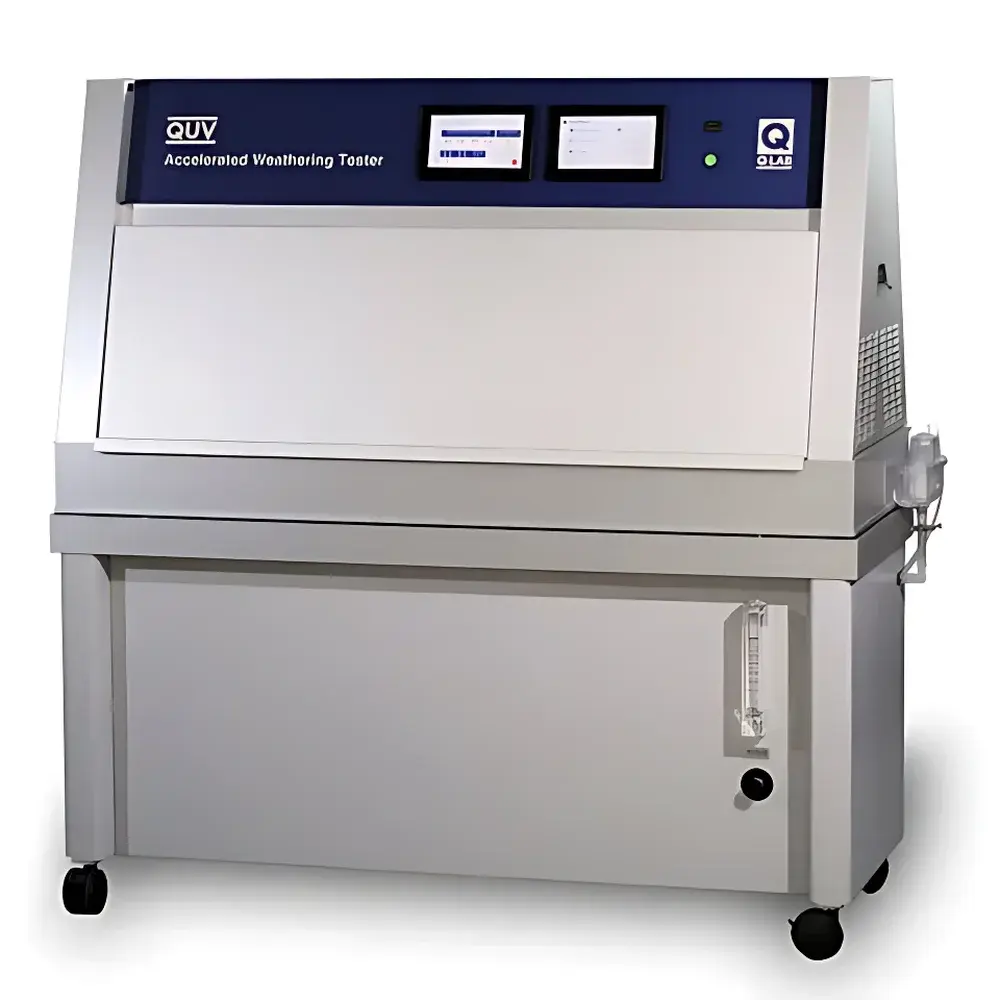
The Q-Lab QUV/Spray Advanced UV Accelerated Weathering Tester is an engineered solution for simulating critical outdoor degradation mechanisms—ultraviolet radiation, thermal cycling, moisture condensation, and water spray—in a controlled laboratory environment. Unlike conventional UV exposure chambers, the QUV/Spray integrates three distinct environmental stressors in programmable sequences: UV irradiation (via fluorescent UVA-340, UVB-313EL, or UVA-351 lamps), condensation-driven humidity (generated by heated water pan and surface temperature differential), and calibrated water spray (12 nozzles, 7 L/min total flow). This tri-modal capability enables replication of real-world weathering phenomena—including thermal shock from rapid cooling, mechanical erosion from prolonged rainfall, and photochemical degradation under spectrally accurate UV spectra. The system operates on the principle that UV photons (280–400 nm), though constituting only ~5% of terrestrial solar energy, dominate polymer chain scission, pigment fading, and coating delamination. By precisely controlling irradiance at 340 nm (e.g., 0.68 W/m²—equivalent to summer noon sunlight—or up to 75% higher for accelerated testing), black panel temperature (45–80 °C), and condensation duration (40–60 °C saturated environment), the QUV/Spray delivers reproducible, physically meaningful aging data aligned with field performance.
Key Features
- Triple-stress simulation: Independent control of UV irradiation, condensation, and water spray within a single test cycle
- SunEye closed-loop irradiance control system: Real-time monitoring and automatic lamp power adjustment to maintain setpoint irradiance (0.25–1.80 W/m² @ 340 nm) with ±0.01 W/m² display resolution
- NIST-traceable calibration: CR-10 radiometer-based verification compliant with ISO 9000; factory-calibrated for UV-A and UV-B bands
- Black panel temperature control: Precision regulation between 45 °C and 80 °C during irradiation phases
- Condensation module: Heated water pan generates saturated vapor; differential cooling induces realistic dew formation on specimen surfaces
- Spray subsystem: 12 stainless-steel nozzles deliver uniform 7 L/min deionized water flow—critical for thermal shock simulation and surface erosion assessment
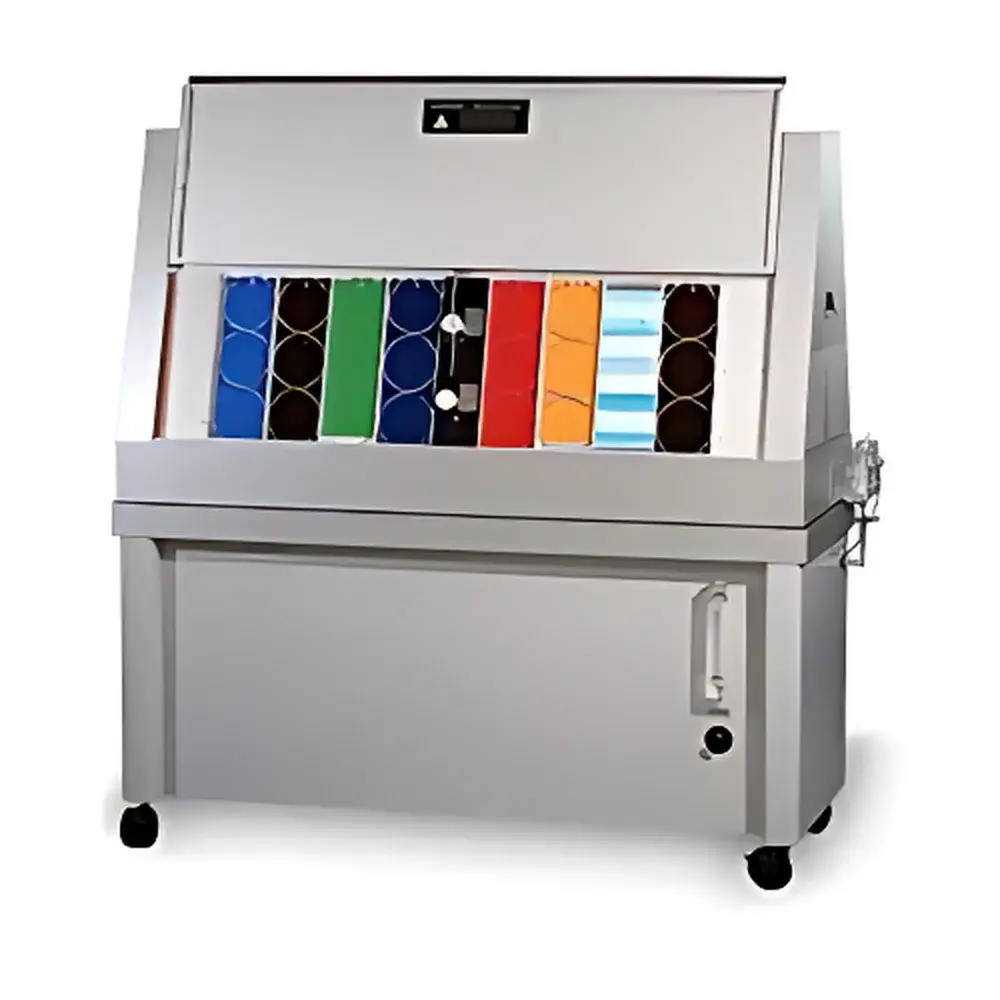
- High-capacity sample rack: Accommodates 48 standard 75 × 150 mm specimens; modular fixtures support flat, curved, and 3D components
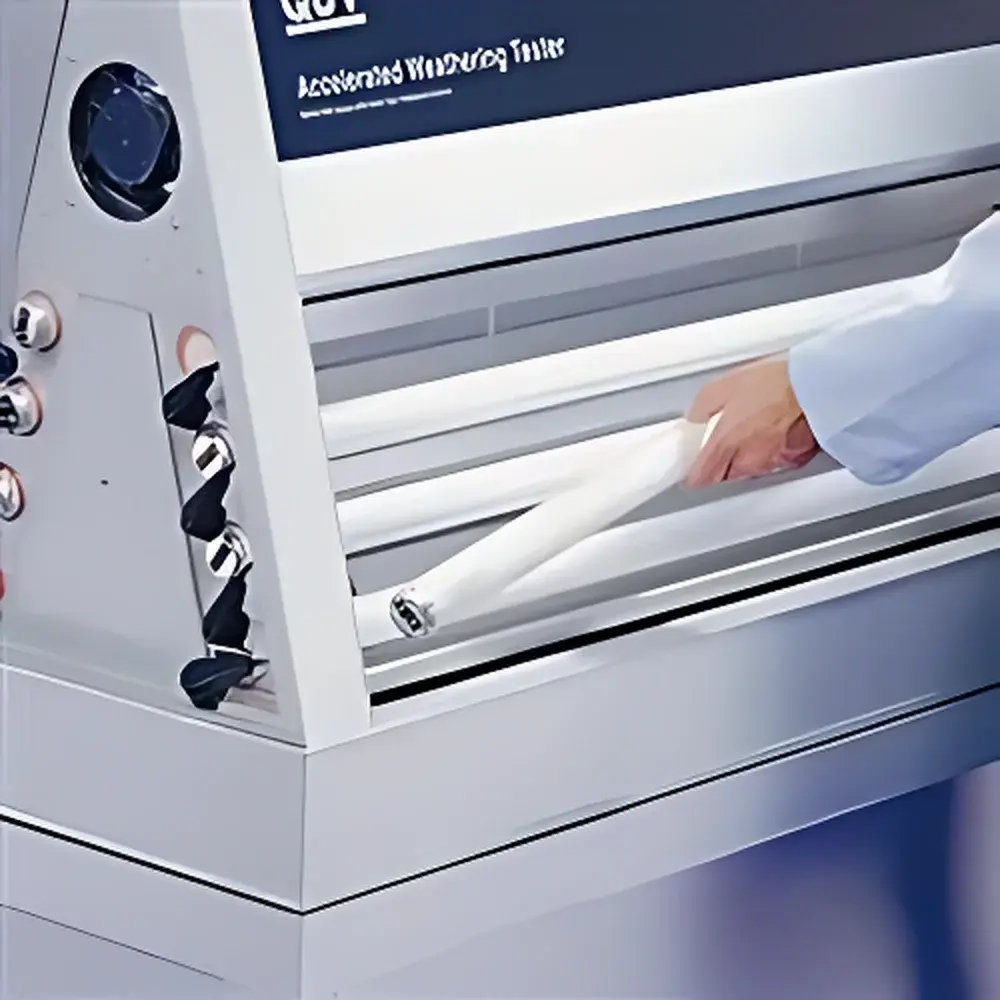
- Lamp compatibility: Interchangeable UVA-340 (sunlight-spectrum match), UVB-313EL (aggressive acceleration), and UVA-351 (window-filtered UV) tubes
Sample Compatibility & Compliance
The QUV/Spray accommodates rigid and flexible substrates—including paints, coatings, plastics, automotive trim, architectural sealants, and photovoltaic encapsulants—without requiring vacuum clamping or edge shielding. Its standardized 75 × 150 mm panel configuration ensures inter-laboratory comparability. The instrument meets the technical requirements of ASTM G154 (Standard Practice for Operating Fluorescent Ultraviolet (UV) Lamp Apparatus for Exposure of Non-Metallic Materials), ISO 4892-3 (Plastics — Methods of Exposure to Laboratory Light Sources — Part 3: Fluorescent UV Lamps), JIS D0205 (Automotive Paint Durability), SAE J2020 (Accelerated Exposure of Automotive Exterior Materials), and GB/T 14522 (Chinese national standard for UV aging). All irradiance control and temperature logging functions comply with GLP audit requirements, including electronic signature-ready data logs traceable to user-defined operator IDs and timestamped calibration events.
Software & Data Management
The QUV/Spray operates via Q-Lab’s proprietary Q-Support software suite, enabling full-cycle programming (irradiation → condensation → spray → dark), real-time parameter visualization, and automated report generation in PDF/CSV formats. Data integrity is maintained through 21 CFR Part 11-compliant audit trails: all setpoint changes, calibration actions, and alarm events are immutably logged with operator ID, timestamp, and reason-for-change fields. Raw irradiance, black panel temperature, chamber humidity, and spray activation status are sampled every 30 seconds and stored locally with battery-backed memory. Exported datasets include metadata headers compliant with ASTM E2912 (Standard Guide for Data Elements for Computerized Laboratory Information Systems), facilitating integration into LIMS environments and statistical process control (SPC) workflows.
Applications
The QUV/Spray is deployed across R&D, QC, and regulatory validation labs to quantify material durability under UV-dominated degradation pathways. Key use cases include: evaluating UV stabilizer efficacy in polyolefins and PVC compounds; benchmarking gloss retention and chalking resistance in architectural coatings; validating colorfastness of textile dyes per AATCC TM16; assessing adhesion loss in automotive clearcoats after cyclic UV/water exposure; qualifying encapsulant stability for silicon photovoltaic modules (IEC 61215); and supporting FDA 510(k) submissions for UV-exposed medical device housings. Its high correlation with Florida and Arizona field exposures—particularly for UVA-340 lamp configurations—makes it a preferred tool for predictive lifetime modeling using Arrhenius-based kinetic analysis.
FAQ
Why is deionized water required for the spray function?
Deionized water prevents mineral deposition on specimens and nozzle clogging, ensuring consistent spray pattern integrity and eliminating ionic contamination that could accelerate electrochemical corrosion or interfere with optical measurements.
How does condensation differ from spray in weathering simulation?
Condensation replicates nocturnal dew formation—prolonged surface wetness enabling hydrolytic degradation—whereas spray simulates convective rain events, inducing thermal shock and mechanical abrasion.
Can the QUV/Spray operate without spray functionality?
Yes; users may disable the spray module and run standard QUV cycles (UV + condensation only) while retaining full irradiance and temperature control fidelity.
What lamp type best correlates with natural sunlight exposure?
UVA-340 lamps emit spectral output closely matching terrestrial solar UV (295–365 nm), delivering the highest correlation with outdoor Florida exposure for most organic materials.
Is third-party ISO/IEC 17025 calibration available?
Yes; Q-Lab-certified service engineers perform on-site irradiance and temperature verification per ISO/IEC 17025, issuing accredited certificates with measurement uncertainty budgets.



