
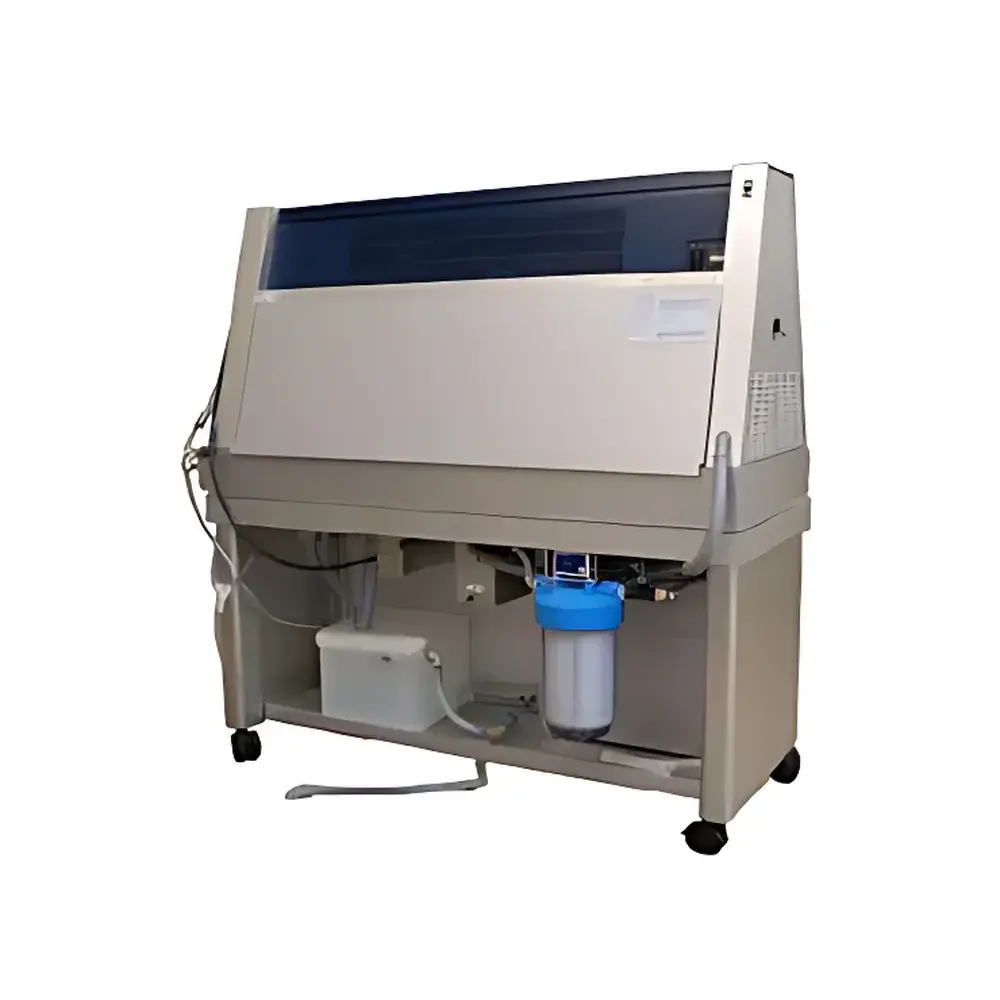
Q-LAB QUV/spray UV Aging Test Chamber
| Brand | Q-LAB |
|---|---|
| Origin | USA |
| Model | QUV/spray |
| UV Wavelength Range | 295–400 nm (UVA-340, UVA-351, UVB-313, QFS-40, Cool White options) |
| Sample Capacity | Up to 48 specimens (75 mm × 150 mm) |
| Condensation System | Distillation-purified water cycle |
| Spray Function | Deionized water only |
| Compliance | ASTM G154, ISO 4892-3, SAE J2020, GB/T 14522, IEC 61215, MIL-STD-810, FDA 21 CFR Part 11 (with optional software) |
Overview
The Q-LAB QUV/spray UV Aging Test Chamber is an industry-standard accelerated weathering instrument engineered for precision simulation of solar ultraviolet radiation and associated environmental stressors—primarily UV exposure, condensation, and controlled water spray. Unlike broad-spectrum xenon arc systems, the QUV/spray employs fluorescent UV lamps with tightly defined spectral power distributions (SPD), enabling highly reproducible photochemical degradation studies under controlled laboratory conditions. Its core measurement principle relies on controlled photon flux in the critical 295–400 nm range, where photodegradation mechanisms—including chain scission, oxidation, and chromophore bleaching—are most active in polymers, coatings, textiles, and automotive materials. The system’s design adheres to fundamental photobiological and photochemical acceleration principles: irradiance stability, thermal management of specimen surfaces (via black panel or black standard thermometer control), and realistic moisture cycling through condensation and spray modules. This architecture ensures correlation with real-world outdoor exposure—particularly for materials subjected to subtropical, desert, or coastal climates—while maintaining strict traceability for regulatory and quality assurance workflows.
Key Features
- Fluorescent UV lamp options with certified, stable SPD: UVA-340 (sunlight cutoff at 295 nm), UVA-351 (window-filtered UV), UVB-313 (accelerated short-wave UV), QFS-40 (legacy automotive specification), and Cool White (indoor lighting simulation).
- Patented condensation system that purifies tap water via natural distillation during cyclic condensation—eliminating mineral deposits and ensuring consistent dew formation without external deionization.
- Independent programmable spray module using only deionized water; enables thermal shock (short bursts) or mechanical erosion (prolonged cycles), both configurable per test standard.
- Precision black panel temperature control (range: 35–80 °C, typical operating range 40–70 °C) with high-stability PID regulation and NIST-traceable calibration support.
- Modular sample rack accommodating up to 48 standard 75 mm × 150 mm specimens; adjustable holders accept substrates up to 20 mm thick; optional custom fixtures for 3D components, lenses, and irregular geometries.
- Integrated self-diagnostic controller with real-time system monitoring, error logging, service reminders, and fail-safe shutdown protocols compliant with IEC 61508 functional safety guidelines.
Sample Compatibility & Compliance
The QUV/spray accommodates rigid and semi-rigid flat specimens—including painted metal panels, polymer sheets, composite laminates, elastomers, and coated fabrics—without requiring edge trimming or substrate modification. Its chamber geometry and lamp array ensure uniform irradiance distribution across the entire exposure plane (±15% per ASTM G154 Annex A2). The system is validated for full compliance with major international standards: ASTM G154 (fluorescent UV exposure), ISO 4892-3 (plastics—UV exposure methods), SAE J2020 (automotive exterior materials), IEC 61215 (photovoltaic module qualification), and GB/T 14522 (Chinese national standard for paint and coating aging). When equipped with Ethernet connectivity and optional Q-Lab’s “Virtual Strip” software, it supports 21 CFR Part 11-compliant electronic records, audit trails, user access controls, and electronic signatures—meeting GLP and GMP documentation requirements for regulated industries including medical device packaging and pharmaceutical secondary packaging validation.
Software & Data Management
Standard Ethernet interface enables remote monitoring, firmware updates, and secure data export. Optional “Virtual Strip” PC software provides automated acquisition of irradiance, temperature, spray timing, and condensation duration—logging timestamped parameters at user-defined intervals (1 sec to 60 min resolution). All datasets are stored in CSV and XML formats compatible with LIMS integration and statistical process control (SPC) platforms. Software-generated reports include calibration history, lamp usage hours, system fault logs, and deviation alerts—fully traceable for internal audits or third-party certification bodies. Data transmission to Q-Lab Technical Support is encrypted and supports diagnostic session initiation with live telemetry, reducing mean time to resolution (MTTR) for operational anomalies.
Applications
- Accelerated durability assessment of automotive clearcoats, interior trims, and headlamp lenses per SAE J2020 and GMW14124.
- Photostability testing of pharmaceutical packaging films (e.g., PVC/PVDC blisters) under ICH Q1B guidelines.
- Weathering qualification of photovoltaic encapsulants and backsheet materials per IEC 61215 and UL 1703.
- R&D screening of UV stabilizers, HALS additives, and pigment systems in architectural coatings and industrial finishes.
- Correlation studies between lab-based QUV cycles and natural Florida or Arizona exposure racks using Q-Lab’s proprietary CRF (Correlation Reference File) database.
- Indoor lightfastness evaluation of retail signage, museum-grade display materials, and office furniture using Cool White lamp configuration.
FAQ
What UV lamp types are supported—and how do they differ in application?
The QUV/spray accepts five lamp families: UVA-340 (best sunlight match down to 295 nm), UVA-351 (simulates UV transmitted through window glass), UVB-313 (high-energy short-wave for rapid QC screening), QFS-40 (legacy specification for certain OEM automotive tests), and Cool White (for indoor lighting environments). Lamp selection must align with target degradation mechanism and relevant test standard.
Why is deionized water required for the spray function?
Mineral residues from tap water cause spotting, scaling, and non-uniform wetting—compromising test repeatability and potentially accelerating non-photolytic failure modes. DI water ensures spray-induced thermal/mechanical stress remains decoupled from ionic contamination effects.
Can the QUV/spray operate without spray or condensation cycles?
Yes. Users may configure standalone UV-only, UV + condensation, UV + spray, or full cyclic sequences—each independently programmable via the controller interface or Virtual Strip software.
How is irradiance calibrated and maintained over lamp lifetime?
Irradiance is monitored using a calibrated UV sensor (typically 340 nm or 313 nm channel); Q-Lab lamps maintain ±10% SPD stability for ≥5,000 hours. Calibration certificates are provided with each lamp batch, and system-level verification follows ASTM E2431 procedures.
Is remote diagnostics available for troubleshooting?
Yes. With Ethernet enabled and Virtual Strip installed, users may authorize secure remote sessions with Q-Lab engineers who access real-time sensor data, controller logs, and historical exposure profiles to diagnose anomalies without onsite intervention.



