
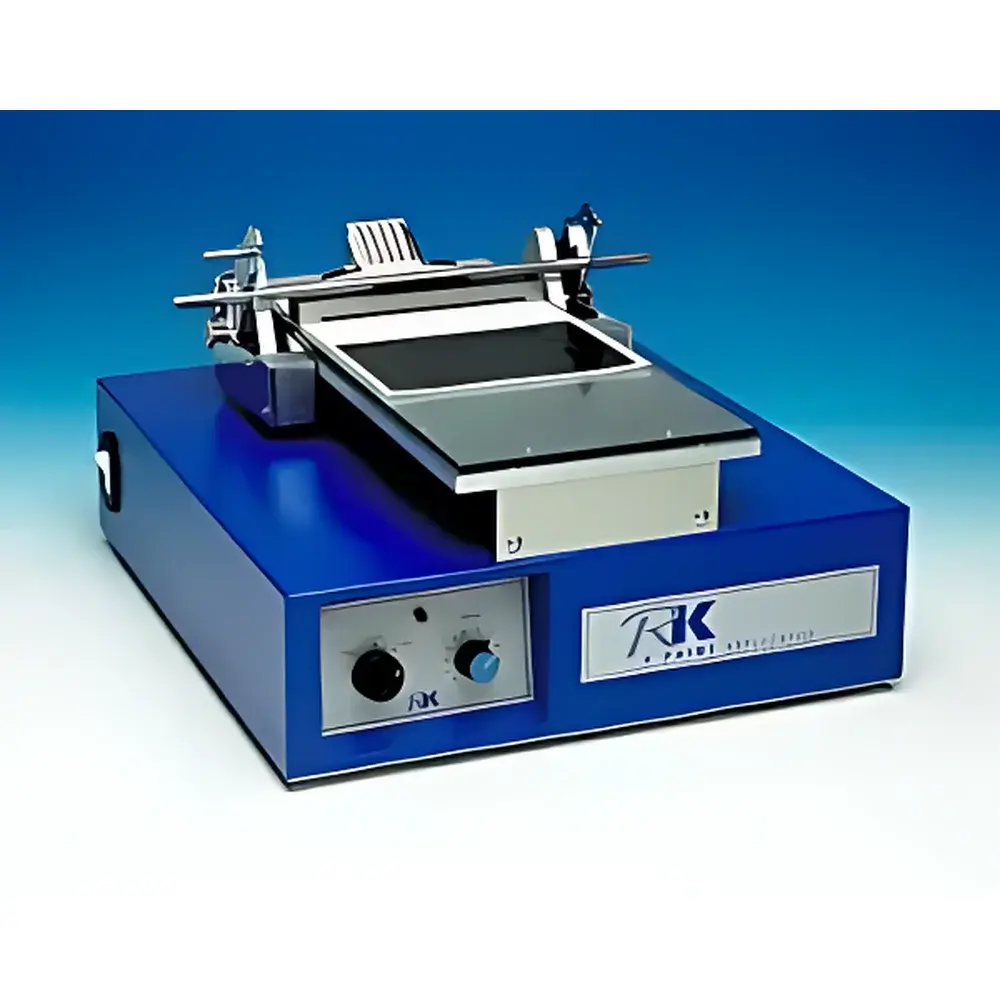
RK KPA Laboratory-Scale Coating Applicator
| Brand | RK |
|---|---|
| Origin | United Kingdom |
| Manufacturer Type | Authorized Distributor |
| Origin Category | Imported |
| Model | KPA |
| Power Supply | 220 V, 50 Hz |
| Coating Speed | 2–15 m/min (adjustable) |
| Compliance | ASTM D823-92a |
| Standard Bed | Tempered Glass Impression Bed |
| Compatible Applicators | Doctor Blade (Bird), Quadrant, Adjustable Micrometer, and Square-Edge Applicators |
| Optional Beds | Vacuum, Magnetic, or Heated Impression Beds |
| Sample Substrates | Cardstock, Steel Panels, and Other Rigid Flat Substrates |
Overview
The RK KPA Laboratory-Scale Coating Applicator is an engineered precision instrument designed for controlled, repeatable thin-film deposition in R&D and quality assurance laboratories. It operates on the principle of gap-controlled doctor blade (or “bird bar”) coating—a gravure-adjacent method where a fixed clearance between the applicator edge and substrate governs wet film thickness. Unlike manual drawdown techniques, the KPA eliminates operator-induced variability by integrating a motor-driven carriage with regulated linear velocity and consistent normal force application. This architecture ensures high reproducibility across sequential runs—critical for comparative analysis in formulation development, batch release testing, and regulatory submission support. The system is purpose-built for solvent-based and water-based coatings—including architectural paints, industrial primers, graphic inks, and functional barrier coatings—where precise film thickness control directly impacts optical, mechanical, and chemical performance evaluation.
Key Features
- Motorized carriage with digitally adjustable speed from 2 to 15 meters per minute, enabling systematic variation of shear history and solvent evaporation kinetics during wet-film formation.
- Fixed-gap applicator mounting system compatible with ISO/ASTM-standardized blades: Bird-type (ISO 2808 Type A), Quadrant (Type B), Micrometer-adjustable (Type C), and Square-edge (Type D) applicators—all interchangeable without recalibration.
- Tempered glass impression bed as standard, providing dimensional stability, thermal uniformity, and non-porous surface integrity for minimal substrate interaction and effortless cleaning.
- Modular bed interface supporting optional vacuum, magnetic, or heated impression beds—enabling enhanced substrate adhesion for low-surface-energy films (e.g., polyolefins), rapid-cure formulations, or temperature-dependent rheology studies.
- Robust aluminum frame with precision-ground linear rails and belt-driven motion system, ensuring long-term mechanical stability and positional repeatability within ±0.1 mm over 300 mm travel range.
- Compliance with ASTM D823-92a (Standard Practice for Producing Films of Uniform Thickness of Paint, Varnish, and Related Products on Test Panels), facilitating traceable method alignment across global QC labs.
Sample Compatibility & Compliance
The KPA accommodates rigid, planar substrates up to 300 mm × 400 mm, including Leneta cards, stainless steel panels (ASTM D609), aluminum test plates, and custom-cut polymer sheets. Its low-vibration drive train and uniform pressure distribution prevent substrate warping or edge lifting—essential for accurate opacity, gloss, and adhesion measurements. All operational parameters (speed, dwell time, ambient temperature/humidity logging) are manually documented per GLP guidelines; when integrated with external environmental chambers or digital loggers, full audit trails can be maintained for GMP-aligned environments. While the KPA itself does not embed electronic data capture, its mechanical consistency supports compliance with ISO 9001:2015 clause 7.1.5 (monitoring and measuring resources) and ASTM D1849 (standard test method for drying time of coatings).
Software & Data Management
The KPA is a standalone electromechanical system with no embedded firmware or proprietary software. Speed adjustment is performed via front-panel potentiometer with calibrated analog feedback—eliminating firmware dependencies, cybersecurity risks, or version obsolescence. Users maintain full traceability through manual logbooks or integration with LIMS platforms via external timing sensors or video-based motion tracking. For laboratories requiring 21 CFR Part 11 compliance, the device may be operated under documented SOPs that define calibration frequency (recommended annually against traceable tachometer standards), preventive maintenance checks (belt tension, rail lubrication, blade edge inspection), and change control procedures for accessory swaps (e.g., applicator type or bed configuration). RK provides UKAS-traceable calibration certificates upon request for speed verification.
Applications
- Formulation screening: Rapid generation of gradient-thickness films to evaluate hiding power (ASTM D2805), contrast ratio, and tint strength.
- QC release testing: Reproducible preparation of reference panels for colorimetric analysis (CIE L*a*b*, ΔE00), gloss measurement (ASTM D523), and pencil hardness (ASTM D3363).
- Aging and durability studies: Uniform film application prior to QUV accelerated weathering (ASTM G154), salt spray (ASTM B117), or humidity cycling exposure.
- Substrate compatibility assessment: Controlled coating on low-energy surfaces (e.g., PP, PET) using vacuum or heated beds to assess wetting behavior and defect formation.
- Regulatory dossier support: Film preparation for FDA-compliant packaging ink migration studies (EU 10/2011) or VOC content validation per EPA Method 24.
FAQ
What substrates are compatible with the KPA?
Standard substrates include Leneta white cards, cold-rolled steel panels (ASTM D609), and aluminum test plates. Custom rigid flat materials up to 4 mm thickness and 300 mm × 400 mm footprint may be used if surface flatness deviation remains below 0.05 mm over 100 mm.
Can the KPA be used for water-based coatings without edge defects?
Yes—when paired with a vacuum impression bed and optimized blade geometry (e.g., micrometer-adjustable quadrants), the KPA minimizes beading and streaking in high-surface-tension systems by enhancing substrate contact and reducing Marangoni flow instabilities.
Is speed calibration traceable to national standards?
RK offers optional UKAS-accredited speed verification using a Class 1 handheld laser tachometer calibrated to NPL standards. Calibration reports include uncertainty budgets and traceability statements per ISO/IEC 17025.
How often should the glass impression bed be cleaned?
The tempered glass bed must be wiped with lint-free cloth and isopropanol before each use cycle. Residue inspection under 10× magnification is recommended after every 10 coating cycles to detect micro-scratches affecting film uniformity.
Does RK supply applicators certified to ISO 2808?
Yes—RK distributes ISO 2808-compliant applicators with individual metrology reports confirming edge geometry, parallelism, and hardness (HRC 60–65), validated per EN ISO 17025 accredited laboratory protocols.





