
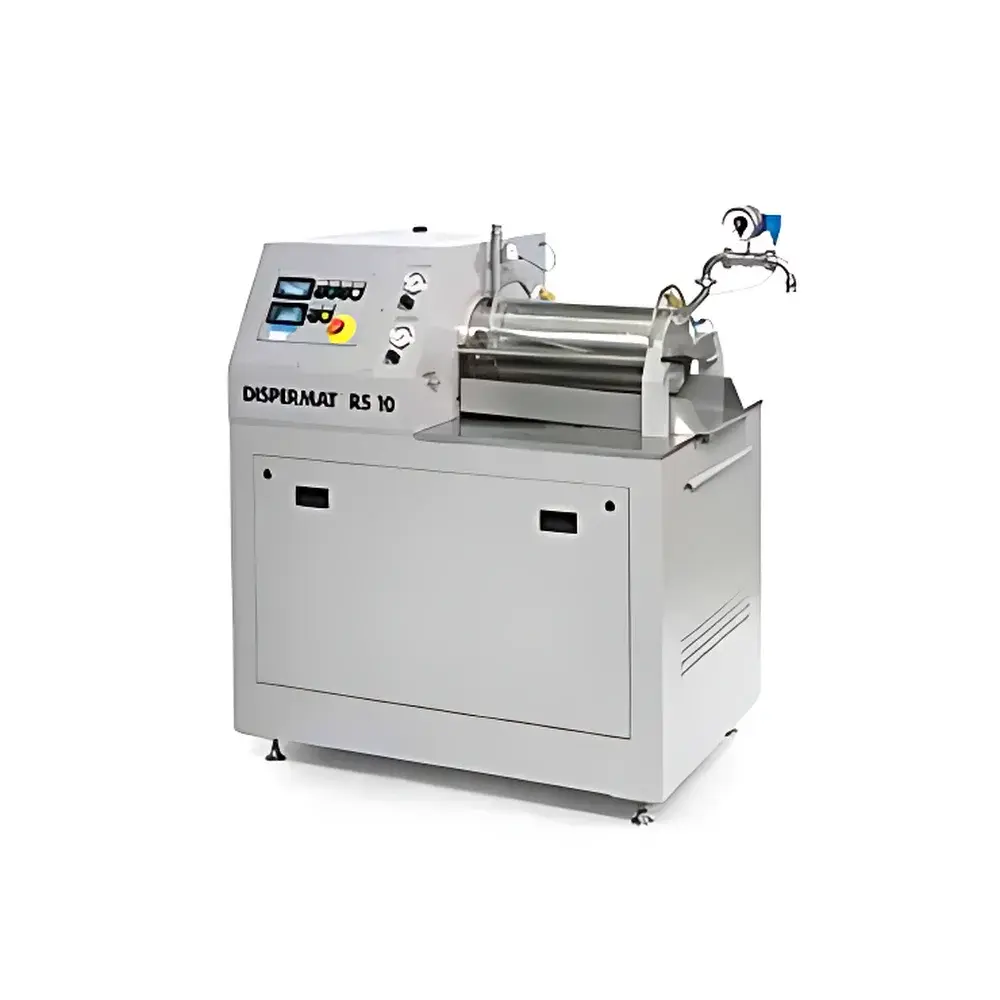
VMA DISPERMAT RS Horizontal Bead Mill
| Brand | VMA |
|---|---|
| Origin | Germany |
| Model | DISPERMAT RS |
| Instrument Type | Horizontal Bead Mill |
| Sample Applicability | Soft Materials |
| Feed Particle Size | <15 mm |
| Final Particle Size (D90) | 0.01–0.5 mm |
| Batch Volume | 100–600 L |
| Drive Power | 15–45 kW |
| Rotational Speed Range | 50–2600 rpm |
| Grinding Chamber Volume | 20–600 L |
| Bearing Configuration | Dual-bearing shaft |
| Separation System | Dynamic Gap Bead Retention |
| Cooling | Integrated Jacketed Shaft with External Chiller Loop |
| Sealing | Mechanical Seal with Siphon-Cooled Lubrication Reservoir |
| Safety | Pressure-Actuated Electronic Cut-off, Rotatable Lid, Integrated Relief Valve |
| Optional Packages | ATEX-compliant M-Ex Explosion-Proof Control, Process Data Logging & Digital Interface (RS485/Modbus, Ethernet), GLP/GMP-Compliant Audit Trail Module |
Overview
The VMA DISPERMAT RS is a high-performance horizontal bead mill engineered for laboratory-scale and pilot-plant dispersion, deagglomeration, and wet grinding of temperature-sensitive and shear-sensitive materials. Operating on the principle of attrition and impact between grinding media (typically zirconia or stainless steel beads, 0.1–2.0 mm diameter) and suspended particles in a liquid medium, the DISPERMAT RS utilizes a horizontally oriented, jacketed grinding chamber driven by a robust dual-bearing shaft. Its design adheres to fundamental principles of colloidal processing—maximizing energy transfer efficiency while minimizing thermal load via active cooling of both the grinding shaft and chamber walls. This architecture enables reproducible sub-micron particle size reduction (D90 down to 0.01 mm) under tightly controlled hydrodynamic conditions, making it suitable for R&D workflows requiring strict process traceability and scalability to production-grade mills.
Key Features
- Dual-bearing drive shaft ensures mechanical stability at high rotational speeds (up to 2600 rpm), reducing vibration and extending service life under continuous operation.
- Dynamic gap bead retention system prevents media ejection without restricting flow, enabling uninterrupted circulation and consistent residence time distribution across batch volumes from 100 to 600 L.
- Integrated cooling circuit through the hollow grinding shaft—coupled with optional external chiller integration—maintains slurry temperature within ±2 °C during extended runs, critical for heat-labile polymers, biological suspensions, and pharmaceutical nanosuspensions.
- Rotatable lid with ergonomic clamping mechanism allows rapid access to the grinding chamber for cleaning, media replacement, or inspection—reducing downtime and supporting strict hygiene protocols (e.g., ISO 22000, FDA cGMP Annex 1).
- Full-spectrum safety architecture: pressure-sensing electronic contact switch triggers automatic shutdown upon overpressure; mechanical seal includes siphon-cooled reservoir for continuous lubricant thermal management; integrated relief valve complies with PED 2014/68/EU requirements.
- Modular control platform supports optional ATEX-certified M-Ex explosion-proof configuration (Zone 1/21), essential for processing solvent-based dispersions containing volatile organic compounds (VOCs).
Sample Compatibility & Compliance
The DISPERMAT RS accommodates soft, non-fibrous, and moderately abrasive feedstocks—including polymer pastes, pigment concentrates, ceramic slurries, battery electrode slurries, and biopolymer dispersions—with maximum feed particle size ≤15 mm. It is not intended for dry grinding or highly fibrous, elastic, or metallic samples. All wetted components are constructed from corrosion-resistant stainless steel (AISI 316L), compliant with FDA 21 CFR 178.3570 for indirect food contact and EU Regulation (EC) No. 1935/2004. The system meets CE Machinery Directive 2006/42/EC and carries conformity documentation for pressure equipment (PED), electromagnetic compatibility (EMC), and low-voltage directives. When equipped with the optional data logging module, it supports 21 CFR Part 11-compliant electronic records, including user authentication, audit trail, and immutable timestamping.
Software & Data Management
The base controller provides analog setpoint adjustment for speed and pressure, with real-time monitoring via integrated digital displays. With the optional Process Control & Interface package, users gain access to a programmable logic controller (PLC)-based HMI with Ethernet/RS485 connectivity. This enables automated recipe execution, live parameter trending (speed, pressure, temperature, flow rate), and export of CSV-formatted process logs compatible with LIMS and MES platforms. The software architecture supports configurable alarm thresholds, event-driven data capture, and encrypted backup—facilitating compliance with GLP, ISO/IEC 17025, and internal quality management systems. All firmware updates are delivered via secure USB import with version-controlled checksum verification.
Applications
- Development of stable nanoscale pigment dispersions for automotive coatings and inkjet inks.
- Preparation of uniform cathode/anode slurries for lithium-ion battery R&D, ensuring narrow particle size distribution (PSD) and minimized agglomerate reformation.
- Formulation of pharmaceutical nanosuspensions meeting USP light scattering criteria for bioavailability enhancement.
- Dispersion of carbon nanotubes and graphene in polymer matrices for conductive composites.
- Stabilization of functionalized silica nanoparticles in aqueous and non-aqueous media for diagnostic reagent development.
FAQ
What is the minimum recommended grinding media size for optimal performance?
For the DISPERMAT RS, zirconia beads ranging from 0.3 mm to 1.0 mm diameter are recommended depending on target D90; smaller beads (<0.5 mm) are used for sub-100 nm final distributions, while larger beads improve throughput for coarse-to-fine transitions.
Can the system be validated for GMP environments?
Yes—when configured with the optional audit trail module, mechanical seal integrity test protocol, and IQ/OQ documentation package, the DISPERMAT RS supports equipment qualification per ASTM E2500 and Annex 15 guidelines.
Is remote monitoring supported out-of-the-box?
Remote access requires the Process Control & Interface option; standard units operate as standalone controllers without network capability.
What maintenance intervals are specified for the mechanical seal and bearings?
VMA recommends seal inspection every 500 operating hours and bearing lubrication every 2000 hours under continuous duty; full service intervals are documented in the EN ISO 13849-1-compliant maintenance manual.
Does the system support closed-loop recirculation with inline particle size analysis?
Yes—the discharge port is fitted with DIN 11851 sanitary flanges and can be integrated with real-time laser diffraction analyzers (e.g., Malvern Mastersizer Insite) via custom manifold design and PID-controlled bypass loop.



