
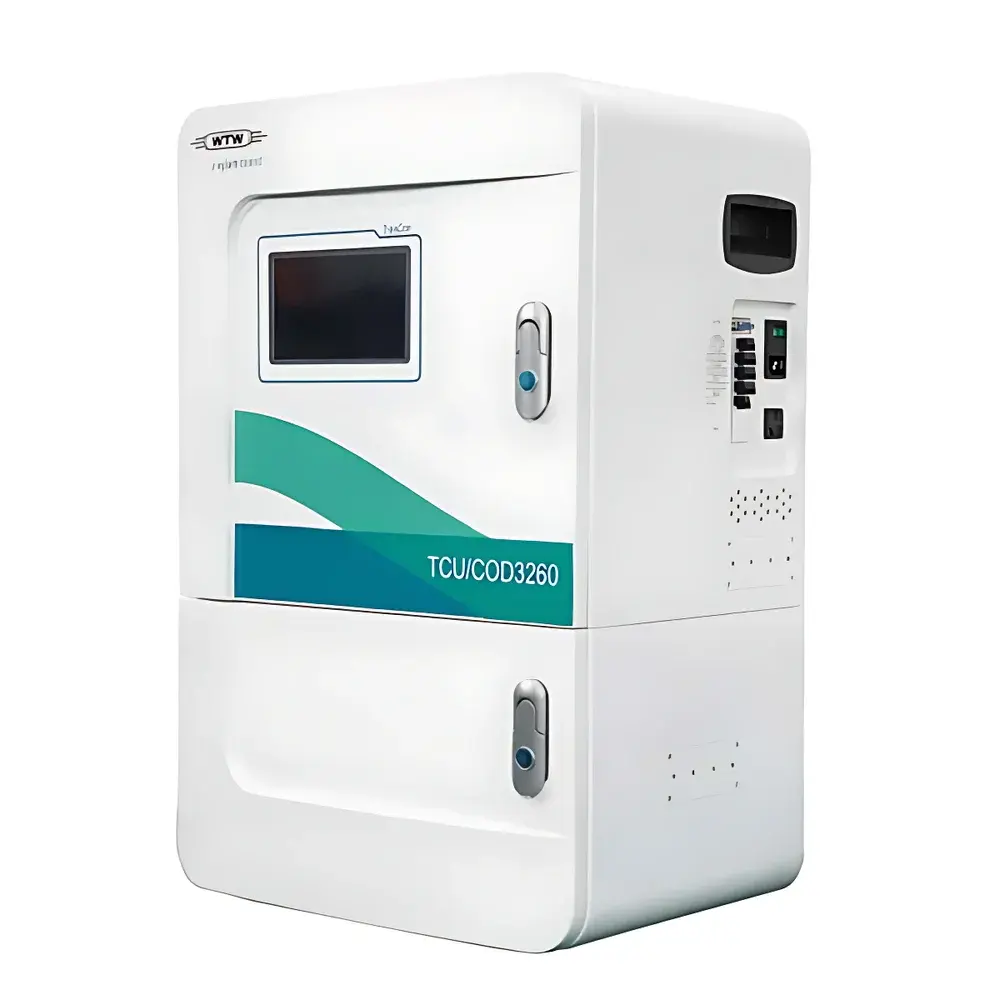
WTW TCU/COD3260 Online Permanganate Index (CODMn) Analyzer
| Brand | WTW |
|---|---|
| Origin | Germany |
| Model | TCU/COD3260 |
| Measurement Principle | Acidic Potassium Permanganate Oxidation with Potentiometric Endpoint Detection (Dual Platinum Electrodes) |
| Temperature Control | 100 °C ± 1 °C |
| Detection Range | 0.5–10 mg/L O₂ (as KMnO₄) |
| Accuracy | ±5% of reading (typical, matrix-dependent) |
| Reagent Consumption | ≤3.5 mL per analysis cycle |
| Sample Flow Requirement | 0.5–2.0 L/min |
| Power Supply | 230 VAC, 50/60 Hz |
| IP Rating | IP65 (enclosure) |
| Compliance | EN ISO 8467:2022, DIN 38409-H12, EPA Method 410.2 (adapted), GLP-ready architecture |
Overview
The WTW TCU/COD3260 Online Permanganate Index (CODMn) Analyzer is an industrial-grade, fully automated system engineered for continuous, unattended monitoring of the permanganate index in surface water, raw drinking water sources, and pre-treatment process streams. It implements the standardized acidic potassium permanganate oxidation method—defined in EN ISO 8467:2022 and DIN 38409-H12—as a robust surrogate for low-level organic load assessment where classical dichromate-based COD (CODCr) is overly aggressive or non-specific. The instrument performs sequential reagent dosing, precisely controlled thermal digestion at 100 °C, potentiometric endpoint detection via dual platinum electrodes, and stoichiometric back-titration with standardized KMnO₄ solution. Unlike spectrophotometric or electrochemical proxies, this method delivers traceable, chemically grounded results aligned with regulatory reporting requirements for source water quality surveillance.
Key Features
- Dual platinum electrode system for high-reproducibility potentiometric endpoint detection—immune to color, turbidity, or suspended solids interference.
- Integrated temperature-controlled digestion block maintaining ±1 °C stability at 100 °C, ensuring consistent reaction kinetics across seasonal ambient variations.
- Non-contact fluid handling architecture: negative-pressure aspiration eliminates direct contact between peristaltic pump tubing and reagents or sample—reducing carryover, chemical degradation, and maintenance frequency.
- Modular mechanical design enables rapid field replacement of core subunits (digestion module, titration manifold, electrode assembly) without full system shutdown.
- Independent reagent cartridge bay with sealed, light-protected compartments—supports up to 30 days of unattended operation using standard 500-mL reagent bottles (KMnO₄, Na₂C₂O₄, H₂SO₄).
- IP65-rated enclosure with conformal-coated PCBs and corrosion-resistant internal fasteners—validated for outdoor mounting in humid, coastal, or wastewater-adjacent environments.
Sample Compatibility & Compliance
The TCU/COD3260 is validated for use with low-turbidity (<5 NTU), low-chloride (<200 mg/L Cl⁻), and non-oily aqueous matrices typical of upland rivers, reservoirs, spring-fed intakes, and clarified pre-filtration streams. It excludes samples containing high concentrations of Fe²⁺, NO₂⁻, or S²⁻ unless pretreated per EN ISO 8467 Annex B. All measurement sequences generate full audit trails—including reagent lot numbers, digestion temperature logs, titration curves, and endpoint deviation flags—supporting compliance with EU Water Framework Directive (2000/60/EC) monitoring protocols and GLP/GMP-aligned QA documentation. Firmware supports optional 21 CFR Part 11-compliant user authentication and electronic signature modules upon configuration.
Software & Data Management
Embedded firmware (v3.2+) provides local web interface (HTTPS-enabled) for real-time diagnostics, calibration history, and method parameter adjustment. Raw titration data (mV vs. time) and calculated CODMn values are timestamped and exportable via Modbus TCP, RS-485 (ASCII/RTU), or optional 4–20 mA analog output (HART 7 compatible). Integrated SD card logging retains ≥12 months of 15-minute interval records with checksum validation. Remote firmware updates and secure configuration backup are supported through WTW’s AQUAconnect cloud platform—requiring no third-party middleware or proprietary drivers.
Applications
- Continuous compliance monitoring of raw water intakes under national drinking water ordinances (e.g., German TrinkwV §6, China GB 3838-2002 Class II/III).
- Trend analysis of seasonal organic loading shifts in alpine or forested catchments.
- Early-warning detection of accidental organic contamination events upstream of treatment plants.
- Performance verification of bank filtration or slow-sand pre-treatment units.
- Integration into SCADA systems for adaptive coagulant dosing control based on real-time oxidizable load estimation.
FAQ
What standards does the TCU/COD3260 comply with?
It adheres to EN ISO 8467:2022, DIN 38409-H12, and is method-validated against EPA 410.2 for permanganate index determination.
Can it operate in freezing ambient conditions?
Yes—the enclosure includes optional thermostatic heating (−20 °C to +50 °C operational range) and glycol-compatible sample line tracing.
Is manual calibration required between analyses?
No; the system performs automatic zero-point verification and endpoint sensitivity checks before each analysis cycle using built-in reference solutions.
How often must reagents be replaced?
At typical 2-hour measurement intervals, KMnO₄ and Na₂C₂O₄ cartridges last ≥25 days; H₂SO₄ lasts ≥40 days (500-mL bottles, standard concentration).
Does it support remote diagnostics and troubleshooting?
Yes—via embedded VNC server and WTW’s AQUAconnect portal, enabling secure technician access to live sensor diagnostics, pump status, and error code interpretation.
Related Products







