
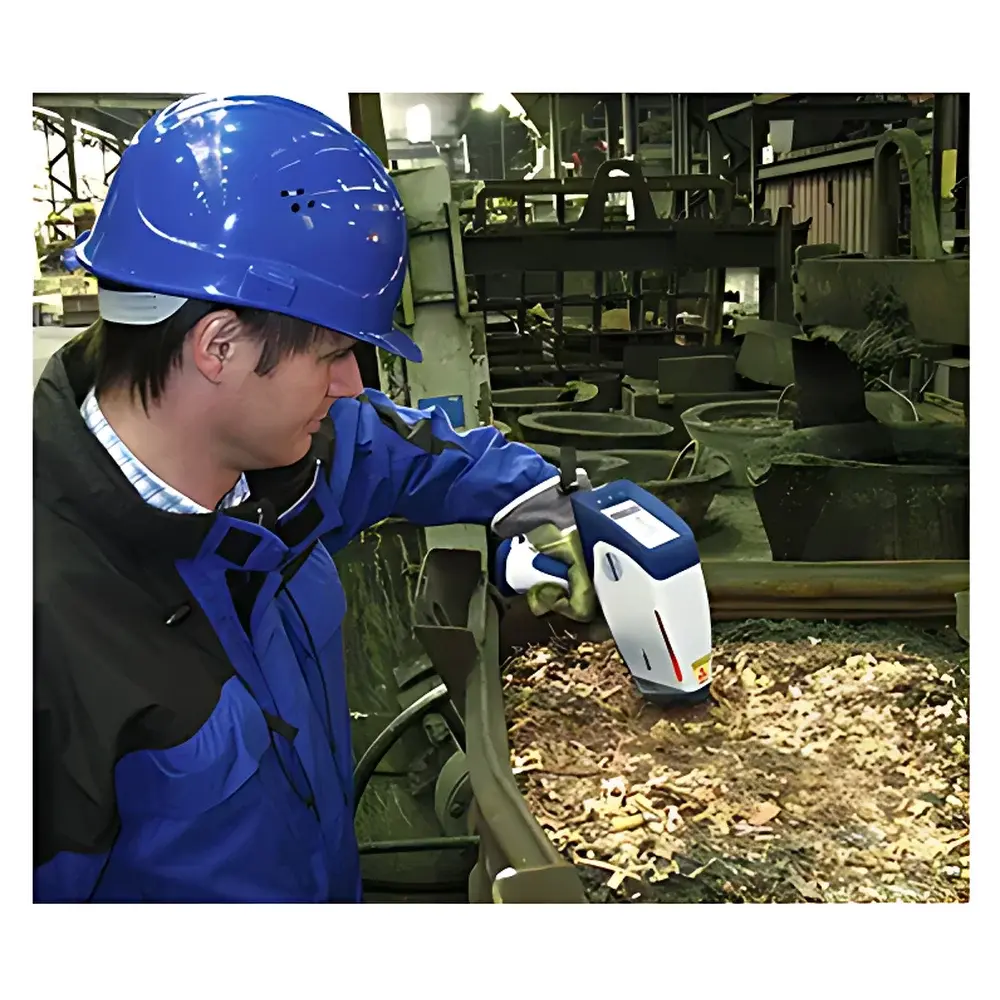
Bruker S1 TITAN Portable Energy Dispersive X-Ray Fluorescence Spectrometer for Positive Material Identification (PMI)
| Brand | Bruker |
|---|---|
| Origin | Germany |
| Model | S1 TITA |
| Application | Handheld/Portable |
| Element Range | Na (11) – U (92) |
| Detection Range | 1 ppm – 99.99% |
| Energy Resolution | <140 eV |
| Repeatability | 0.1% |
| Detector | Silicon Drift Detector (SDD) |
| Weight | 1.5 kg |
| Compliance | API RP 578, ASTM E2857, ISO 17025 (when operated under accredited conditions), FDA 21 CFR Part 11–ready software configuration |
Overview
The Bruker S1 TITAN is a handheld energy dispersive X-ray fluorescence (EDXRF) spectrometer engineered for positive material identification (PMI) and quantitative elemental analysis in industrial field environments. It operates on the fundamental principle of X-ray fluorescence: when a sample is irradiated with high-energy X-rays, inner-shell electrons are ejected from constituent atoms; as outer-shell electrons fill these vacancies, characteristic secondary X-rays—unique to each element—are emitted and detected by the silicon drift detector (SDD). The instrument’s optimized excitation geometry, vacuum- or helium-purge-capable measurement chamber (optional), and real-time spectral deconvolution enable reliable detection of elements from sodium (Na, Z=11) to uranium (U, Z=92), supporting compliance-driven verification of alloy composition across upstream oil & gas, power generation, chemical processing, and fabrication facilities.
Key Features
- Robust, IP54-rated magnesium alloy housing with ergonomic grip and integrated shock-absorbing bumper—designed for daily use in harsh plant environments.
- TITAN-grade radiation-hardened SDD detector delivering <140 eV Mn Kα energy resolution at 100,000 cps, ensuring high peak separation and low background noise for trace-level quantification down to 1 ppm.
- Continuous Automatic Gain Calibration (CAGC) compensates for detector drift and temperature fluctuations, maintaining long-term measurement stability without manual recalibration.
- Integrated 2 MP autofocus camera with LED ring illumination enables precise targeting of small features, weld seams, or curved surfaces—critical for pipe weld PMI and heat-affected zone (HAZ) analysis.
- Optional micro-spot collimation (3 mm or 1 mm) facilitates spatially resolved analysis on heterogeneous samples or narrow geometries such as valve stems or turbine blades.
- Onboard library of over 400 standardized alloy grades—including UNS, ASTM, DIN, JIS, GB, and EN designations—with support for user-defined grade templates and pass/fail threshold logic per element.
Sample Compatibility & Compliance
The S1 TITAN accommodates flat, curved, rough, oxidized, or coated metallic surfaces—including hot pipes up to 400 °C (with optional high-temperature adapter kit). Its non-destructive, no-sample-prep workflow aligns with API Recommended Practice 578 (2022 edition) for PMI program implementation and verification. When deployed with audit-trail-enabled firmware and secure user authentication, the system supports GLP/GMP-aligned data integrity requirements per FDA 21 CFR Part 11. Measurement protocols are traceable to NIST SRM reference materials, and routine performance verification follows ASTM E2857 (Standard Guide for Validation of EDXRF Elemental Analysis Systems).
Software & Data Management
Firmware runs Bruker’s proprietary MSA (Mobile Spectral Analysis) software, featuring intuitive touchscreen navigation, multi-language UI, and context-aware measurement mode selection (e.g., “Stainless Steel ID”, “Ni-Alloy Quant”, “Limit Check”). All spectra, calibration logs, operator IDs, GPS coordinates, timestamps, and image captures are stored in encrypted SQLite databases compliant with IEC 62443-3-3 security guidelines. Data export supports CSV, PDF reports (with digital signature), and direct integration into LIMS via OPC UA or RESTful API. Remote firmware updates and centralized fleet management are supported through Bruker’s CloudConnect portal.
Applications
- Pre-installation verification of piping, flanges, valves, and pressure vessels in refineries and petrochemical plants per API RP 578 Section 5.3.
- Rapid sorting of incoming raw materials and scrap metals to prevent cross-contamination in foundries and metal service centers.
- Weld overlay verification and cladding thickness estimation using ratio-based Fe/Cr/Ni/Mo correlations.
- Failure investigation support—detecting unintended intermetallic phases or segregation zones via spot-to-spot mapping (manual grid mode).
- Regulatory screening for restricted substances (e.g., Pb, Cd, Hg, Cr⁶⁺) in alloys supplied to EU markets under RoHS Directive Annex II.
FAQ
Does the S1 TITAN require radioactive sources or external cooling?
No. It uses a low-power, air-cooled X-ray tube (Ag anode, max 40 kV / 10 µA) and solid-state SDD—no liquid nitrogen or Peltier coolers required.
Can it analyze light elements such as Mg, Al, and Si reliably?
Yes—when operated in vacuum or He-purge mode, the instrument achieves sub-100 ppm detection limits for Mg (Z=12) and Al (Z=13) in aluminum alloys and titanium matrices.
Is spectral data export compliant with 21 CFR Part 11?
Yes—when configured with electronic signatures, audit trail logging, and role-based access control, the system meets ALCOA+ data integrity principles and satisfies Part 11 predicate rule requirements.
How is measurement reproducibility validated onsite?
Users perform daily verification using certified check standards (e.g., Bruker CRM-101); repeatability of ≤0.1% RSD for major alloying elements is confirmed per ASTM E2857 Annex A2.
What accessories extend its operational envelope?
Available options include high-temperature probe (400 °C), tripod mount with laser pointer, ruggedized battery pack (12 h runtime), and Bluetooth barcode scanner for automated sample ID linkage.






