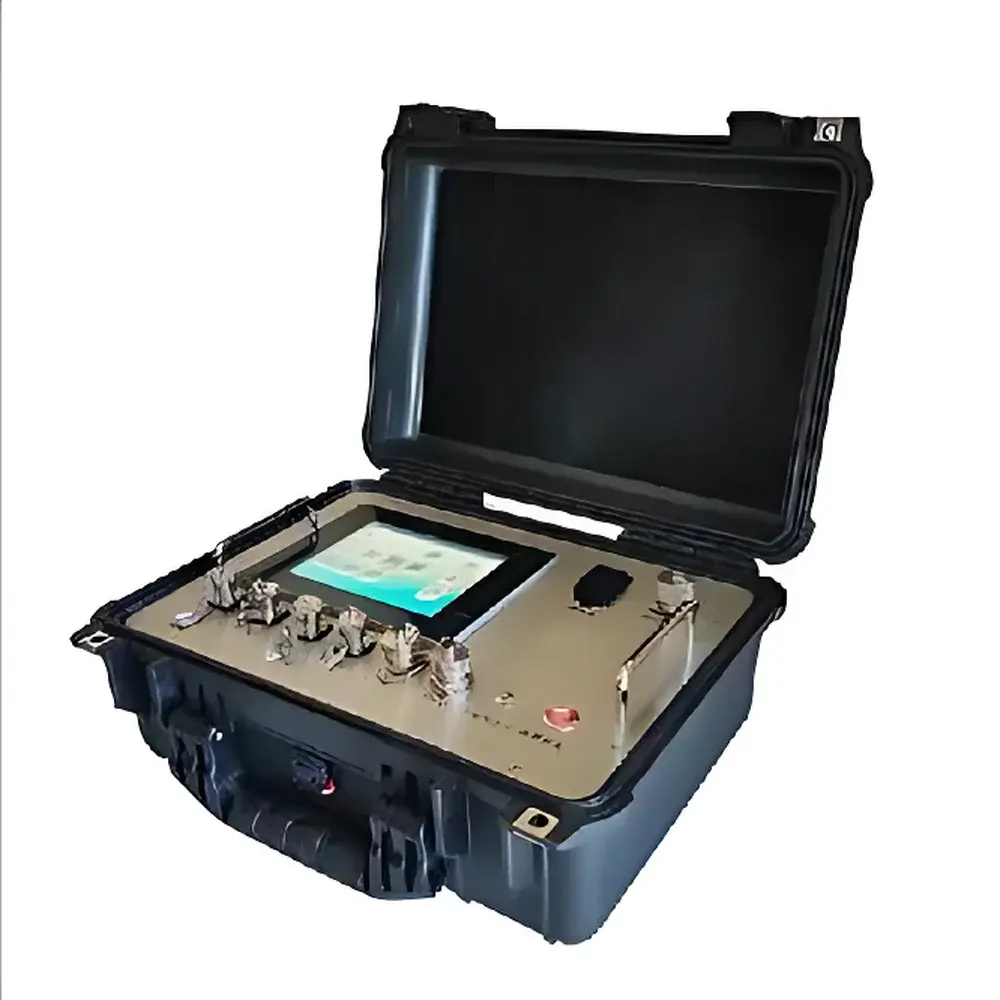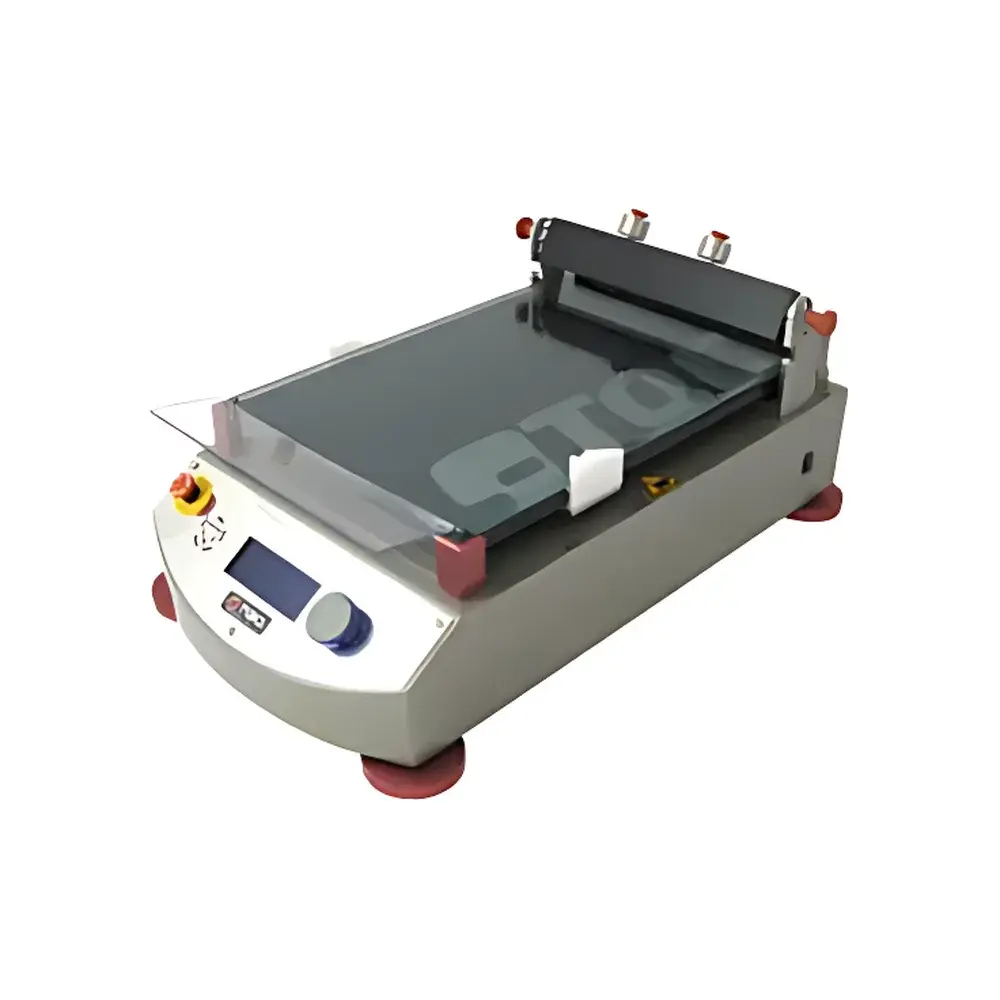
TQC AB3120 Automatic Film Applicator
| Brand | TQC |
|---|---|
| Country of Origin | Netherlands |
| Model Range | AB3120–AB3405 |
| Power Supply | 115–230 V, 50–60 Hz |
| Bed Type | Flat Glass Bed (AB3120/AB3125) |
| Speed Range | 2–500 mm/s |
| Stroke Length | 50–359 mm |
| Stroke Accuracy | ±2 mm |
| Speed Accuracy | ±1% of set value |
| Substrate Size | DIN A3 (297 × 420 mm) |
| Maximum Coater Length | 300 mm |
| Maximum Coater Height | 80 mm |
| Wire Rod Length | Up to 325 mm (spiral zone: 364 mm) |
| Wire Rod Max Diameter at Mounting Point | Ø10 mm |
| Vacuum Capacity | –178 mbar (models with vacuum pump) |
| Dimensions (L×W×H) | 650 × 350 × 240 mm |
| Display | Monochrome LCD (193 × 64 px, 100 × 35 mm active area) |
| Power Consumption | ≤80 W (base unit) |
| Safety Compliance | EU Machinery Directive 2006/42/EC |
| Operating Temperature Range (Heated Models) | Ambient +5 °C to Ambient +100 °C (absolute max 140 °C) |
| Temperature Resolution | 1 °C (set), 0.1 °C (readout) |
| Dry Time Recorder | 1 min–2880 min (48 h), accuracy <1% of set time, up to 8 concurrent measurements |
Overview
The TQC AB3120 Automatic Film Applicator is a precision-engineered laboratory instrument designed for reproducible, standardized coating deposition on rigid and flexible substrates. Based on controlled linear motion and regulated mechanical pressure, the AB3120 eliminates operator-dependent variables—such as hand speed, applied force, angle consistency, and dwell time—that inherently compromise thickness uniformity in manual drawdown applications. Its core operating principle relies on a motor-driven traversing arm that moves a calibrated applicator (e.g., doctor blade, wire-wound rod, or Baker applicator) across a stationary substrate under precisely defined kinematic parameters. This ensures consistent shear history, residence time, and gap control—critical factors governing film formation, leveling behavior, and final dry-film thickness (DFT). The AB3120 serves as a foundational tool in R&D, QC, and regulatory testing workflows where coating homogeneity directly impacts downstream evaluation of rheology, opacity, gloss, adhesion, abrasion resistance, and drying kinetics.
Key Features
- Flat glass bed platform (AB3120/AB3125) optimized for easy cleaning and optical clarity during wet-film inspection.
- Digital menu-driven interface with intuitive rotary/push encoder navigation—no manual required for routine operation.
- Adjustable stroke length (50–359 mm) and speed (2–500 mm/s) with 12 preconfigured velocity steps and custom programmability.
- Integrated safety system featuring dual safeguards: emergency stop button and proximity-sensing intelligent hand detector that halts arm movement upon detection of operator intrusion.
- Low-noise vacuum pump (60–66 dB(A)) with acoustic damping, integrated into vacuum-bed models (AB3220/AB3225/AB3320/AB3325/AB3400/AB3405).
- Automatic test chart clamping and release mechanism—eliminates manual handling before and after coating cycles.
- Retractable coater storage rack mounted at trailing edge; arm retracts automatically post-application, reducing cycle time and operator intervention.
- Robust steel frame with vibration-dampening support feet ensuring mechanical stability during high-precision traversal.
- LED task lighting (5 W warm-white) integrated above working zone for visual assessment of wet film integrity and defect detection.
- Compliance with EU Machinery Directive 2006/42/EC, including CE marking, documented risk assessment, and full conformity declaration.
Sample Compatibility & Compliance
The AB3120 accommodates a wide range of standard and custom applicators—including ASTM D823-compliant wire-wound rods (also known as Mayer rods), ISO 2808-compliant Bird-type blades, and Baker-type applicators—enabling precise gap control for target wet-film thicknesses from ~5 µm to >200 µm depending on rod diameter or blade geometry. It supports substrates up to DIN A3 size (297 × 420 mm) and thicknesses up to 35 mm (including wet layer), including glass slides, aluminum panels, coated paperboard, PET films, metal foils, and textile swatches. All models are compatible with industry-standard test charts (e.g., Leneta, BYK, TQC), and vacuum-bed variants provide secure fixation for low-stiffness or porous media. The instrument meets requirements for GLP-compliant laboratories when used with audit-trail-capable software (via optional RS232/USB interface), and its mechanical repeatability supports validation per ISO/IEC 17025 and ASTM D4400 for coating application procedures.
Software & Data Management
While the AB3120 operates as a standalone benchtop unit with embedded firmware, it features an RS232 serial port (and optional USB-to-serial adapter) for integration with external LIMS or custom data acquisition systems. Parameter logs—including speed, stroke length, date/time stamp, and operator ID (if entered)—can be exported for traceability. When paired with TQC’s optional Dry Time Recorder module (integrated in AB3400/AB3405), the system captures and stores up to eight independent drying profiles simultaneously, with timestamped events aligned to ISO 9117-1 (tack-free time), ISO 9117-3 (dust-free time), and ASTM D1640 (dry-to-touch). Temperature-controlled models support thermal profiling per ASTM D2197 and ISO 2808 Annex B, enabling correlation between substrate temperature and solvent evaporation dynamics. Firmware updates are performed via SD card or PC connection, maintaining compliance with evolving internal quality system requirements.
Applications
The AB3120 is routinely deployed across industrial R&D and production QA/QC environments for preparation of standardized test specimens in accordance with international standards including ASTM D823, ISO 2808, ISO 1514, EN 23272, and JIS K 5600-1-4. Key use cases include: formulation screening of architectural paints, automotive basecoats, coil coatings, and powder coating slurries; viscosity and sag resistance evaluation of high-solids systems; development of functional barrier coatings for packaging films; optimization of inkjet and flexographic ink transfer behavior; accelerated weathering panel preparation; and raw material qualification of resins, pigments, and rheology modifiers. Its reproducibility makes it indispensable for inter-laboratory round-robin studies and regulatory submissions requiring documented coating process control.
FAQ
What substrates are compatible with the AB3120?
Standard rigid substrates (glass, aluminum, steel, plastic sheets) and semi-flexible media (paperboard, PET film, textiles) up to 35 mm total thickness are supported. Vacuum-bed models enhance hold-down for low-tensile or porous materials.
Can I use non-TQC applicators with this instrument?
Yes—the AB3120 accepts any standard applicator with mounting dimensions within 300 mm length and 80 mm height, provided mechanical rigidity and alignment tolerance meet ISO 2808 requirements.
Is the AB3120 suitable for GMP-regulated environments?
When operated with version-locked firmware, parameter logging, and electronic signature-enabled software (via third-party integration), the AB3120 supports 21 CFR Part 11 compliance for electronic records and signatures.
How often does the glass bed require cleaning?
After each coating run—especially when using high-pigment or solvent-borne formulations—to prevent cross-contamination and ensure consistent adhesion and leveling behavior.
Does the AB3120 require calibration certification?
Speed and stroke length are factory-calibrated against traceable metrology standards; annual verification using certified linear encoders or laser interferometry is recommended for ISO/IEC 17025 accreditation.