
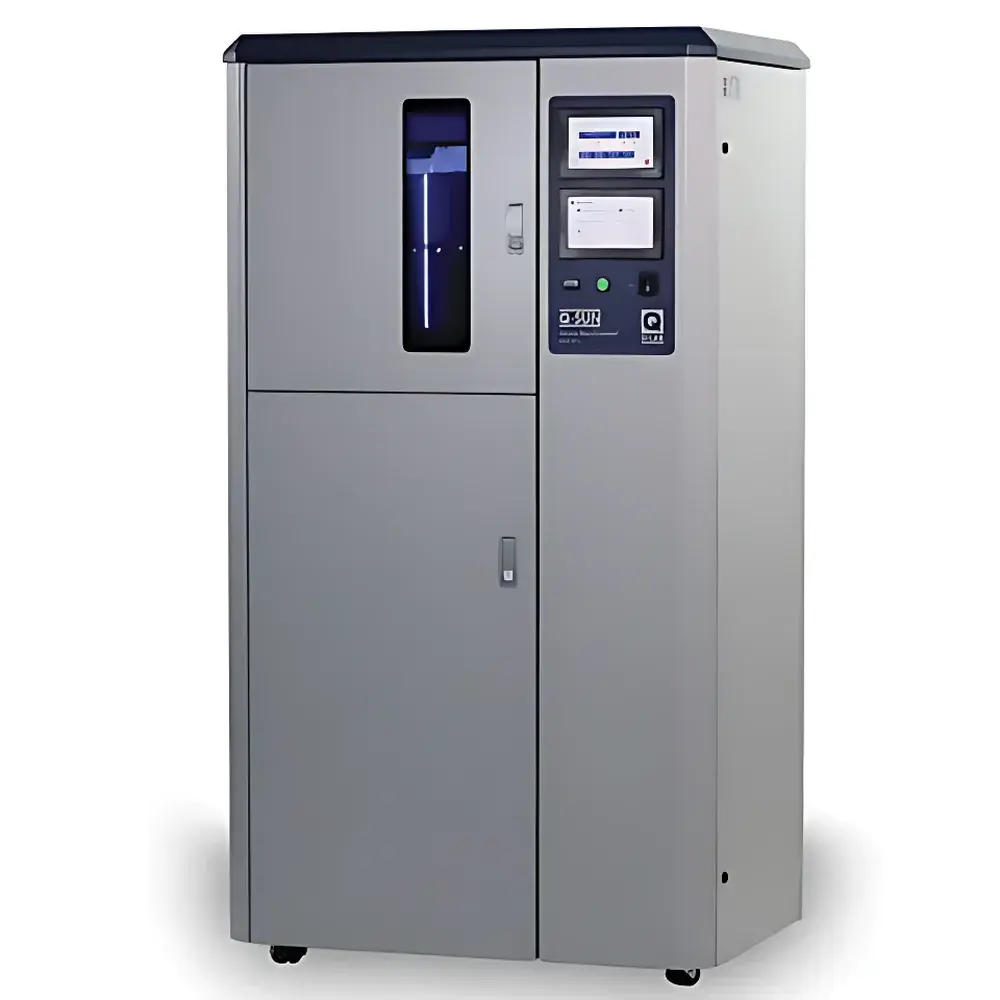
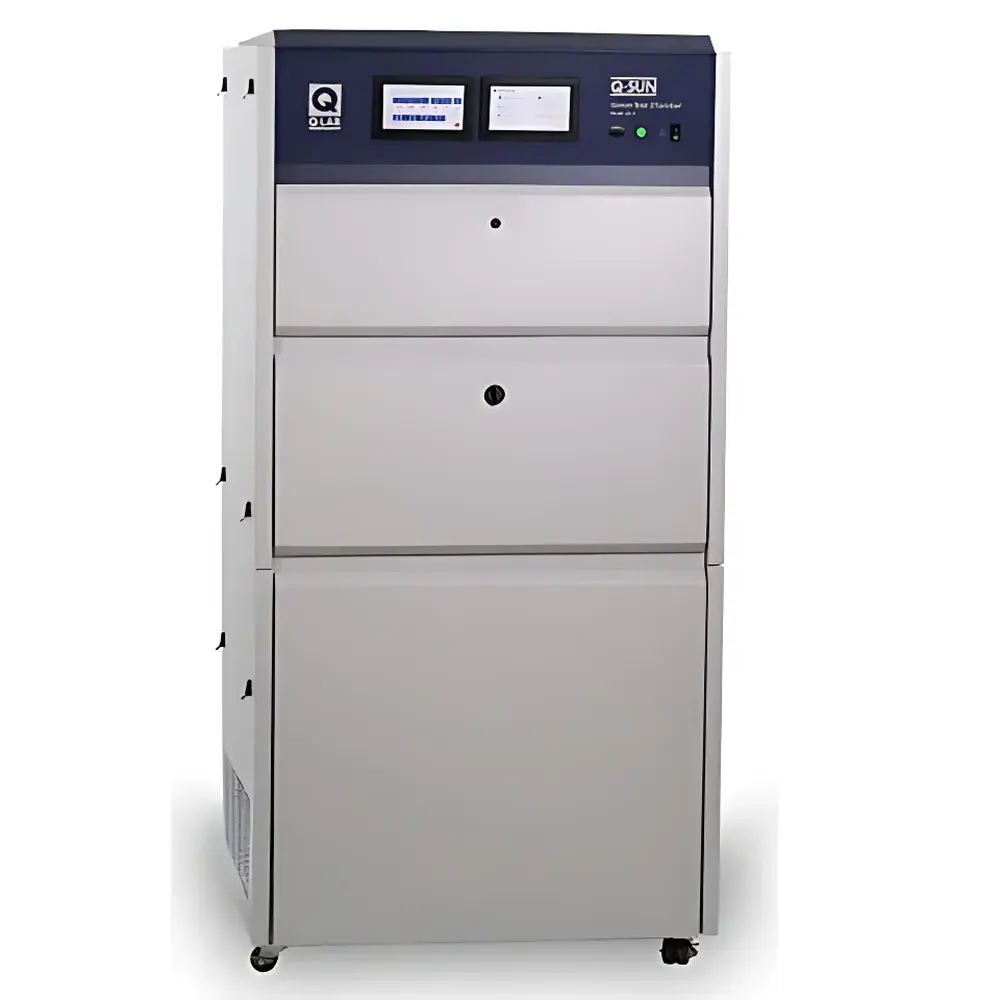
Q-LAB Q-SUN Xe-2 Xenon Arc Weathering Test Chamber
| Brand | Q-LAB |
|---|---|
| Origin | USA |
| Model | Q-SUN Xe-2 |
| Xenon Lamp Power | 1800 W |
| Spectral Match | Full-spectrum solar simulation (300–800 nm) |
| Irradiance Control | SOLAR EYE broadband or narrowband (340 nm, 420 nm, TUV) |
| Black Panel Temperature Range | 35–103 °C |
| Relative Humidity Control | Standard, 10–95% RH |
| Water Spray | Optional, programmable during light/dark cycles |
| Sample Capacity | 31 AATCC pre-cut specimens (16 fixtures, 46 × 264 mm each) |
| Lamp Life | Up to 3000 hours |
| Compliance | ISO 4892-2, ASTM G155, AATCC TM16, ISO 105 B02/B04, IEC 60068-2-9, GB/T 8427, SAE J2412, PV 3929, VDA 675242, ASTM D4355 |
Overview
The Q-LAB Q-SUN Xe-2 Xenon Arc Weathering Test Chamber is an engineered solution for accelerated exposure testing of materials under controlled, reproducible conditions that closely replicate natural sunlight, heat, and moisture. Utilizing a single 1800 W air-cooled xenon arc lamp, the system delivers full-spectrum irradiance (300–800 nm), enabling high-fidelity simulation of solar radiation—including UV, visible, and near-infrared wavelengths—without requiring deionized water cooling infrastructure. This architecture supports rigorous photostability and weathering assessments across diverse industrial sectors, including textiles, automotive interiors, plastics, coatings, roofing membranes, and geotextiles. The chamber operates on the principle of controlled xenon arc irradiation combined with precise regulation of black panel temperature, relative humidity, and optional water spray—parameters directly linked to photochemical degradation kinetics. Its design adheres to fundamental requirements of accelerated testing methodology: spectral fidelity, irradiance stability, thermal uniformity, and environmental repeatability.
Key Features
- Air-cooled 1800 W xenon lamp with extended service life up to 3000 hours—eliminating dependency on deionized water circulation systems and reducing total cost of ownership.
- SOLAR EYE irradiance monitoring and feedback control system, maintaining stable output at user-selectable wavelengths (340 nm, 420 nm, or total UV), ensuring test repeatability across instruments and laboratories.
- Integrated black panel temperature sensor with adjustable setpoint range from 35 °C to 103 °C, enabling correlation with real-world surface heating effects under varying spectral and intensity conditions.
- Standard relative humidity control (10–95% RH), continuously monitored and regulated using deionized water feed—critical for hydrolytic degradation studies in polymers and textile dyes.
- Optional programmable water spray system, operating during both irradiated and dark cycles, simulating dew, rain, and thermal shock effects in outdoor exposure scenarios.
- High-capacity vertical sample rack accommodating 31 AATCC pre-cut specimens (46 × 264 mm per fixture, 16 total fixtures), delivering 1882 cm² of exposed area—optimized for throughput without compromising irradiance uniformity.
- AUTO-CAL automated calibration system eliminating reliance on reference lamps; enables rapid, traceable recalibration of irradiance sensors without external hardware or manual intervention.
- Intuitive multi-language controller (English, French, Spanish, Italian, German) with built-in Ethernet connectivity for data logging, remote diagnostics, and audit-ready event history.
Sample Compatibility & Compliance
The Q-SUN Xe-2 accommodates flat, rigid, or flexible specimens—including woven/nonwoven textiles, painted panels, polymer films, rubber compounds, and coated substrates—via standardized mounting fixtures compliant with AATCC, ISO, and ASTM geometries. It meets or exceeds requirements of over 50 international test standards, including ISO 4892-2 (plastics), ISO 105-B02/B04 (textile colorfastness), ASTM G155 (xenon arc exposure), AATCC TM16 (lightfastness), SAE J2412 (automotive interior materials), PV 3929 (Volkswagen), VDA 675242 (German automotive), and ASTM D4355 (geotextiles). All compliance claims are validated through third-party interlaboratory round-robin studies and documented in Q-LAB’s publicly available technical bulletins. The system supports GLP-compliant operation when configured with password-protected user roles, electronic signatures, and 21 CFR Part 11–ready audit trails via optional software modules.
Software & Data Management
The embedded controller provides real-time display and logging of irradiance (W/m²), black panel temperature (°C), chamber air temperature (°C), and relative humidity (%RH). Data is stored internally and exportable via Ethernet to CSV or XML formats for integration into LIMS or quality management systems. Firmware includes self-diagnostic routines that monitor lamp voltage, cooling airflow, humidity saturation, and sensor drift—triggering actionable alerts prior to parameter excursion. Optional Q-LAB’s SunTest™ PC software extends functionality with advanced scheduling, multi-test sequencing, statistical trend analysis, and automated report generation aligned with ISO/IEC 17025 documentation requirements. All firmware updates are digitally signed and version-controlled to ensure traceability and regulatory readiness.
Applications
The Q-SUN Xe-2 serves as a primary tool for predictive durability assessment in R&D, QC, and regulatory submission workflows. In textile laboratories, it validates colorfastness per ISO 105-B02 under window-glass-filtered spectra. Automotive suppliers use it to qualify dashboard materials against SAE J2412 cycle profiles incorporating UV, temperature ramping, and condensation phases. Roofing manufacturers assess membrane integrity per ASTM D4798 under extended UV + moisture cycling. Packaging developers evaluate ink fade resistance per ISO 12040, while medical device firms screen polymer housings per ISO 10993-12 biocompatibility guidance. Its versatility extends to failure mode analysis—enabling identification of UV-induced embrittlement, pigment migration, chalking, or hydrolytic chain scission through sequential sampling and post-exposure mechanical/visual evaluation.
FAQ
What spectral filter configurations does the Q-SUN Xe-2 support?
It uses dual-stage filtration: an outer borosilicate sleeve and inner seven-element filter assemblies. Configurations include Window-IR (ISO/AATCC “window glass” spectrum) and Window-B/SL (AATCC TM16), both optimized for transmission above 290 nm with infrared attenuation.
Is deionized water required for operation?
Yes—for both the humidity generation system and optional water spray function. Conductivity must remain below 1 µS/cm to prevent mineral deposition on optics and sensors.
How is irradiance calibration maintained over time?
Via the AUTO-CAL system, which performs in-situ verification using integrated reference photodiodes—no external calibration lamp or technician intervention is needed between scheduled maintenance intervals.
Can the Q-SUN Xe-2 operate unattended for extended periods?
Yes. It supports continuous 24/7 operation with automated fault recovery, thermal cutouts, and email/SNMP alerting for critical events such as lamp failure or humidity loss.
Does the system meet FDA 21 CFR Part 11 requirements?
When paired with Q-LAB’s validated SunTest™ software and configured with role-based access control, electronic signatures, and immutable audit logs, it satisfies electronic record and signature requirements for regulated environments.
Related Products



