
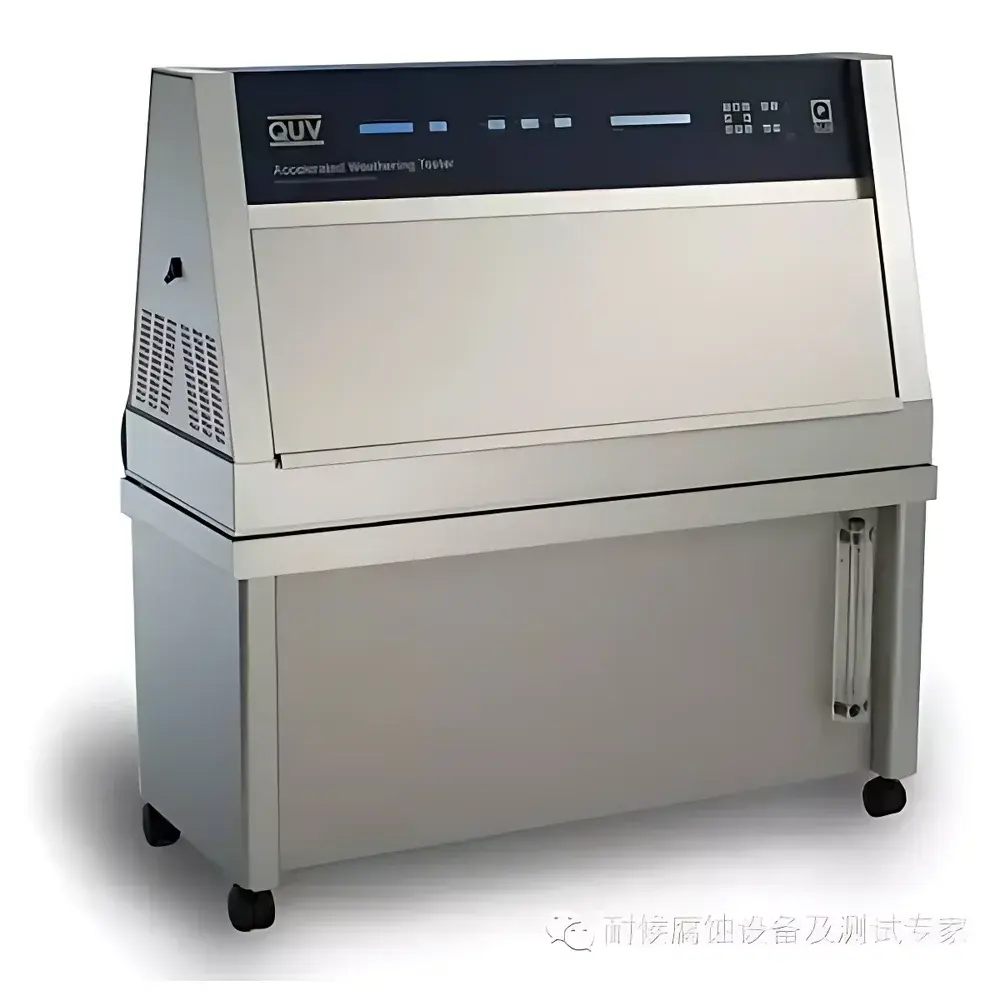
Q-LAB QUV Fluorescent UV Aging Test Chamber
| Brand | Q-LAB |
|---|---|
| Origin | USA |
| Manufacturer Type | Authorized Distributor |
| Origin Category | Imported |
| Model | QUV |
| Pricing | Upon Request |
| UV Irradiance Control | Yes (except QUV/basic) |
| UV Lamp Options | UVA-340, UVA-351, UVB-313, QFS-40, Cool White Fluorescent |
| Condensation Mechanism | Water-jacketed condensation via heated water pan |
| Sample Capacity | Up to 48 specimens (75 mm × 150 mm) in QUV/se, QUV/spray, and QUV/cw configurations |
| Temperature Control | Precise black panel and chamber air temperature regulation |
| Compliance | Designed to support ASTM G154, ISO 4892-3, SAE J2020, and other UV exposure standards |
Overview
The Q-LAB QUV Fluorescent UV Aging Test Chamber is an industry-standard accelerated weathering instrument engineered for precision simulation of solar ultraviolet (UV) radiation effects on polymeric, coating, automotive, and architectural materials. Unlike broad-spectrum xenon arc or carbon arc sources, the QUV system employs calibrated fluorescent UV lamps—each with a defined spectral power distribution (SPD)—to replicate specific segments of terrestrial sunlight’s UV spectrum. This targeted irradiation enables controlled, reproducible assessment of photochemical degradation mechanisms including polymer chain scission, chromophore bleaching, surface oxidation, gloss loss, chalking, cracking, and embrittlement. The system operates on the principle that UV photons (particularly 295–400 nm) initiate free-radical reactions in organic matrices; subsequent thermal and moisture-driven secondary processes accelerate physical deterioration. By isolating and intensifying this critical spectral region, the QUV delivers accelerated yet scientifically relevant aging data—typically compressing years of outdoor exposure into weeks of laboratory testing.
Key Features
- UV-Specific Lamp Architecture: Interchangeable lamp types—including UVA-340 (sunlight-simulating, 295–365 nm), UVA-351 (through-window filtration), UVB-313 (high-energy, aggressive aging), QFS-40 (fluorescent sunlamp), and Cool White fluorescent—allow precise matching of test spectra to application-specific exposure conditions.
- Stable Spectral Output: Q-LAB UV lamps maintain consistent SPD over their rated lifetime (5,000-hour warranty), eliminating spectral drift common in xenon systems and ensuring inter-laboratory reproducibility without frequent recalibration.
- Condensation Humidity Simulation: A heated water pan generates saturated vapor at elevated temperatures, producing uniform, contaminant-free condensate on specimen surfaces—mimicking natural dew formation without mineral deposits or spotting.
- Precision Temperature Regulation: Independent black panel thermometer (BPT) and chamber air temperature control enable strict adherence to standardized test profiles per ASTM G154 Cycle 1–6 or ISO 4892-3 protocols.
- SunEye Irradiance Control (optional on QUV/se, QUV/spray, QUV/cw): Closed-loop feedback system dynamically adjusts lamp voltage to maintain user-defined irradiance setpoints (e.g., 0.73 W/m² @ 340 nm for UVA-340), compensating for lamp aging, ambient fluctuations, and batch variability.
- Modular Sample Handling: Adjustable rack system accommodates flat panels (75 mm × 150 mm), curved substrates, lenses, and 3D components; custom fixtures available for non-standard geometries.
Sample Compatibility & Compliance
The QUV chamber supports rigid and flexible specimens up to 12.7 mm thick, including paints, plastics, textiles, adhesives, composites, and elastomers. Its design conforms to key international standards governing UV exposure testing: ASTM G154 (Standard Practice for Operating Fluorescent Ultraviolet (UV) Lamp Apparatus for Exposure of Non-Metallic Materials), ISO 4892-3 (Plastics — Methods of Exposure to Laboratory Light Sources — Part 3: Fluorescent UV Lamps), SAE J2020 (Automotive Exterior Materials UV Exposure), and AATCC TM186 (Textiles). When configured with irradiance control and calibrated sensors, the system meets GLP documentation requirements and supports audit-ready traceability for regulated industries. Data integrity aligns with FDA 21 CFR Part 11 principles through optional software logging with electronic signatures and change history.
Software & Data Management
While the base QUV controller provides manual cycle programming, integration with Q-LAB’s optional QUV Software Suite enables automated test sequencing, real-time irradiance and temperature trending, alarm notification, and exportable CSV/Excel reports. All logged parameters—including BPT temperature, chamber air temperature, irradiance output, cycle phase duration, and lamp operating hours—are time-stamped and stored with immutable audit trails. The software supports multi-user access control, password-protected configuration changes, and configurable report templates compliant with internal QA/QC and external certification body requirements (e.g., ISO/IEC 17025).
Applications
The QUV system is routinely deployed across R&D, quality assurance, and regulatory submission workflows. Typical use cases include: validating UV stabilizer efficacy in polyolefins and PVC formulations; benchmarking exterior automotive clearcoats against OEM specifications; qualifying architectural sealants for ASTM C1135 durability; assessing photostability of medical device packaging films; screening inkjet inks for outdoor signage longevity; and supporting IEC 61215 qualification of PV module encapsulants. Its predictability and standardization make it a preferred tool for supplier qualification, failure analysis root-cause studies, and comparative material ranking under controlled UV stress.
FAQ
What UV lamp should I select for my application?
UVA-340 best replicates terrestrial sunlight below 365 nm and is recommended for general outdoor exposure simulation. UVB-313 provides more aggressive degradation for rapid screening or highly stabilized materials. UVA-351 simulates UV filtered through window glass—ideal for interior applications.
How does condensation differ from spray or immersion in weathering tests?
Condensation replicates nocturnal dew formation—low-energy, uniform, non-erosive moisture deposition—whereas spray introduces mechanical stress and variable wetting patterns. QUV/cw (condensation only) and QUV/spray (spray + UV) offer distinct environmental stress combinations per test standard requirements.
Is irradiance calibration required for compliance?
Yes. ASTM G154 and ISO 4892-3 mandate periodic verification of irradiance output using NIST-traceable radiometers. Q-LAB recommends annual sensor calibration and lamp replacement at 5,000 hours to maintain measurement uncertainty within ±5%.
Can the QUV accommodate non-standard sample sizes?
Yes. While standard racks hold 48 × 75 mm × 150 mm specimens, custom mounting solutions—including vertical holders, curved substrate clamps, and fixture-integrated thermocouple ports—are available upon request for engineering validation testing.



