
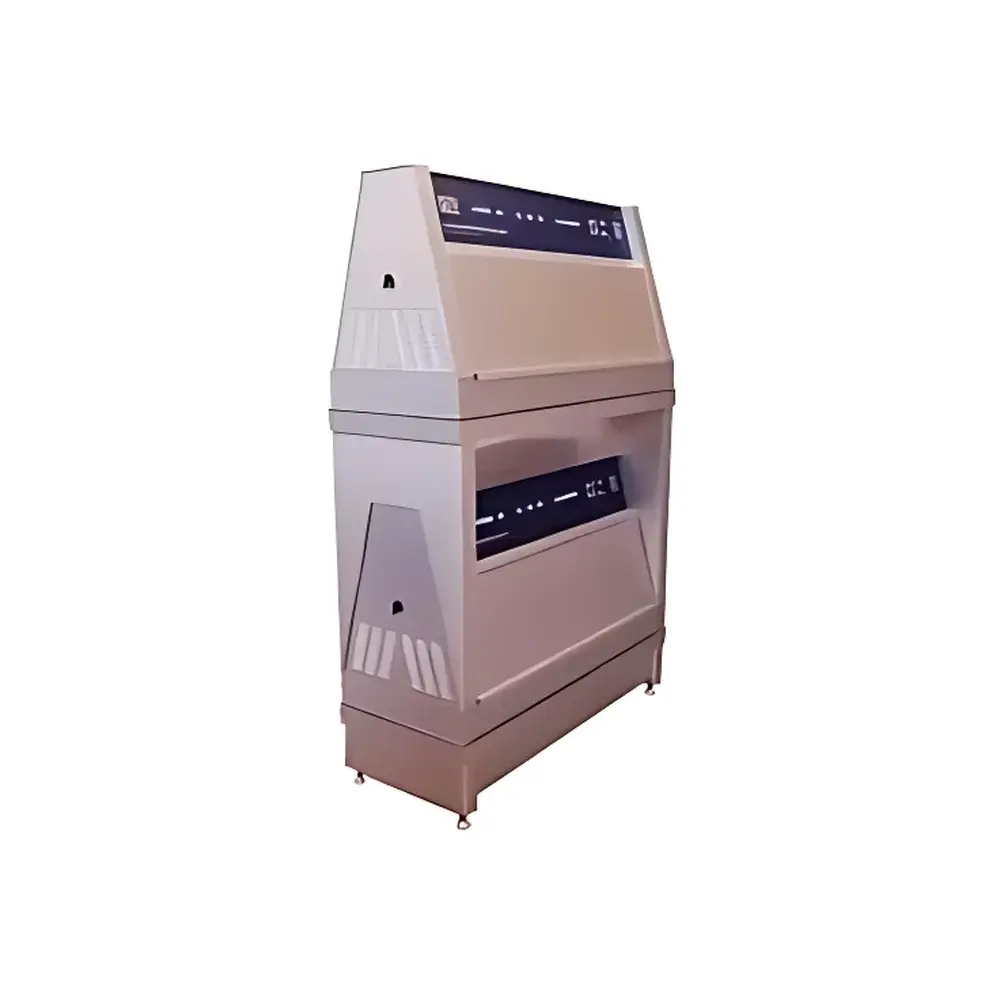
Q-Lab QUV/SE Solar Eye UV Aging Test Chamber
| Brand | Q-Lab |
|---|---|
| Origin | USA |
| Model | QUV/SE |
| UV Lamp Types | UVA-340, UVA-351, UVB-313, QFS-40, Cool White (QUV/cw only) |
| Irradiance Control | SOLAR EYE closed-loop feedback system |
| Condensation Mechanism | Water distillation via natural evaporation/condensation cycle |
| Sample Capacity | Up to 48 specimens (75 mm × 150 mm) |
| Compliance | ASTM G154, ISO 4892-3, JIS D0205, SAE J2020, GB/T 14522, and other international UV exposure standards |
| Software Interface | Multilingual (English, French, Spanish, Italian, German), real-time exposure condition display, self-diagnostic alerts, AUTOCAL calibration assistant |
Overview
The Q-Lab QUV/SE Solar Eye UV Aging Test Chamber is an industry-standard accelerated weathering instrument engineered for precision simulation of solar ultraviolet radiation and condensation-driven moisture exposure. It operates on the principle of fluorescent UV irradiation—using narrow-band ultraviolet lamps to replicate the most photochemically aggressive portion of terrestrial sunlight (295–400 nm)—combined with a controlled condensation cycle that mimics dew formation, the dominant moisture mechanism in outdoor degradation. Unlike xenon arc or carbon arc systems, the QUV/SE leverages stable, spectrally consistent fluorescent UV lamps whose spectral power distribution (SPD) remains invariant over extended service life (up to 5,000 hours), ensuring high inter-laboratory reproducibility and long-term test fidelity. Its design conforms to core international test standards including ASTM G154 (Standard Practice for Operating Fluorescent Ultraviolet (UV) Lamp Apparatus for Exposure of Non-Metallic Materials), ISO 4892-3 (Plastics — Methods of Exposure to Laboratory Light Sources — Part 3: Fluorescent UV Lamps), and JIS D0205 (Automotive Paint Durability Testing).
Key Features
- SOLAR EYE Irradiance Control System: A patented, closed-loop optical feedback mechanism continuously monitors UV intensity at specimen plane using a calibrated sensor and dynamically adjusts lamp power output to maintain user-specified irradiance setpoints (e.g., 0.68 W/m² @ 340 nm for UVA-340). This eliminates drift due to lamp aging or voltage fluctuation, delivering superior repeatability across test runs and laboratories.
- Distillation-Based Condensation Cycle: The chamber’s water pan utilizes ambient air cooling to induce condensation directly onto specimen surfaces—mimicking nocturnal dew formation. Evaporation and condensation act as a natural purification process, eliminating mineral buildup without requiring deionized water or external humidification systems.
- Modular UV Lamp Compatibility: Supports five lamp types optimized for distinct exposure profiles: UVA-340 (best-match to solar cutoff at 295 nm), UVA-351 (filtered through window glass), UVB-313 (accelerated, high-energy UV for QC/R&D), QFS-40 (legacy automotive specification), and Cool White (for indoor lighting simulation in QUV/cw configuration).
- Robust, Low-Maintenance Architecture: Solid-state electronics, corrosion-resistant stainless-steel interior, and tool-free lamp access enable >95% operational uptime. AUTOCAL simplifies radiometric recalibration with guided prompts and integrated sensor diagnostics.
- Multilingual Touchscreen Interface: Intuitive 7-inch color display supports English, French, Spanish, Italian, and German. Real-time monitoring includes irradiance, black panel temperature, chamber temperature, elapsed time, and active fault codes with contextual help text.
Sample Compatibility & Compliance
The QUV/SE accommodates up to 48 flat specimens measuring 75 mm × 150 mm (3″ × 6″) on its standard sample racks. Specimen holders are designed for uniform exposure geometry and thermal equilibrium, minimizing edge effects and shadowing. All configurations comply with dimensional and mounting requirements defined in ASTM G154 Annex A1 and ISO 4892-3 Clause 6. The system supports GLP/GMP-aligned operation through optional audit-trail logging (via Q-Lab’s QUV Connect software), meeting traceability expectations under FDA 21 CFR Part 11 when paired with validated electronic signatures. Routine calibration follows ISO/IEC 17025 principles using NIST-traceable reference sensors (e.g., Q-Lab’s UV-340 Calibrator).
Software & Data Management
While the QUV/SE operates autonomously via embedded firmware, it integrates seamlessly with Q-Lab’s QUV Connect software suite for enhanced data governance. QUV Connect enables remote monitoring, automated report generation (PDF/CSV), historical trend analysis, and secure export of irradiance logs, temperature profiles, and alarm histories. All data fields are timestamped with millisecond resolution and support configurable retention policies. For regulated environments, optional 21 CFR Part 11 compliance packages include electronic signature workflows, role-based access control, and immutable audit trails—fully compatible with enterprise LIMS and quality management systems (QMS).
Applications
The QUV/SE serves critical roles across polymer science, coatings R&D, automotive OEM validation, architectural product certification, and photovoltaic module qualification. Typical use cases include evaluating pigment stability in automotive clearcoats per SAE J2020; assessing UV resistance of PVC roofing membranes against ASTM D4329; validating label adhesion and ink fade resistance for pharmaceutical packaging under ISO 11607-1; and screening encapsulant yellowing in solar panels per IEC 61215. Its ability to isolate UV-driven degradation mechanisms—separate from thermal or visible-light effects—makes it indispensable for root-cause failure analysis and predictive lifetime modeling.
FAQ
What UV lamp type should I select for outdoor durability testing?
UVA-340 lamps provide the closest spectral match to terrestrial sunlight below 365 nm and are recommended for general outdoor exposure simulation per ASTM G154 Cycle 1.
Can the QUV/SE simulate rain or thermal shock?
No—the QUV/SE replicates UV irradiation and dew-like condensation only. For spray, thermal cycling, or combined stress testing, Q-Lab’s Q-SUN xenon test chambers or custom multi-stress platforms are required.
How often must UV lamps be replaced?
Lamp replacement intervals depend on accumulated irradiance dose and lamp type; typical service life is 1,600–5,000 hours. SOLAR EYE control extends usable life by compensating for output decay, but spectral integrity verification per ISO 4892-3 Annex B is advised every 1,000 hours.
Is distilled or deionized water required for condensation?
No—tap water is sufficient. The condensation cycle inherently purifies water through phase change, preventing scale accumulation on specimens or chamber walls.
Does the QUV/SE meet ISO 17025 calibration requirements?
Yes—when used with Q-Lab’s certified calibration services and NIST-traceable reference instruments, the system supports full ISO/IEC 17025-compliant uncertainty budgets for irradiance and temperature measurements.



