
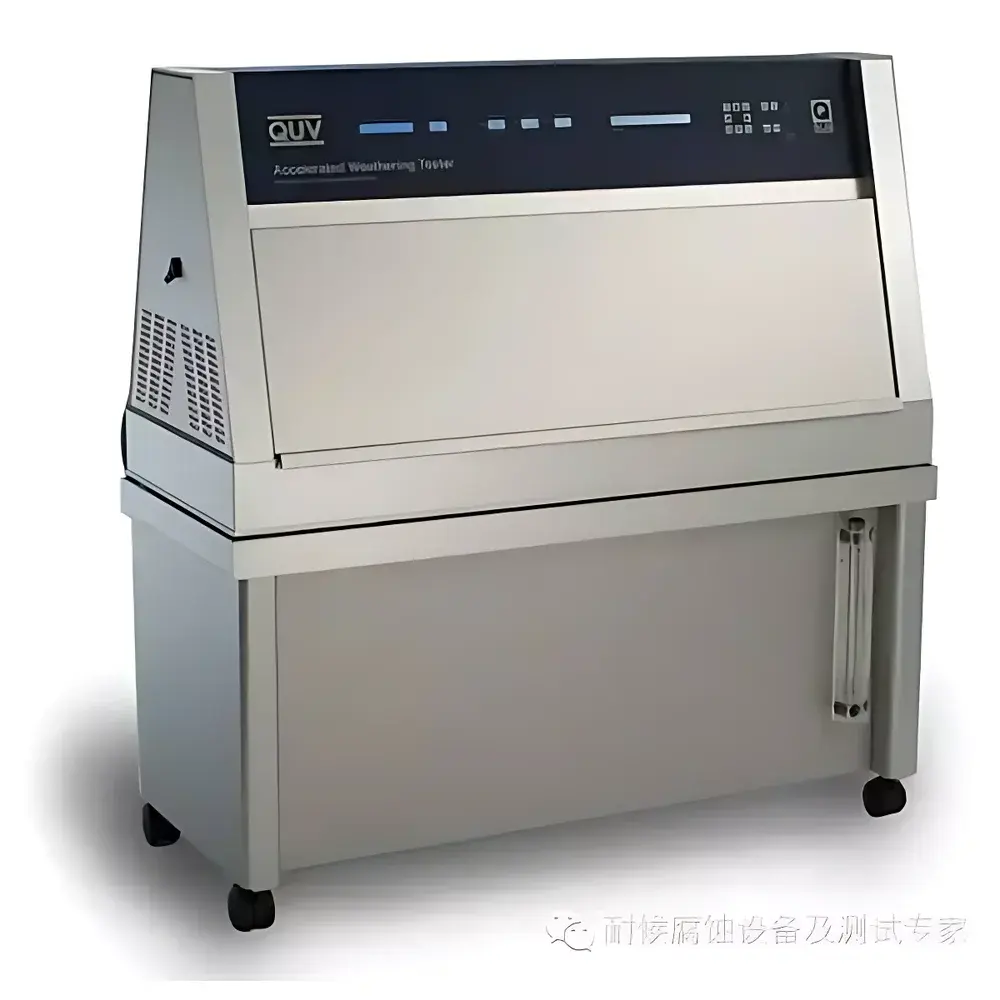
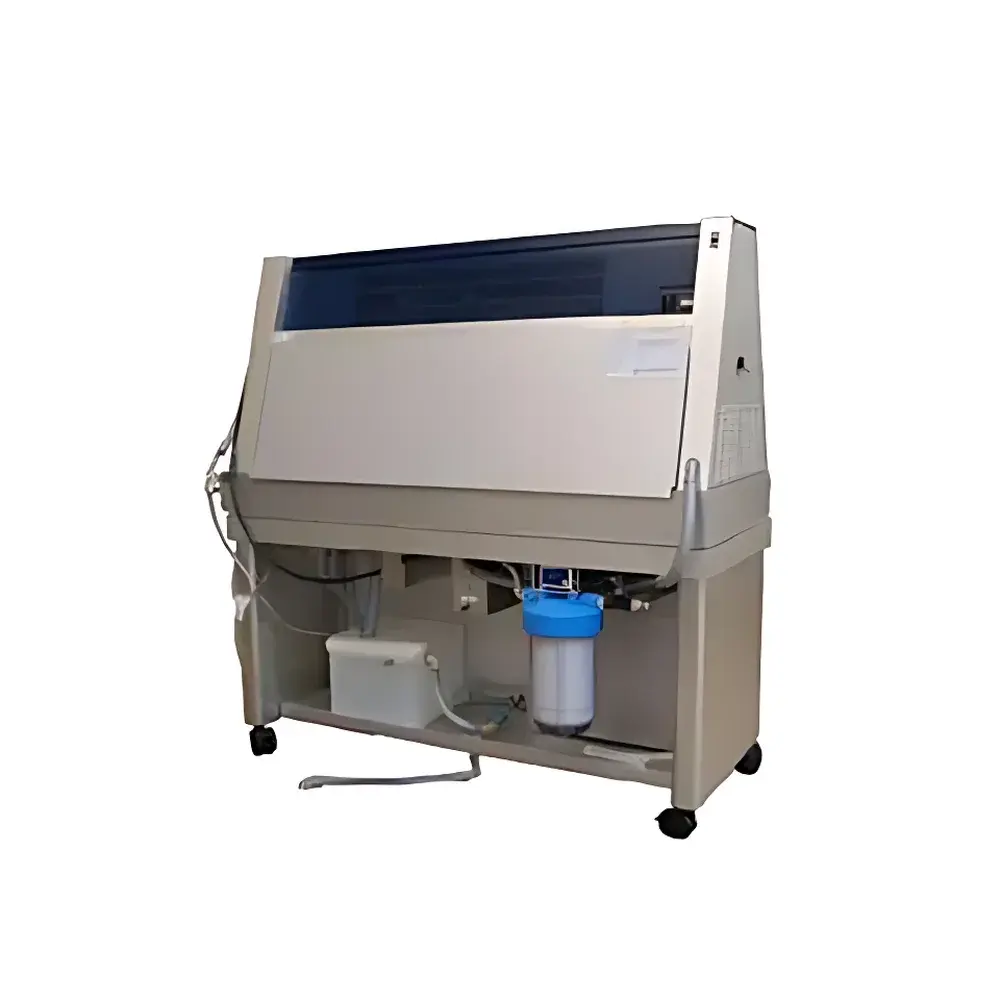
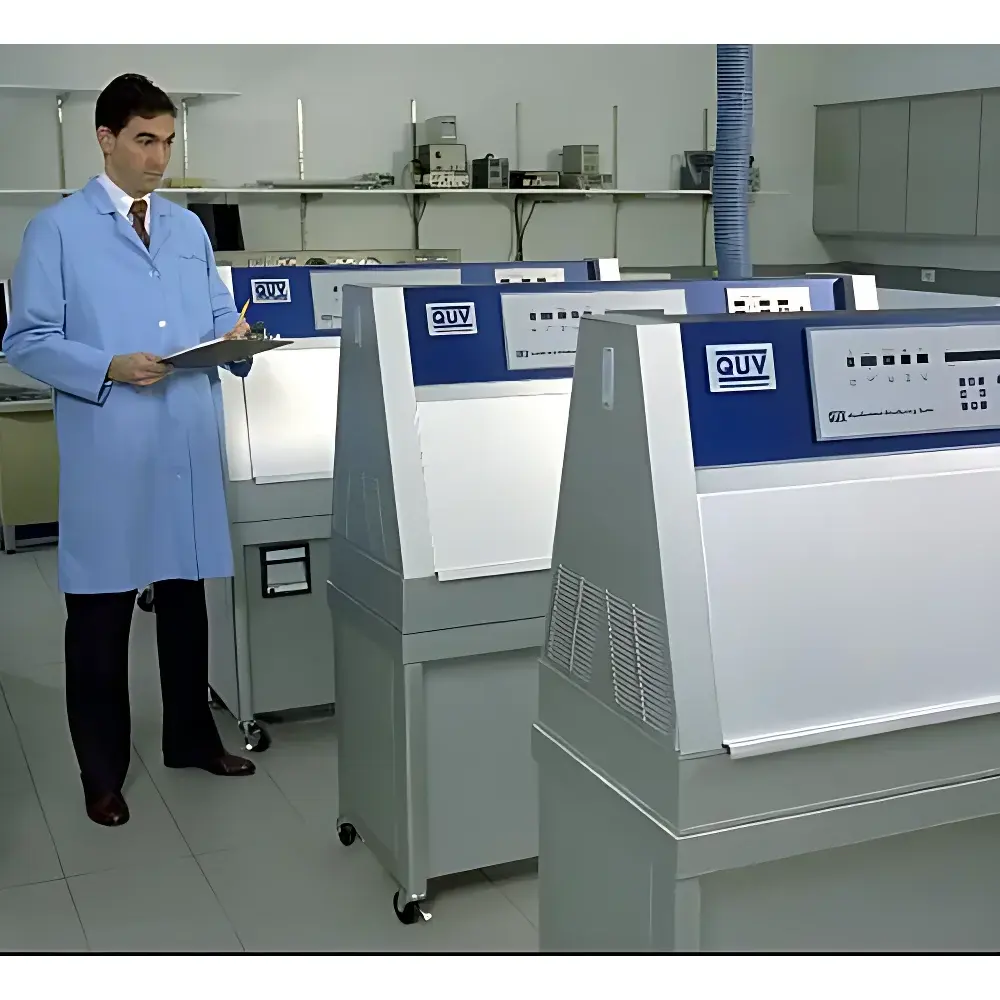
Q-LAB QUV Accelerated Weathering Tester with UV Irradiation and Condensation Simulation
| Brand | Q-LAB |
|---|---|
| Origin | USA |
| Model | QUV |
| UV Wavelength Range | 280–400 nm |
| Compliance | ASTM G154, ISO 4892-3, SAE J2020, IEC 61215 (UV preconditioning), FDA 21 CFR Part 11 (software-enabled configurations) |
| Sample Capacity | Up to 48 specimens (75 × 150 mm) |
| Power Supply | 230 V ±10%, 50/60 Hz, max. 2000 W |
| Water Requirements | Deionized or tap water (pH 6.0–8.0), 2–80 psi, ~8 L/day for condensation cycle |
Overview
The Q-LAB QUV Accelerated Weathering Tester is an industry-standard benchtop environmental test chamber engineered for high-fidelity simulation of solar ultraviolet (UV) radiation and moisture-induced degradation mechanisms. Unlike broad-spectrum xenon arc or carbon arc systems, the QUV employs fluorescent UV lamps emitting within the critical 280–400 nm range—encompassing UVC, UVB, and UVA bands—to replicate the most photochemically aggressive portion of terrestrial sunlight. Its proprietary condensation mechanism mimics nocturnal dew formation by thermally cycling specimen surfaces against saturated humid air at controlled black panel temperatures (typically 40–60 °C during condensation, 45–80 °C during irradiation). This dual-stress approach—UV photon flux coupled with cyclic hydration/dehydration—accelerates polymer chain scission, pigment fading, coating delamination, and surface chalking at rates significantly exceeding natural outdoor exposure. The system is widely adopted in R&D labs, quality assurance departments, and certification bodies seeking reproducible, traceable, and standards-compliant weathering data under GLP and ISO/IEC 17025 frameworks.
Key Features
- UV lamp array with spectral output aligned to ASTM G154 Cycle 1 (UVA-340) or Cycle 4 (UVB-313), enabling material-specific stress profiling
- Integrated condensation system utilizing ambient-temperature water reservoir with bottom-mounted heater—eliminating immersion corrosion and extending heater service life
- Externally mounted water-level indicator for real-time monitoring without chamber access
- Ergonomic upward-swinging door design minimizing footprint (140 × 60 × 120 cm) and facilitating unobstructed specimen loading/unloading
- Adjustable specimen rack depth accommodating variable substrate thicknesses (e.g., rigid panels, flexible films, molded parts)
- Caster-mounted base for lab mobility; standard configuration includes grounded 3-m power cord (230 V ±10%, 2000 W max)
- Microprocessor-based controller with programmable irradiance setpoints, temperature profiles, and timed spray cycles (on select models)
- Calibration-ready architecture: compatible with NIST-traceable radiometers (e.g., Q-Lab’s Calibrator Model 810) to maintain irradiance accuracy over lamp lifetime (>5000 h for UVA-340, >1600 h for UVB-313)
- Bilingual (English/Chinese) operator manuals and intuitive icon-driven interface supporting multi-language firmware updates
Sample Compatibility & Compliance
The QUV accommodates flat, rigid, or semi-flexible specimens up to 75 × 150 mm per slot, with standardized racks holding up to 48 samples simultaneously. Compatible substrates include automotive clearcoats, architectural sealants, photovoltaic encapsulants, textile dyes, medical device polymers, and aerospace composites. All operational modes comply with internationally recognized weathering standards: ASTM G154 (fluorescent UV exposure), ISO 4892-3 (plastics—UV exposure), SAE J2020 (automotive exterior materials), and IEC 61215 (photovoltaic module qualification). When equipped with optional irradiance control and audit-trail software, the system supports 21 CFR Part 11 compliance for regulated industries requiring electronic record integrity, user authentication, and change history logging.
Software & Data Management
The QUV’s embedded controller stores up to 100 test programs with independent ramp/soak segments for irradiance, black panel temperature, and condensation duration. Optional Q-Lab’s SolarEye™ software enables remote monitoring, real-time graphing of irradiance drift and temperature stability, automated report generation (PDF/CSV), and export of raw sensor logs for statistical process control (SPC) analysis. Data integrity safeguards include password-protected parameter editing, timestamped event logs (e.g., lamp replacement, calibration), and configurable alarm thresholds for out-of-spec conditions. For GLP/GMP environments, optional validation packages provide IQ/OQ documentation templates aligned with ISO/IEC 17025 requirements.
Applications
This instrument serves as a primary tool for predictive durability assessment across sectors: evaluating UV stabilizer efficacy in polyolefins; quantifying gloss retention and color shift (ΔE) in automotive paints per OEM specifications; validating adhesion performance of pressure-sensitive tapes under cyclic humidity; screening encapsulant yellowing in solar modules per IEC 61215 Clause 10.11; and qualifying biodegradable packaging films for shelf-life modeling. Its rapid cycle times (e.g., 4-hr UV + 4-hr condensation = ~1 month outdoor equivalence) accelerate formulation iteration while maintaining correlation to field failure modes such as microcracking, hydrolytic degradation, and photooxidative embrittlement.
FAQ
What UV spectra are available, and how do they differ in application?
The QUV offers UVA-340 lamps (peak at 340 nm), closely matching solar UV below 360 nm for realistic daylight simulation, and UVB-313 lamps (peak at 313 nm), delivering accelerated stress for quality control screening where speed outweighs spectral fidelity.
Can the QUV replicate rain erosion or thermal shock?
Yes—select models (e.g., QUV/spray) integrate programmable water spray nozzles that deliver deionized water at ambient temperature onto hot specimens, inducing thermal shock and simulating acid rain or dew dissolution effects per ASTM D4329 Annex A3.
What maintenance intervals are recommended for optimal repeatability?
Lamp replacement every 1600–5000 hours (model-dependent), quarterly calibration verification using traceable radiometers, and monthly cleaning of the water reservoir and condensate pan with mild detergent to prevent mineral buildup.
Is external HVAC required for stable operation?
Yes—ambient lab temperature must be maintained between 21–27 °C with relative humidity <80% and adequate ventilation; placement near corrosive gas sources (e.g., salt fog chambers) voids warranty due to accelerated cabinet corrosion.
How does the condensation cycle physically simulate dew formation?
By heating the water reservoir to raise chamber humidity, then cooling specimen surfaces via convection against the saturated air—causing water vapor to condense directly onto test specimens at controlled black panel temperatures, replicating the interfacial hydration mechanics of natural dew.



