
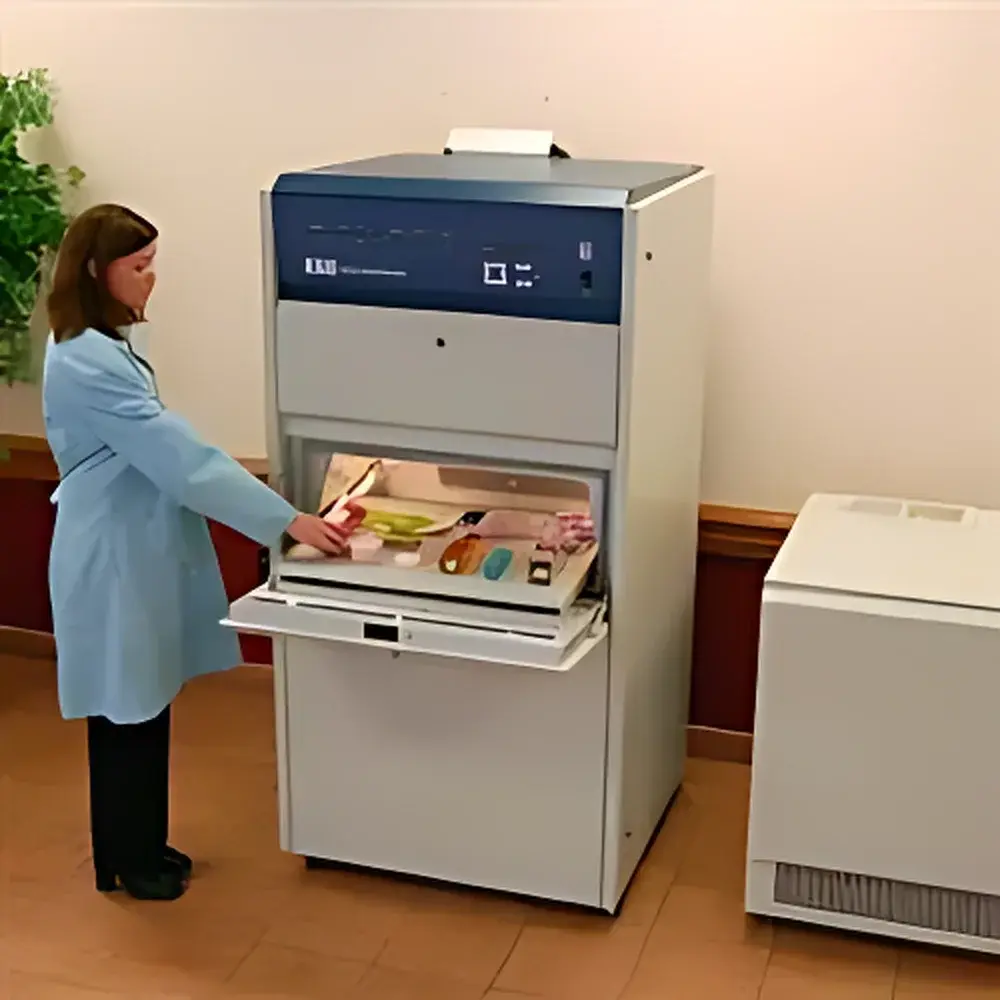
Q-LAB Q-SUN Xe-3-HBS Xenon Arc Weathering Test Chamber
| Brand | Q-LAB |
|---|---|
| Origin | USA |
| Model | Q-SUN Xe-3-HBS |
| Lamp Configuration | Triple independent xenon arc lamps |
| Sample Tray Dimensions | 451 mm × 718 mm (horizontal, universal 3D sample mounting) |
| Lamp Lifetime | Up to 1500 hours |
| Spectral Output | Full-spectrum solar simulation (290–800 nm) with precision optical filtering |
| Humidity Control | Standard integrated RH control (range: 10–95% RH, non-condensing) |
| Water Spray | Optional calibrated spray system with programmable on/off cycles |
| Compliance | Fully compatible with ASTM G151, ASTM G155, ISO 4892-2, ISO 105-B02/B04/B06, AATCC TM16/TM169, SAE J2412/J2527, IEC 60068-2-5, GB/T 8427–2019, GB/T 14576–2013, and over 40 additional international weathering standards |
Overview
The Q-LAB Q-SUN Xe-3-HBS Xenon Arc Weathering Test Chamber is an industrial-grade, full-spectrum accelerated weathering instrument engineered for high-fidelity simulation of terrestrial solar radiation, temperature, humidity, and moisture exposure. It employs three independently controlled xenon arc lamps—each operating under precisely regulated electrical and thermal conditions—to generate a continuous, stable irradiance output that closely matches the spectral power distribution (SPD) of natural sunlight between 290 nm and 800 nm. Unlike narrow-band UV sources or metal halide systems, the xenon arc lamp’s inherent broadband emission enables accurate replication of photodegradation mechanisms involving both UV-driven bond scission and visible-light-mediated pigment fading or polymer oxidation. The chamber’s large-format horizontal sample tray (451 mm × 718 mm) accommodates bulky, three-dimensional specimens—including automotive exterior components, architectural panels, coated wood substrates, and textile swatches—without requiring custom fixtures or rotational indexing. Its robust architecture supports long-duration, unattended operation under stringent GLP-compliant test protocols, making it suitable for R&D validation, quality assurance, and regulatory submission testing.
Key Features
- Triple xenon arc lamp configuration ensures uniform irradiance distribution across the entire exposure plane, minimizing edge effects and enabling statistically representative multi-sample evaluation.
- High-stability optical filter system—including Daylight-Q/B, Window Glass-Q, and Extended UV filters—enables precise spectral tailoring per ASTM G155 Cycle A–F and ISO 4892-2 exposure modes; all filters are quartz-based and rated for ≥5000 hours of continuous use.
- Integrated relative humidity control (10–95% RH, ±3% RH accuracy) with dew point monitoring and PID-regulated steam injection, compliant with ISO 4892-2 Annex B and ASTM D4355 humidity conditioning requirements.
- Optional calibrated water spray system delivers reproducible 0.35–0.45 L/min flow rate at 200–300 kPa pressure, with programmable spray duration, interval, and post-spray dwell time—fully aligned with SAE J2527 wet/dry cycling profiles.
- Real-time irradiance monitoring via NIST-traceable broadband radiometer (340 nm or 420 nm channel), with automatic lamp power compensation to maintain setpoint stability within ±5% over lamp lifetime.
- Touchscreen controller with embedded data logging (10,000+ data points), password-protected user profiles, audit trail capability, and optional 21 CFR Part 11 compliance package for pharmaceutical and medical device applications.
Sample Compatibility & Compliance
The Xe-3-HBS accommodates flat, contoured, and volumetric samples up to 150 mm in height without mechanical interference. Its horizontal exposure geometry replicates real-world orientation for outdoor materials—such as roofing membranes, façade cladding, and automotive trim—where gravitational drainage and surface wetting dynamics significantly influence degradation kinetics. All operational parameters—including irradiance setpoints, black panel temperature (BPT), chamber air temperature, RH ramp rates, and spray timing—are programmable and repeatable per standardized test sequences. The system meets the hardware and software requirements for conformance with ISO/IEC 17025-accredited laboratories and satisfies mandatory instrumentation criteria in ASTM G151 (Standard Practice for Exposing Non-Metallic Materials in Accelerated Test Devices), ISO 4892-2 (Plastics — Methods of Exposure to Laboratory Light Sources), and AATCC TM16 (Colorfastness to Light). Filter selection, lamp aging compensation, and calibration traceability are documented per Q-LAB’s internal Quality Management System (QMS), aligned with ISO 9001:2015.
Software & Data Management
The Q-SUN Controller v5.2 firmware provides intuitive, menu-driven test programming with preloaded method templates for over 40 international standards—including PV 1303 (Volkswagen), GMW 14867 (General Motors), and VDA 675242 (German Automotive Association). All sensor inputs (irradiance, BPT, chamber RTD, RH, spray status) are timestamped and logged at user-defined intervals (1 sec to 60 min). Export formats include CSV, PDF reports, and XML for LIMS integration. Optional Q-LAB’s SunTest™ Software enables remote monitoring, multi-chamber fleet management, statistical trend analysis (X-bar/R charts), and automated pass/fail evaluation against colorimetric delta E* (CIE 2000) or gloss retention thresholds. Audit trails record operator login/logout events, parameter changes, calibration actions, and alarm acknowledgments—fully compliant with FDA 21 CFR Part 11 when enabled with electronic signature modules.
Applications
The Xe-3-HBS serves critical roles in materials science, coatings development, textile engineering, and automotive OEM validation. It is routinely deployed to assess photochemical stability of organic pigments in architectural paints, evaluate UV stabilizer efficacy in polyolefin geomembranes, quantify fading resistance of digital inkjet prints under daylight filtration, and validate weatherability claims for photovoltaic encapsulants per IEC 61215. In the textile sector, it supports AATCC TM169 (Weather-O-Meter) and ISO 105-B04 (Xenon Arc Fade-Ometer) protocols for colorfastness grading. For automotive suppliers, its compatibility with SAE J2412 (Interior) and J2527 (Exterior) enables correlation studies between lab exposure and field service life—particularly where moisture cycling accelerates hydrolytic degradation in polyurethane sealants or polycarbonate headlamp lenses. Research institutions utilize its spectral fidelity to investigate wavelength-dependent quantum yield in photocatalytic TiO₂ coatings and photo-oxidation pathways in biodegradable polymers.
FAQ
What spectral filters are standard on the Xe-3-HBS?
The base configuration includes the Daylight-Q filter for general-purpose solar simulation. Optional filters—Window Glass-Q, Extended UV-Q, and UV-Quartz—are available for specialized applications such as interior material testing or UV-accelerated screening.
Is relative humidity control included as standard equipment?
Yes. Integrated RH control is standard on all Xe-3 models, including the Xe-3-HBS, with full programmability and closed-loop feedback regulation.
Can the Xe-3-HBS perform cyclic exposures with alternating light/dark, spray, and condensation phases?
While the Xe-3-HBS does not support active condensation (i.e., saturated vapor condensation cycles), it fully executes light/dark transitions and programmable spray cycles per ASTM G155 and ISO 4892-2. Condensation functionality requires the separate Q-SUN Xe-1 model equipped with humidity condensation trays.
How is irradiance calibrated and maintained over time?
Calibration is performed using a NIST-traceable reference radiometer prior to shipment. During operation, the system continuously monitors irradiance and automatically adjusts lamp power to compensate for spectral drift and intensity loss, ensuring consistent radiant exposure throughout the lamp’s service life.
Does Q-LAB provide validation documentation for IQ/OQ/PQ protocols?
Yes. Q-LAB supplies comprehensive Installation Qualification (IQ), Operational Qualification (OQ), and Performance Qualification (PQ) templates, along with factory-verified calibration certificates, sensor linearity reports, and filter transmission spectra—all traceable to national metrology institutes.



