
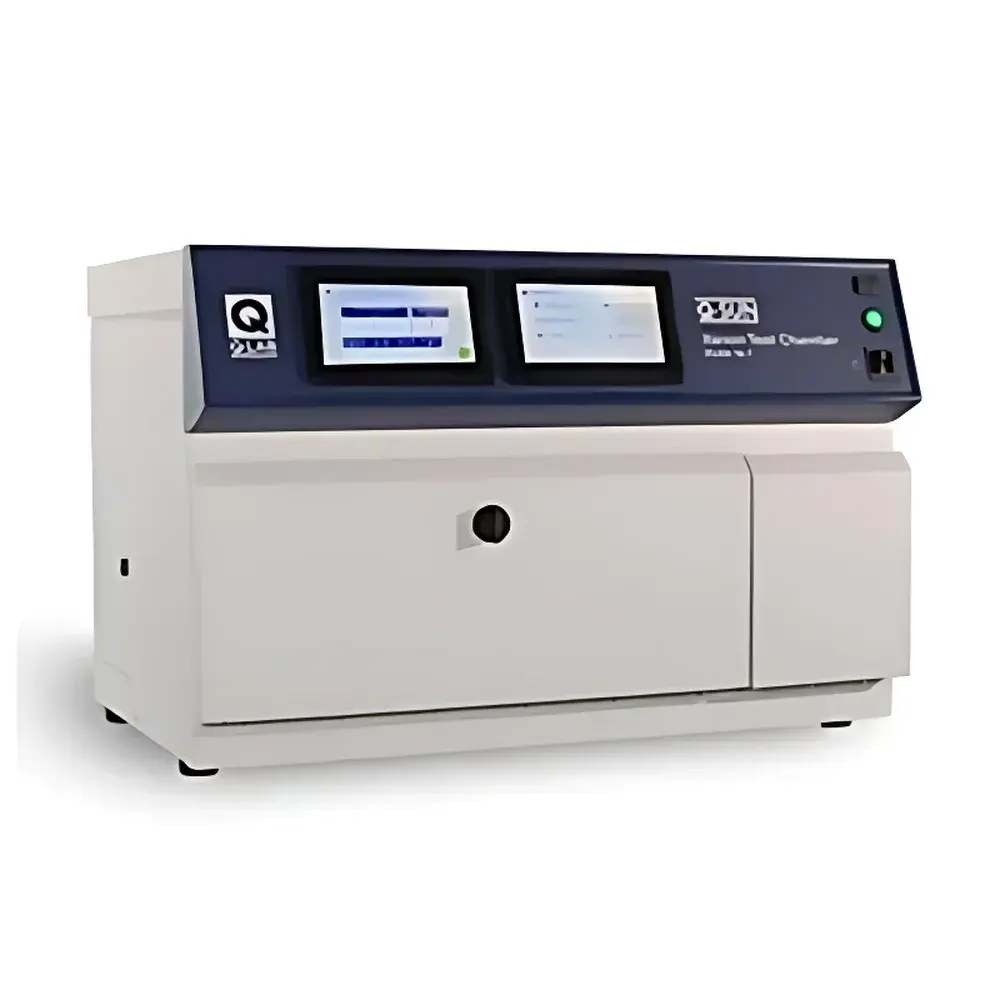
Q-LAB Q-Sun Xe-1 Xenon Arc Weathering Test Chamber
| Brand | Q-LAB |
|---|---|
| Origin | USA |
| Manufacturer Type | Authorized Distributor |
| Product Category | Imported Instrument |
| Model | Q-Sun Xe-1 |
| Xenon Lamp Power | Standard 1.8 kW (air-cooled, single-lamp configuration) |
| Irradiance Range | Up to 1800 W/m² (broadband, 290–2500 nm) |
| Exposure Duration | Adjustable from 1 to 9999 hours (continuous or cyclic) |
| Humidity Control Range | 10–95% RH (operational range, dependent on chamber temperature and filtration configuration) |
| Sample Tray Dimensions | 251 mm × 457 mm (9.88" × 18") |
| Lamp Lifetime | Approx. 1500 hours (typical operational life under standard irradiance setpoints) |
Overview
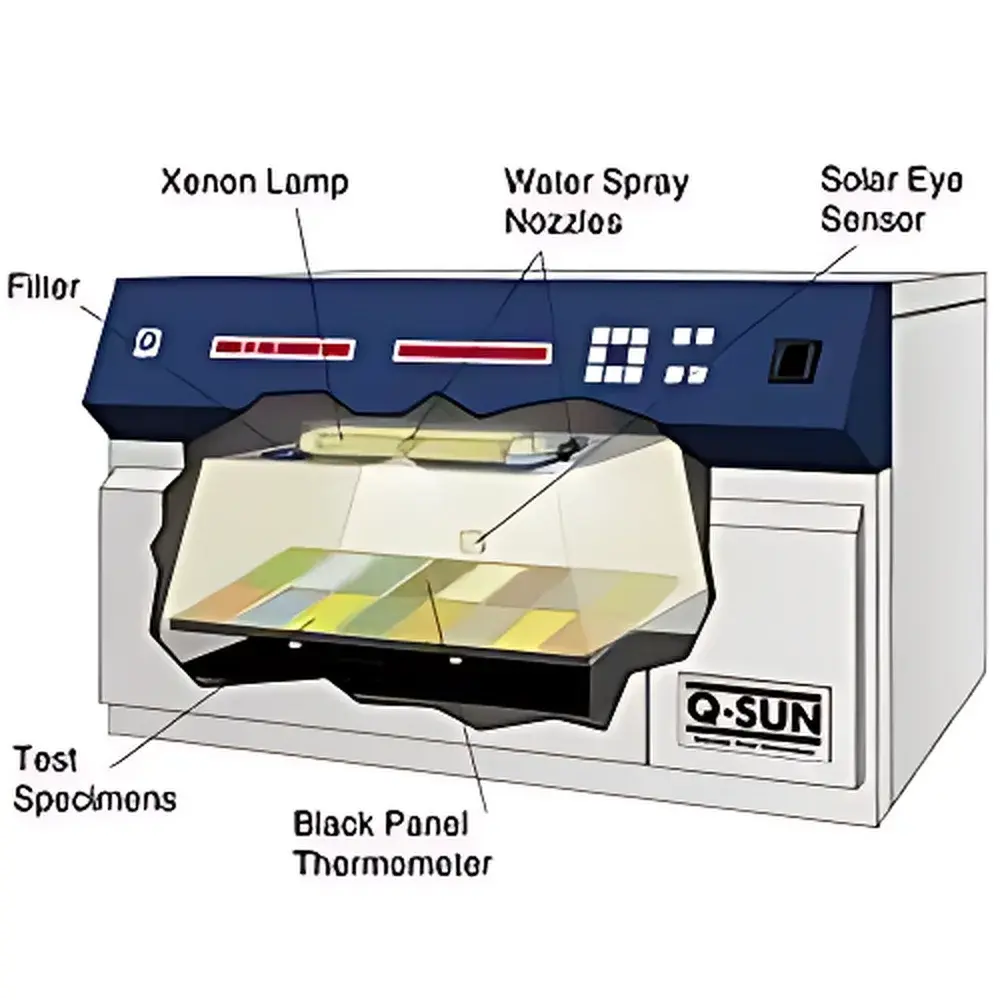
The Q-LAB Q-Sun Xe-1 Xenon Arc Weathering Test Chamber is a compact, air-cooled benchtop instrument engineered for accelerated light stability and weathering evaluation of polymeric, coated, and organic materials. It employs a single 1.8 kW xenon arc lamp to replicate the full solar spectrum—spanning ultraviolet (290–400 nm), visible (400–700 nm), and near-infrared (700–2500 nm) radiation—with spectral fidelity validated against natural sunlight under ASTM G155 and ISO 4892-2. Unlike UV fluorescent or metal halide sources, the xenon arc provides spectrally continuous output, enabling physiologically relevant photodegradation pathways—including photooxidation, chain scission, and pigment fading—that correlate strongly with real-world outdoor exposure. The Xe-1 is specifically designed for laboratories requiring ISO/IEC 17025-compliant, GLP-aligned testing workflows but operating under space or budget constraints. Its fixed single-lamp architecture delivers reproducible irradiance profiles across its 251 mm × 457 mm sliding sample tray, supporting both flat specimens and low-profile 3D components without internal reconfiguration.
Key Features
- Air-cooled 1.8 kW xenon arc lamp with typical service life of 1500 hours—minimizing cooling infrastructure requirements and operational overhead
- Three interchangeable optical filter systems (Daylight, Window Glass, Extended UV) to emulate distinct irradiation environments per ASTM D7869, ISO 11341, and SAE J2527
- Integrated black-panel temperature control (BPT) and relative humidity regulation (10–95% RH), synchronized with irradiance intensity to maintain realistic thermal–radiative stress coupling
- Sliding sample tray with tool-free access—enabling rapid specimen loading, in situ visual assessment, and post-exposure metrology without chamber shutdown
- Front-access lamp and filter replacement—designed for maintenance without disassembly or recalibration downtime
- Compliance-ready firmware supporting audit trails, user-level access controls, and timestamped parameter logging aligned with FDA 21 CFR Part 11 data integrity expectations
Sample Compatibility & Compliance
The Q-Sun Xe-1 accommodates rigid and flexible substrates up to 25 mm in thickness, including painted panels, extruded plastics, textile laminates, automotive interior trims, and pharmaceutical packaging films. Its open-air exhaust design permits direct venting into fume hoods or dedicated HVAC ducts—eliminating condensate accumulation risks associated with recirculated humid air systems. All operational parameters adhere to international standards governing accelerated weathering: ASTM G155 (xenon-arc exposure apparatus), ISO 4892-2 (plastics—methods of exposure to laboratory light sources), and AATCC TM16 (colorfastness to light). Filter selection determines spectral cutoff and irradiance weighting—critical for compliance with sector-specific protocols such as GMW14124 (automotive), Ford CETP 00.00-L-467 (interior materials), and IEC 61215 (photovoltaic module qualification).
Software & Data Management
The instrument operates via Q-LAB’s proprietary SolarEye™ control interface—a Windows-based application delivering real-time monitoring of irradiance (W/m²), black-panel temperature (°C), chamber humidity (% RH), and elapsed exposure time. All parameter changes are logged with user ID, timestamp, and reason-for-change fields, satisfying GLP documentation requirements. Exportable CSV reports include raw sensor outputs, integrated dose metrics (e.g., MJ/m² @ 340 nm), and pass/fail flags based on preconfigured acceptance thresholds. Optional Ethernet connectivity enables remote diagnostics, centralized fleet management via Q-LAB’s SunTest Cloud platform, and automated report generation compatible with LIMS integration.
Applications
This chamber serves as a primary tool for R&D validation and QC release testing across regulated and industrial sectors. In coatings development, it quantifies gloss retention, chalking resistance, and color shift (ΔE* CIELAB) following ISO 2813 and ASTM D2244. For automotive suppliers, it supports accelerated aging of dashboards, seat fabrics, and exterior trim under simulated South Florida or Arizona exposure conditions. Medical device manufacturers use it to assess polymer yellowing and adhesive bond degradation per ISO 10993-12. Packaging engineers rely on its spectral accuracy to evaluate UV barrier efficacy of multilayer films used in sterile barrier systems. Academic researchers apply it to study photostabilizer efficiency, nanocomposite UV absorption kinetics, and climate-driven polymer embrittlement mechanisms.
FAQ
What spectral filters are included with the Q-Sun Xe-1, and how do they differ?
The standard configuration includes the Daylight Filter (Q/B) for outdoor simulation and the Window Glass Filter (Q/FS40) for indoor exposure. An optional Extended UV Filter (Q/UV) is available for enhanced short-wavelength output.
Is calibration traceable to NIST or other national standards?
Yes—Q-LAB provides factory calibration certificates traceable to NIST for irradiance sensors and temperature/humidity transducers, with optional annual recalibration services performed by ISO/IEC 17025-accredited labs.
Can the Xe-1 accommodate custom test protocols beyond standard methods?
Absolutely—the SolarEye™ software allows user-defined irradiance ramps, multi-step humidity cycles, and conditional logic triggers (e.g., hold at 70°C until 500 kJ/m² accumulated dose), enabling bespoke aging profiles.
Does the system support third-party data acquisition or PLC integration?
Yes—via Modbus TCP/IP and analog 4–20 mA output ports, facilitating integration into plant-wide SCADA or MES platforms for Industry 4.0 traceability.
How does lamp aging affect test reproducibility, and what compensation mechanisms exist?
The controller continuously monitors lamp output via a calibrated broadband radiometer and automatically adjusts power supply voltage to maintain setpoint irradiance—ensuring dose consistency throughout lamp life without manual intervention.



