
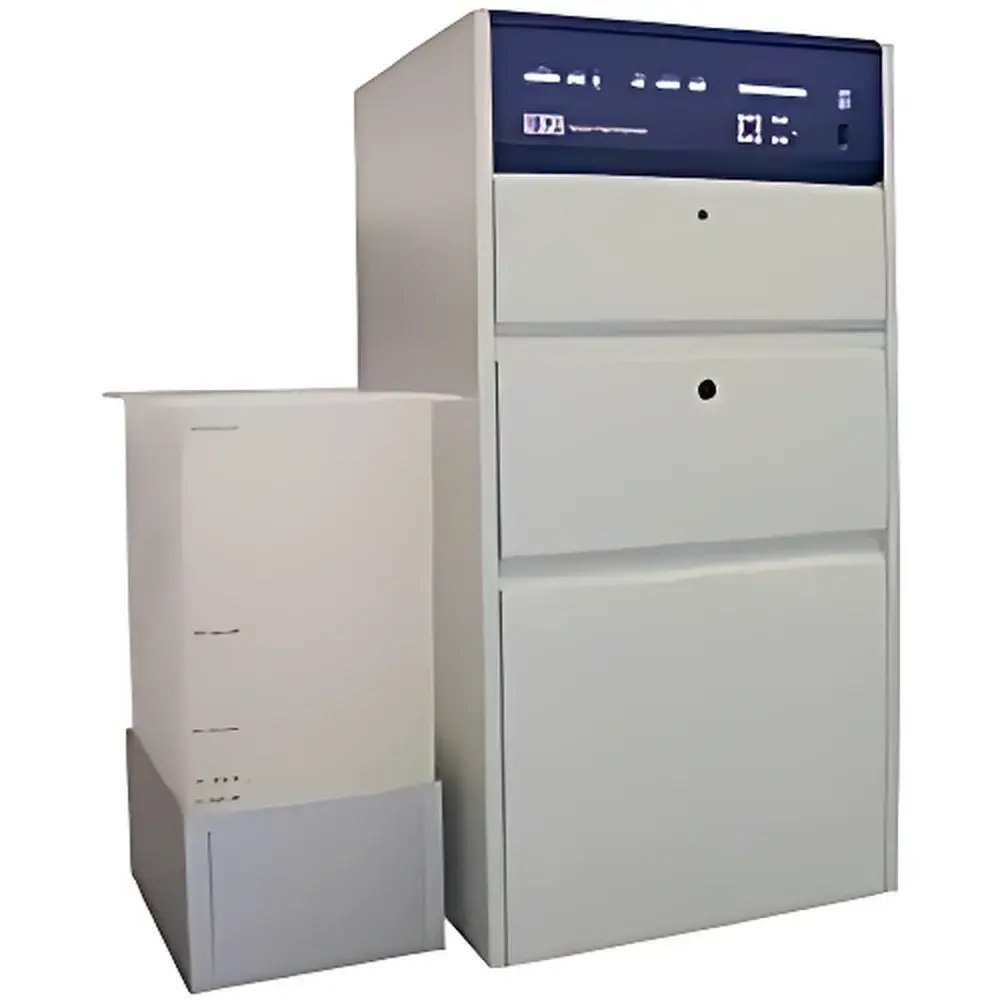
Q-LAB Xe-3-HC Xenon Arc Weathering Test Chamber
| Brand | Q-LAB |
|---|---|
| Origin | USA |
| Model | Xe-3-HC |
| Xenon Lamp Power | 1800 W (3 lamps) |
| Temperature Range | Ambient to 90°C (operational, with refrigeration option) |
| Humidity Range | 20–95% RH |
| Sample Capacity | 55 specimens |
| Sample Tray Dimensions | 45 × 72 cm |
| Sample Tilt Angle | 10° from horizontal |
| Black Panel Temperature Range | 35–110°C (adjustable per sensor) |
| Black Standard Temperature Range | 36–120°C |
| Water Consumption | 0.1 L/min (spray), 44 L/day (humidification) |
| External Dimensions | 78 × 94 × 94 cm |
| Refrigeration Unit Weight | 85 kg |
| Lamp Life Warranty | 1500 hours |
| Compliance | ASTM D2565, D4459, D6695, D7356, ISO 4892-2, ISO 11341, SAE J2527, J2412, GB/T 16422.2, and others |
Overview
The Q-LAB Xe-3-HC Xenon Arc Weathering Test Chamber is a high-fidelity, flat-bed accelerated weathering instrument engineered for reproducible simulation of full-spectrum solar radiation, temperature, and humidity stressors under controlled laboratory conditions. It employs three independently operated, air-cooled 1800 W xenon arc lamps—calibrated to match the spectral power distribution (SPD) of terrestrial sunlight (CIE 85:1989, ISO 4892-2)—with optical filtering to replicate daylight (Daylight Filter) or extended UV (Extended UV Filter). Unlike single-lamp systems, the tri-lamp configuration ensures uniform irradiance distribution across the 45 × 72 cm exposure plane and enables precise spectral stability over extended test durations. The chamber integrates real-time irradiance control via calibrated broadband or narrowband (340 nm, 420 nm) sensors, enabling compliance with critical photometric requirements in ASTM D2565 (outdoor plastics), ASTM D4459 (indoor plastics), and ISO 11341 (paints and varnishes). Its modular architecture supports optional refrigeration for sub-ambient temperature operation—essential for evaluating thermally sensitive materials such as pharmaceuticals, cosmetics, and polymer-based medical devices without inducing non-physiological degradation pathways.
Key Features
- Tri-lamp xenon arc system delivering stable, spectrally accurate irradiance (290–800 nm) with ±5% uniformity across the exposure area
- Programmable relative humidity control (20–95% RH) with precision steam humidification and condensation-capable spray nozzles
- Flat-bed sample mounting at 10° tilt—optimized for natural drainage, consistent exposure geometry, and compatibility with irregular or bulky specimens
- Three independent black panel and black standard temperature sensors (BPT/ BST), each configurable for distinct setpoints to support multi-condition testing protocols
- Integrated refrigeration module enabling operational temperatures down to 10°C—critical for simulating indoor storage or temperate-climate service environments
- Modular sample trays rated for 23 kg load capacity; standard 51 × 102 mm specimen slots plus customizable fixtures for bottles, textiles, and 3D components
- Self-diagnostic lamp monitoring, automatic arc re-strike, and lamp life tracking with 1500-hour warranty on all xenon lamps
Sample Compatibility & Compliance
The Xe-3-HC accommodates diverse material forms—including coated substrates, elastomers, films, fibers, pigmented resins, and packaged consumer goods—without requiring custom jigs or optical compensation. Its open-plan exposure zone permits direct mounting of commercial packaging, automotive trim panels, architectural sealants, and textile swatches. The system is validated against over 40 internationally recognized standards, including ASTM C1519 (sealants), ASTM D7356 (automotive clearcoats under acid rain + UV), ASTM D5071 (plastic photodegradation), and ISO 4892-2 (general xenon exposure methods). All hardware and firmware comply with GLP/GMP data integrity requirements: audit trails, electronic signatures, and 21 CFR Part 11–compliant software options are available upon configuration. Calibration certificates traceable to NIST standards are provided with each shipment.
Software & Data Management
Operation is managed through Q-LAB’s proprietary SUNTEST™ software—available in Windows-native and network-deployable editions. The interface supports fully programmable test cycles combining irradiance ramps, stepwise humidity profiles, temperature gradients, and dark/light phases. Real-time graphs display irradiance (W/m²), BPT/BST, RH%, and chamber ambient values with second-level timestamping. Raw data exports to CSV or Excel-compatible formats include full metadata (lamp hours, filter status, calibration dates). Optional cloud-based data archiving enables remote monitoring, multi-site protocol synchronization, and automated report generation aligned with ISO/IEC 17025 documentation frameworks. All firmware updates maintain backward compatibility with legacy test files and calibration records.
Applications
The Xe-3-HC serves as a primary qualification tool in R&D and QC laboratories across regulated and industrial sectors. In coatings and automotive OEM supply chains, it validates color shift (ΔE*), gloss loss, chalking, and microcracking per SAE J2527 and ASTM D6695. For pharmaceutical packaging, its low-temperature + humidity capability assesses barrier integrity and print adhesion under ICH Q1A(R2) stability conditions. Cosmetics formulators use it to quantify fragrance volatility, emulsion phase separation, and UV-filter degradation kinetics. In construction, it evaluates joint sealant elasticity after ASTM C734 cycling and roofing membrane tensile retention per ASTM D4798. Academic researchers employ its spectral fidelity for mechanistic studies of photo-oxidation in organic photovoltaics and biodegradable polymers.
FAQ
What distinguishes the Xe-3-HC from single-lamp xenon chambers?
The tri-lamp configuration provides superior irradiance uniformity, extended lamp service intervals, and redundancy—ensuring uninterrupted testing even if one lamp requires replacement.
Can the Xe-3-HC perform cyclic tests with alternating UV/dark and wet/dry phases?
Yes. SUNTEST™ software supports up to 99-step programs with independent control of irradiance, temperature, humidity, and spray timing.
Is refrigeration required for all test methods?
No. The base model operates from ambient +10°C to 90°C; refrigeration is optional but recommended for ASTM D4459 (indoor plastics) and pharmaceutical stability protocols.
How often must the xenon lamps be replaced?
Lamps are warrantied for 1500 hours of operation; typical replacement intervals range from 1200–1600 hours depending on irradiance setpoint and filter selection.
Does the system support third-party calibration services?
Yes. Q-LAB-certified field service engineers perform on-site irradiance, temperature, and humidity validation per ISO/IEC 17025 procedures—with documented uncertainty budgets.



