
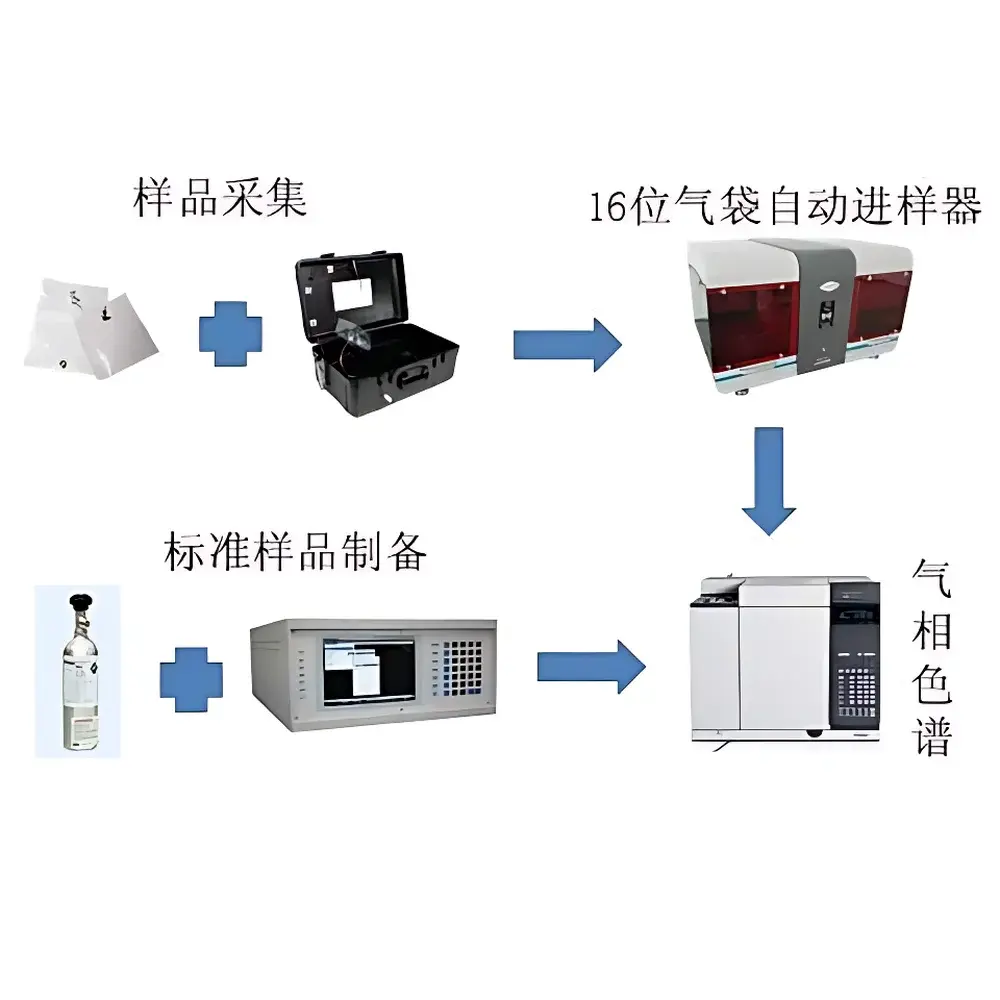
MNK MQ701 Series Automated Gas Bag Sampling & Injection Solution for Total Hydrocarbons, Methane, and Non-Methane Hydrocarbons (NMHC) Analysis
| Brand | MNK |
|---|---|
| Origin | Beijing, China |
| Manufacturer Type | Authorized Distributor |
| Product Origin | Domestic (China) |
| Model | MQ701-16 / MQ701-32 Integrated Solution |
| Pricing | Available Upon Request |
| Core Components | MQ801 Vacuum Sampling Chamber, MQ701-16/MQ701-32 16-/32-Position Automated Gas Bag Injector, MODEL401 Precision Gas Dilution System |
| Compliance | Designed to meet HJ 38–2017 (China EPA Standard for Determination of Total Hydrocarbons, Methane, and NMHC in Stationary Source Exhaust) |
Overview
The MNK MQ701 Series Automated Gas Bag Sampling & Injection Solution is an integrated, laboratory-engineered system designed for compliant, high-throughput analysis of total hydrocarbons (THC), methane (CH₄), and non-methane hydrocarbons (NMHC) in ambient air and stationary source exhaust emissions. Built upon the principles of quantitative gas-phase chromatography (GC), the solution enables trace-level hydrocarbon speciation by coupling standardized sample containment—using inert, low-bleed Tedlar® or FlexFoil® gas sampling bags—with precise, pressure-controlled injection into a gas chromatograph equipped with flame ionization detection (FID). The system architecture adheres to the measurement methodology defined in HJ 38–2017, the official Chinese Environmental Protection Standard specifying analytical procedures for THC, CH₄, and NMHC in fixed pollution sources. Unlike manual syringe-based injection—which introduces variability due to operator technique, bag deformation, and inconsistent purge/injection cycles—the MQ701 platform implements closed-loop pneumatic actuation, calibrated volume displacement, and real-time pressure monitoring to ensure reproducible 1–10 mL sample introduction across all bag types and fill pressures.
Key Features
- Modular automation architecture integrating vacuum-assisted sampling (MQ801 chamber), automated bag positioning (MQ701-16/MQ701-32), and certified gas dilution (MODEL401)
- 16- or 32-position carousel-compatible gas bag injector with programmable dwell time, purge cycles, and injection volume calibration per vial position
- Vacuum sampling chamber (MQ801) enabling controlled, particle-free evacuation and filling of pre-evacuated sampling bags under negative pressure
- MODEL401 dynamic gas dilution system providing NIST-traceable standard gas mixtures at certified dilution ratios (1:10 to 1:10,000) with ≤1.5% CV repeatability
- Full GC interface compatibility via standard 1/8″ or 1/4″ Swagelok® fittings; supports split/splitless and direct injection modes
- Embedded microprocessor control with audit-trail-enabled operation logs, including timestamped bag ID, injection sequence, pressure readings, and error codes
Sample Compatibility & Compliance
The system accommodates standard 0.5 L, 1 L, 3 L, and 6 L gas sampling bags fabricated from laminated aluminum-polyethylene or fluoropolymer-coated polyester films—materials validated per ASTM D6159 and ISO 16000-6 for minimal hydrocarbon adsorption and desorption. All wetted surfaces are electropolished stainless steel or PTFE-lined to prevent catalytic degradation or memory effects. The complete workflow—from bag conditioning and vacuum filling to automated injection and post-run bakeout—is structured to satisfy data integrity requirements under GLP and CNAS-accredited laboratory frameworks. While HJ 38–2017 is the primary regulatory anchor, method validation documentation supports alignment with US EPA Method 25A, ISO 12039, and EN 13649-2 for NMHC quantification in industrial stack testing.
Software & Data Management
The MQ701 controller firmware includes embedded configuration management, method storage (up to 99 user-defined sequences), and CSV export of raw operational metadata (injection count, bag pressure, elapsed cycle time). When interfaced with third-party chromatography data systems (CDS)—including Thermo Chromeleon™, Agilent OpenLab CDS, or Waters Empower™—the system transmits discrete trigger signals and sample ID tags via TTL or Ethernet/IP protocols. Audit trail records comply with ALCOA+ principles (Attributable, Legible, Contemporaneous, Original, Accurate, Complete, Consistent, Enduring, Available) and support retrospective review during regulatory inspections. Optional add-on modules provide 21 CFR Part 11-compliant electronic signatures and role-based access control for multi-user environments.
Applications
This solution is deployed in environmental monitoring laboratories conducting routine compliance testing for municipal wastewater treatment plants, thermal power stations, and chemical manufacturing facilities subject to VOC emission reporting under China’s “Blue Sky Defense Campaign.” It is equally suited for contract testing laboratories serving petrochemical refineries, where batch analysis of >50 stack samples per shift demands unattended overnight operation. Additional use cases include method development for fugitive emission screening (LDAR programs), calibration verification of continuous emission monitoring systems (CEMS), and reference material preparation for interlaboratory comparison studies. The system’s ability to maintain consistent bag headspace equilibration and minimize oxygen ingress also supports extended stability testing of reactive hydrocarbon standards.
FAQ
Does the MQ701-16 support both single- and multi-point calibration sequences?
Yes—calibration routines can be programmed to inject multiple standard concentrations sequentially or repeat a single standard across designated positions for precision assessment.
Can the system accommodate custom bag geometries or non-standard bag valves?
Standard operation assumes industry-compliant quick-connect valves (e.g., Luer-lock or Schrader). Custom valve adapters are available upon engineering review and mechanical validation.
Is remote monitoring or integration with LIMS supported?
Native LIMS connectivity is achieved via HL7 or ASTM E1384-compliant ASCII file exchange; optional OPC UA gateway enables real-time status polling and alarm notification.
What maintenance intervals are recommended for the pneumatic manifold and pressure sensors?
Quarterly verification of zero/span drift on integrated pressure transducers (±0.5% FS accuracy) and annual replacement of elastomeric seals in the injection head are specified in the maintenance logbook.
How is carryover between high-concentration and low-concentration samples mitigated?
The system executes three-stage purging: (1) internal line evacuation, (2) carrier gas flush through the bag valve interface, and (3) blank bag injection—each step configurable in duration and flow rate within the method editor.







