
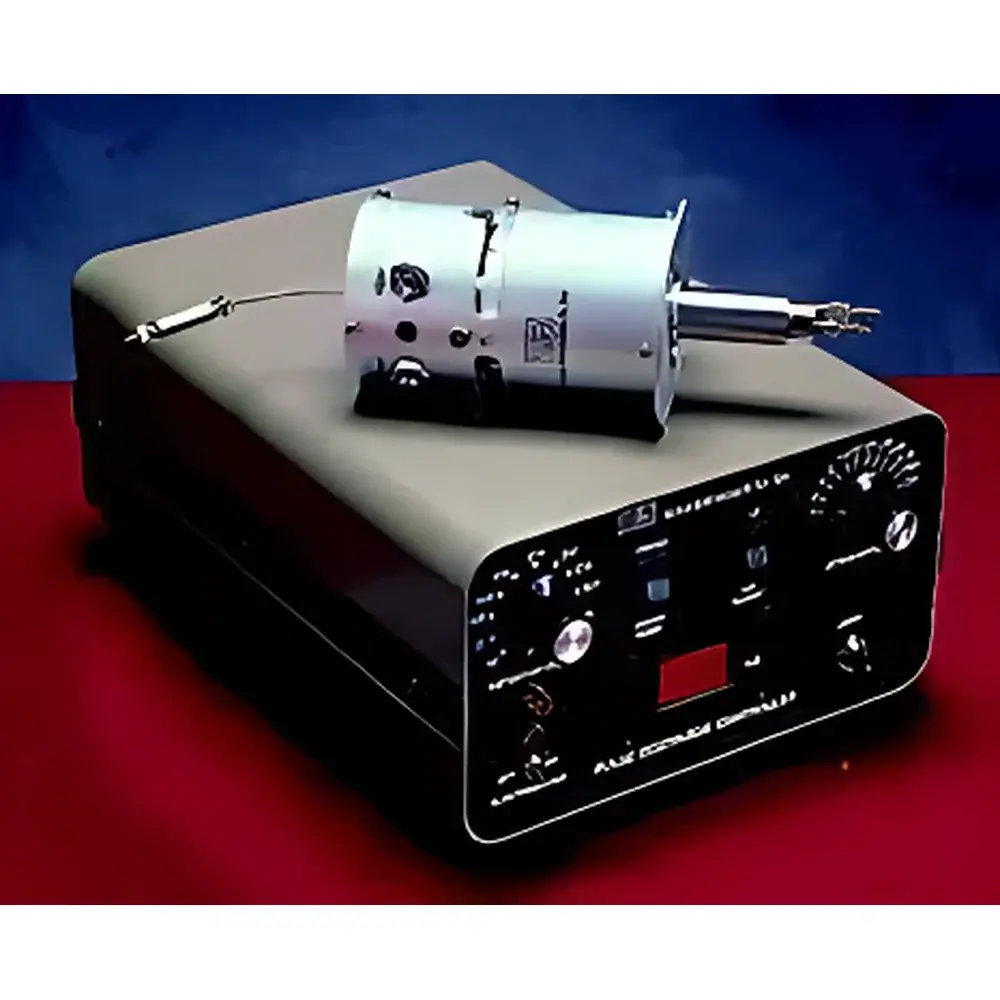
VICI D-2 Pulse Discharge Helium Ionization Detector (PDD)
| Brand | VICI |
|---|---|
| Origin | USA |
| Model | D-2 |
| Detection Modes | Electron Capture (EC) and Helium Ionization (HI) |
| Ion Source | Pulsed DC helium discharge (non-radioactive) |
| Detection Principle | Electron capture for electronegative compounds |
| Minimum Detectable Concentration | Sub-pg (10⁻¹² g) in EC mode |
| Linear Dynamic Range | >10⁵ (HI mode) |
| Gas Requirements | Ultra-high-purity helium (99.999%+, with integrated purifier) |
| Compatibility | Retrofit-capable for legacy GC systems (e.g., Agilent, Thermo, Shimadzu) |
| Regulatory Compliance | Fully compliant with EPA Method 8021B, ASTM D6667, and USP <621> for residual solvent analysis |
Overview
The VICI D-2 Pulse Discharge Detector (PDD) is a non-radioactive, dual-mode gas chromatographic detector engineered for high-sensitivity, selective, and universal trace analysis. Unlike conventional electron capture detectors (ECD) that rely on radioactive ⁶³Ni sources, the D-2 employs a stable, low-power pulsed DC helium discharge as its ionization source—eliminating regulatory burdens, disposal costs, and safety protocols associated with radioactive materials. Its operational principle hinges on two distinct physical mechanisms: in Electron Capture (EC) mode, it selectively detects compounds with high electron affinity (e.g., halogenated hydrocarbons, organochlorine pesticides, CFCs) via capture of thermalized electrons generated in the helium plasma; in Helium Ionization (HI) mode, it functions as a universal, non-destructive detector through Penning ionization—where metastable helium atoms (He*) collide with analyte molecules to produce positive ions and secondary electrons. This dual-mode architecture enables seamless switching between selectivity and broad-spectrum response without hardware modification.
Key Features
- Non-radioactive ion source: Eliminates licensing, transport restrictions, and long-term disposal liabilities per IAEA SSG-34 and NRC 10 CFR Part 30.
- Dual-mode operation: Single detector platform supports both EC and HI detection modes via software-selectable voltage and pulse timing parameters.
- Retrofit-ready design: Integrates directly with existing GC systems (including Agilent 7890/8890, Thermo ISQ, and Shimadzu GC-2010 series) using standard ¼” column connections and analog/digital I/O interfaces.
- Integrated helium purification: On-board getter-based purifier maintains He purity ≥99.999%, critical for stable baseline and sub-ppb detection limits in HI mode.
- Optimized flow geometry: Counter-current helium carrier gas flow relative to column effluent enhances ionization efficiency and reduces peak broadening.
- High reproducibility: Pulse frequency (1–5 kHz), amplitude (0–300 V), and dwell time are digitally controlled with ≤0.1% stability over 24 h, ensuring inter-day precision per ISO/IEC 17025 calibration requirements.
Sample Compatibility & Compliance
The D-2 demonstrates exceptional compatibility across volatile and semi-volatile compound classes. In EC mode, it delivers validated sensitivity for EPA priority pollutants including chlorpyrifos (LOD = 0.8 pg on-column), trichloroethylene (LOD = 1.2 pg), and perfluorooctanoic acid (PFOA) derivatives. In HI mode, it quantifies permanent gases (H₂, O₂, N₂, CO, CH₄), light hydrocarbons (C₁–C₆), sulfur compounds (H₂S, COS), and polar species (NH₃, H₂O vapor) without chemical degradation. The system conforms to multiple regulatory frameworks: EPA Method 8021B for halogenated organics; ASTM D6667 for total volatile sulfur in fuels; and USP for residual solvents in pharmaceuticals. All firmware and data acquisition modules support audit trails, electronic signatures, and 21 CFR Part 11 compliance when paired with validated GC control software (e.g., OpenLab CDS or Chromeleon).
Software & Data Management
The D-2 operates via VICI’s proprietary PDD Control Suite v3.2—a Windows-based application supporting real-time pulse parameter optimization, mode switching, and baseline drift compensation algorithms. Raw signal output is digitized at 100 kHz with 24-bit resolution, enabling high-fidelity peak integration for complex matrices. Data files comply with ASTM E1947 (chromatographic data exchange format) and are exportable to CSV, AIA, or CDF formats. Integrated GLP logging records all method changes, calibration events, and maintenance actions with user ID, timestamp, and IP address—meeting ISO 17025 clause 7.7 and FDA inspection expectations. Remote diagnostics and firmware updates are supported over Ethernet with TLS 1.2 encryption.
Applications
The D-2 is widely deployed in environmental laboratories for monitoring halogenated contaminants in soil extracts and drinking water per EPA SW-846; in petrochemical QA/QC for ultra-trace sulfur speciation in reformulated gasoline; in semiconductor manufacturing for ppb-level moisture and oxygen impurity verification in bulk specialty gases; and in pharmaceutical development for residual solvent profiling in APIs under ICH Q3C guidelines. Its non-destructive nature preserves sample integrity for downstream MS confirmation, while its wide linear range (10⁵ in HI mode) eliminates need for split injections in multi-concentration assays.
FAQ
Does the D-2 require radioactive source licensing or annual leak testing?
No. The pulsed helium discharge eliminates all radiological hazards, removing requirements under NRC 10 CFR Part 30 or equivalent national regulations.
Can the D-2 replace an existing FID without GC hardware modifications?
Yes—provided the GC oven accommodates the D-2’s 120 mm × 80 mm footprint and 24 VDC power input; column routing and detector gas lines are mechanically compatible with standard 1/8″ Swagelok fittings.
What helium purity is required for optimal HI-mode performance?
≥99.999% (5.0 grade) helium with ≤0.1 ppm total hydrocarbons and ≤0.05 ppm H₂O/O₂; the integrated purifier extends consumable life to ≥12 months under continuous operation.
Is EC-mode selectivity comparable to traditional ⁶³Ni-ECD?
Yes—validated against NIST SRM 1647 (chlorinated pesticide mix) shows equivalent or improved signal-to-noise ratios and lower baseline drift over 72-h continuous runs.
How is calibration traceability maintained for regulatory submissions?
Each unit ships with NIST-traceable calibration certificates for EC (using α-HCH) and HI (using methane in air), with documented uncertainty budgets per ISO/IEC 17025:2017 Annex A.







